

cavity cross section of 7a ranged from 9.56 Â 12.09 Å (upper rim) to 7.91 Â 8.84 Å
(low rim) [19]. Macrocycle 7c showed similar structural features to those of 7a, and
the dihedral angle between the face-to-face phenolic rings is only 6.95
. For 13d
containing two 2-methylresorcin subunits, similar structural feature to that of 7a was
observed [20].
For triptycene-derived calix[5]arene 16a and its demethylated macrocycle 17a,
the crystal structures showed they adopted cone conformations (Fig. 5e, f), in which
intramolecular hydrogen bonding between the adjacent phenol hydroxyl groups or
between the ether oxygen atoms and their adjacent phenol hydroxyl protons might
play an important role in formation of the fixed conformations [21]. We also inferred
that these intramolecular hydrogen bonding interactions might play an important role
in the formation of their fixed cone conformations. Pentabromo-substituted calix[5]
arene 24 also kept cone conformations, but 25 with the phenol hydroxyl groups all
substituted by methoxy groups showed 1,2-alternate conformation due to the lack of
intramolecular hydrogen bonding (Fig. 5h) [22].
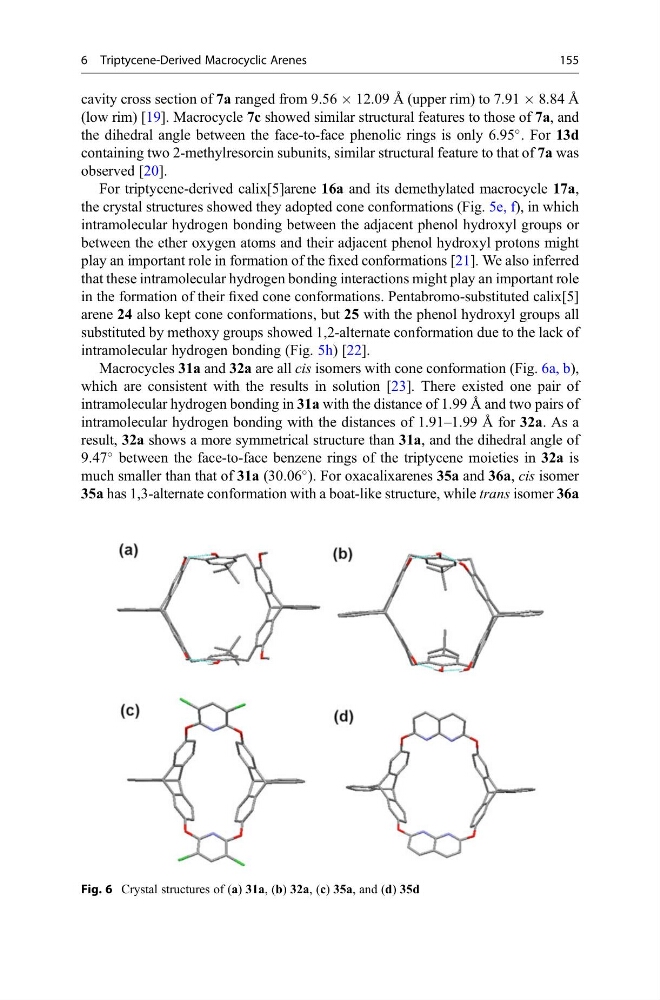
Macrocycles 31a and 32a are all cis isomers with cone conformation (Fig. 6a, b),
which are consistent with the results in solution [23]. There existed one pair of
intramolecular hydrogen bonding in 31a with the distance of 1.99 Å and two pairs of
intramolecular hydrogen bonding with the distances of 1.91–1.99 Å for 32a. As a
result, 32a shows a more symmetrical structure than 31a, and the dihedral angle of
9.47
between the face-to-face benzene rings of the triptycene moieties in 32a is
much smaller than that of 31a (30.06
). For oxacalixarenes 35a and 36a, cis isomer
35a has 1,3-alternate conformation with a boat-like structure, while trans isomer 36a
Fig. 6 Crystal structures of (a) 31a, (b) 32a, (c) 35a, and (d) 35d
6 Triptycene-Derived Macrocyclic Arenes
155
(low rim) [19]. Macrocycle 7c showed similar structural features to those of 7a, and
the dihedral angle between the face-to-face phenolic rings is only 6.95
. For 13d
containing two 2-methylresorcin subunits, similar structural feature to that of 7a was
observed [20].
For triptycene-derived calix[5]arene 16a and its demethylated macrocycle 17a,
the crystal structures showed they adopted cone conformations (Fig. 5e, f), in which
intramolecular hydrogen bonding between the adjacent phenol hydroxyl groups or
between the ether oxygen atoms and their adjacent phenol hydroxyl protons might
play an important role in formation of the fixed conformations [21]. We also inferred
that these intramolecular hydrogen bonding interactions might play an important role
in the formation of their fixed cone conformations. Pentabromo-substituted calix[5]
arene 24 also kept cone conformations, but 25 with the phenol hydroxyl groups all
substituted by methoxy groups showed 1,2-alternate conformation due to the lack of
intramolecular hydrogen bonding (Fig. 5h) [22].
Macrocycles 31a and 32a are all cis isomers with cone conformation (Fig. 6a, b),
which are consistent with the results in solution [23]. There existed one pair of
intramolecular hydrogen bonding in 31a with the distance of 1.99 Å and two pairs of
intramolecular hydrogen bonding with the distances of 1.91–1.99 Å for 32a. As a
result, 32a shows a more symmetrical structure than 31a, and the dihedral angle of
9.47
between the face-to-face benzene rings of the triptycene moieties in 32a is
much smaller than that of 31a (30.06
). For oxacalixarenes 35a and 36a, cis isomer
35a has 1,3-alternate conformation with a boat-like structure, while trans isomer 36a
Fig. 6 Crystal structures of (a) 31a, (b) 32a, (c) 35a, and (d) 35d
6 Triptycene-Derived Macrocyclic Arenes
155