

bridged groups. These observations suggested that trans isomers 44b–46b do not
adopt the chair conformation but fixed curved-boat conformation without the high
symmetry at room temperature, which are different from those of the triptycenederived oxacalixarenes with trans isomers [24]. However, the
1
H NMR and
13
C
NMR spectra of trans isomer 47b showed its high symmetrical structure with a chair
conformation in solution. We deduced that the different properties of dynamic conformational interconversion probably resulted in the different conformations between 47b
and 44b–46b [24, 29]. Similarly, triptycene-derived diazadioxacalixarenes 50 and
51a–c are also pairs of diastereomers due to the 3D structural characteristic of
triptycene unit [30]. By the
1
H NMR spectroscopy, their spectra exhibit that the cis
isomers 50a–c adopt twisted boat conformation, while the trans isomers 51a–c are in a
symmetrical chair conformation.
For triptycene-derived tetralactam macrocycles 52a and 52b [31], they are a pair
of diastereomers because their
1 H NMR spectra are greatly different from each other.
Both of cis isomer 52a and trans isomer 52b have highly symmetrical structures, and
they exhibit only one signal for the N-H protons and two single signals for the
bridgehead protons of the triptycene moieties in their
1 H NNR spectra.
6.2.3 Structures in Solid State
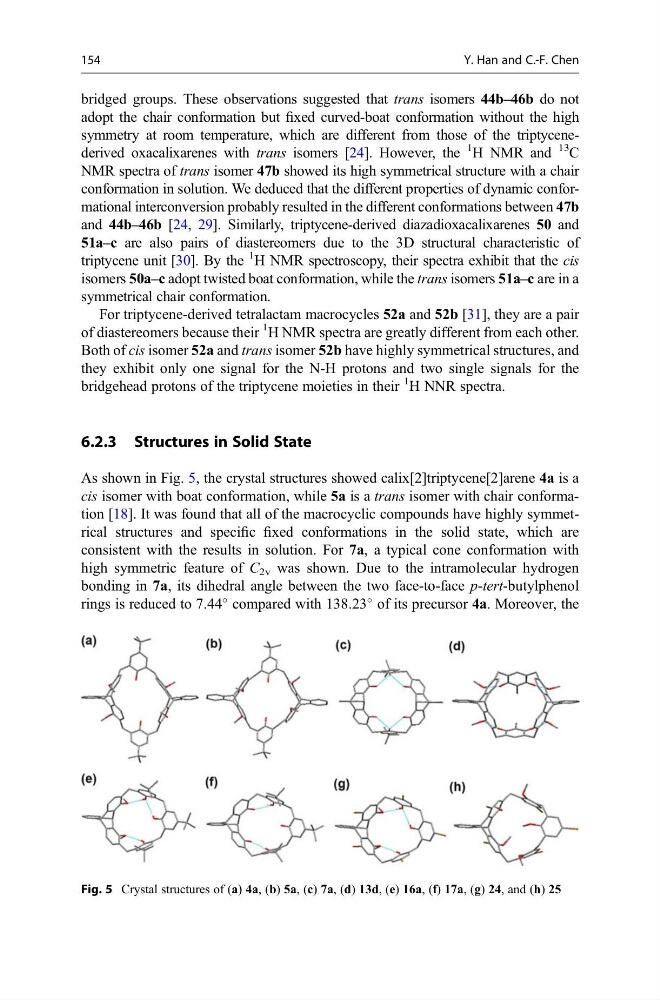
As shown in Fig. 5, the crystal structures showed calix[2]triptycene[2]arene 4a is a
cis isomer with boat conformation, while 5a is a trans isomer with chair conformation [18]. It was found that all of the macrocyclic compounds have highly symmetrical structures and specific fixed conformations in the solid state, which are
consistent with the results in solution. For 7a, a typical cone conformation with
high symmetric feature of C 2v was shown. Due to the intramolecular hydrogen
bonding in 7a, its dihedral angle between the two face-to-face p-tert-butylphenol
rings is reduced to 7.44
compared with 138.23
of its precursor 4a. Moreover, the
Fig. 5 Crystal structures of (a) 4a, (b) 5a, (c) 7a, (d) 13d, (e) 16a, (f) 17a, (g) 24, and (h) 25
154
Y. Han and C.-F. Chen
adopt the chair conformation but fixed curved-boat conformation without the high
symmetry at room temperature, which are different from those of the triptycenederived oxacalixarenes with trans isomers [24]. However, the
1
H NMR and
13
C
NMR spectra of trans isomer 47b showed its high symmetrical structure with a chair
conformation in solution. We deduced that the different properties of dynamic conformational interconversion probably resulted in the different conformations between 47b
and 44b–46b [24, 29]. Similarly, triptycene-derived diazadioxacalixarenes 50 and
51a–c are also pairs of diastereomers due to the 3D structural characteristic of
triptycene unit [30]. By the
1
H NMR spectroscopy, their spectra exhibit that the cis
isomers 50a–c adopt twisted boat conformation, while the trans isomers 51a–c are in a
symmetrical chair conformation.
For triptycene-derived tetralactam macrocycles 52a and 52b [31], they are a pair
of diastereomers because their
1 H NMR spectra are greatly different from each other.
Both of cis isomer 52a and trans isomer 52b have highly symmetrical structures, and
they exhibit only one signal for the N-H protons and two single signals for the
bridgehead protons of the triptycene moieties in their
1 H NNR spectra.
6.2.3 Structures in Solid State
As shown in Fig. 5, the crystal structures showed calix[2]triptycene[2]arene 4a is a
cis isomer with boat conformation, while 5a is a trans isomer with chair conformation [18]. It was found that all of the macrocyclic compounds have highly symmetrical structures and specific fixed conformations in the solid state, which are
consistent with the results in solution. For 7a, a typical cone conformation with
high symmetric feature of C 2v was shown. Due to the intramolecular hydrogen
bonding in 7a, its dihedral angle between the two face-to-face p-tert-butylphenol
rings is reduced to 7.44
compared with 138.23
of its precursor 4a. Moreover, the
Fig. 5 Crystal structures of (a) 4a, (b) 5a, (c) 7a, (d) 13d, (e) 16a, (f) 17a, (g) 24, and (h) 25
154
Y. Han and C.-F. Chen