

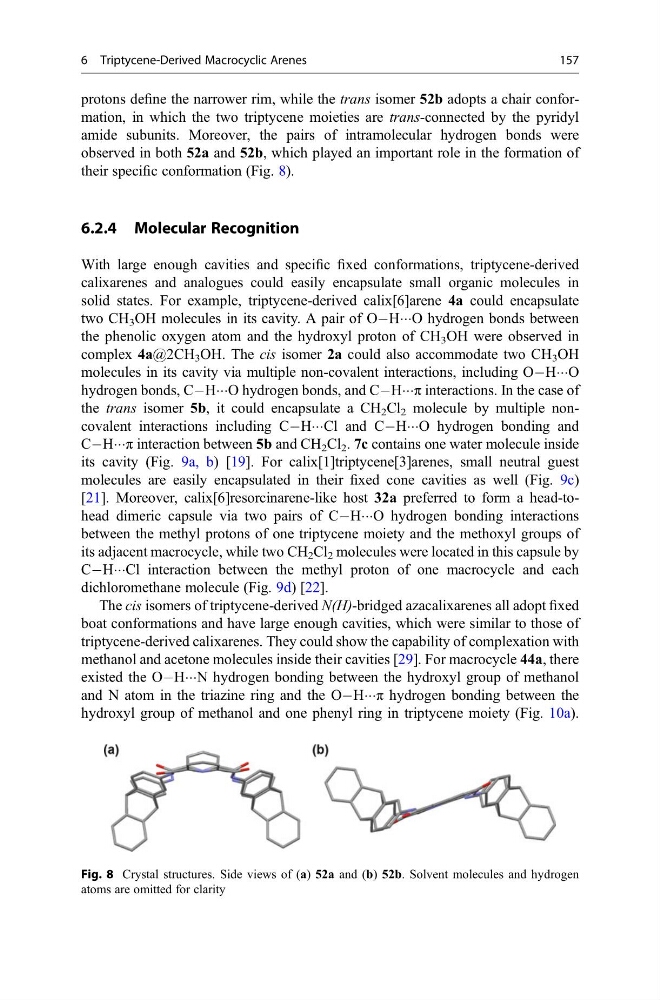
protons define the narrower rim, while the trans isomer 52b adopts a chair conformation, in which the two triptycene moieties are trans-connected by the pyridyl
amide subunits. Moreover, the pairs of intramolecular hydrogen bonds were
observed in both 52a and 52b, which played an important role in the formation of
their specific conformation (Fig. 8).
6.2.4 Molecular Recognition
With large enough cavities and specific fixed conformations, triptycene-derived
calixarenes and analogues could easily encapsulate small organic molecules in
solid states. For example, triptycene-derived calix[6]arene 4a could encapsulate
two CH 3 OH molecules in its cavity. A pair of OÀHÁÁÁO hydrogen bonds between
the phenolic oxygen atom and the hydroxyl proton of CH 3 OH were observed in
complex 4a@2CH 3 OH. The cis isomer 2a could also accommodate two CH 3 OH
molecules in its cavity via multiple non-covalent interactions, including OÀHÁÁÁO
hydrogen bonds, CÀHÁÁÁO hydrogen bonds, and CÀHÁÁÁπ interactions. In the case of
the trans isomer 5b, it could encapsulate a CH 2 Cl 2 molecule by multiple noncovalent interactions including CÀHÁÁÁCl and CÀHÁÁÁO hydrogen bonding and
CÀHÁÁÁπ interaction between 5b and CH 2 Cl 2 . 7c contains one water molecule inside
its cavity (Fig. 9a, b) [19]. For calix[1]triptycene[3]arenes, small neutral guest
molecules are easily encapsulated in their fixed cone cavities as well (Fig. 9c)
[21]. Moreover, calix[6]resorcinarene-like host 32a preferred to form a head-tohead dimeric capsule via two pairs of CÀHÁÁÁO hydrogen bonding interactions
between the methyl protons of one triptycene moiety and the methoxyl groups of
its adjacent macrocycle, while two CH 2 Cl 2 molecules were located in this capsule by
CÀHÁÁÁCl interaction between the methyl proton of one macrocycle and each
dichloromethane molecule (Fig. 9d) [22].
The cis isomers of triptycene-derived N(H)-bridged azacalixarenes all adopt fixed
boat conformations and have large enough cavities, which were similar to those of
triptycene-derived calixarenes. They could show the capability of complexation with
methanol and acetone molecules inside their cavities [29]. For macrocycle 44a, there
existed the OÀHÁÁÁN hydrogen bonding between the hydroxyl group of methanol
and N atom in the triazine ring and the OÀHÁÁÁπ hydrogen bonding between the
hydroxyl group of methanol and one phenyl ring in triptycene moiety (Fig. 10a).
Fig. 8 Crystal structures. Side views of (a) 52a and (b) 52b. Solvent molecules and hydrogen
atoms are omitted for clarity
6 Triptycene-Derived Macrocyclic Arenes
157
amide subunits. Moreover, the pairs of intramolecular hydrogen bonds were
observed in both 52a and 52b, which played an important role in the formation of
their specific conformation (Fig. 8).
6.2.4 Molecular Recognition
With large enough cavities and specific fixed conformations, triptycene-derived
calixarenes and analogues could easily encapsulate small organic molecules in
solid states. For example, triptycene-derived calix[6]arene 4a could encapsulate
two CH 3 OH molecules in its cavity. A pair of OÀHÁÁÁO hydrogen bonds between
the phenolic oxygen atom and the hydroxyl proton of CH 3 OH were observed in
complex 4a@2CH 3 OH. The cis isomer 2a could also accommodate two CH 3 OH
molecules in its cavity via multiple non-covalent interactions, including OÀHÁÁÁO
hydrogen bonds, CÀHÁÁÁO hydrogen bonds, and CÀHÁÁÁπ interactions. In the case of
the trans isomer 5b, it could encapsulate a CH 2 Cl 2 molecule by multiple noncovalent interactions including CÀHÁÁÁCl and CÀHÁÁÁO hydrogen bonding and
CÀHÁÁÁπ interaction between 5b and CH 2 Cl 2 . 7c contains one water molecule inside
its cavity (Fig. 9a, b) [19]. For calix[1]triptycene[3]arenes, small neutral guest
molecules are easily encapsulated in their fixed cone cavities as well (Fig. 9c)
[21]. Moreover, calix[6]resorcinarene-like host 32a preferred to form a head-tohead dimeric capsule via two pairs of CÀHÁÁÁO hydrogen bonding interactions
between the methyl protons of one triptycene moiety and the methoxyl groups of
its adjacent macrocycle, while two CH 2 Cl 2 molecules were located in this capsule by
CÀHÁÁÁCl interaction between the methyl proton of one macrocycle and each
dichloromethane molecule (Fig. 9d) [22].
The cis isomers of triptycene-derived N(H)-bridged azacalixarenes all adopt fixed
boat conformations and have large enough cavities, which were similar to those of
triptycene-derived calixarenes. They could show the capability of complexation with
methanol and acetone molecules inside their cavities [29]. For macrocycle 44a, there
existed the OÀHÁÁÁN hydrogen bonding between the hydroxyl group of methanol
and N atom in the triazine ring and the OÀHÁÁÁπ hydrogen bonding between the
hydroxyl group of methanol and one phenyl ring in triptycene moiety (Fig. 10a).
Fig. 8 Crystal structures. Side views of (a) 52a and (b) 52b. Solvent molecules and hydrogen
atoms are omitted for clarity
6 Triptycene-Derived Macrocyclic Arenes
157