

synthesized [24]. When compound 1b reacted with 2,3,5,6-tetrachloropyridine 34a in
DMSO in the presence of Cs 2 CO 3 , the extended oxacalixarenes 35a and 36a could be
obtained in 19% and 25% yield, respectively. By the similar nucleophilic aromatic
substitution reactions of 1b with 1,5-difluoro-2,4-dinitrobenzene 34b in the presence of
K 2 CO 3 , the macrocycles 35b and 36b could be obtained in 22 and 15% yield, respectively. However, the extended oxacalixarenes 35c and 36c could not be synthesized under
the same coupling conditions as above due to the instabilities of target macrocycles.
Under various conditions examined, we found that the target oxacalixarenes 35c and 36c
could be obtained by the S N 2 reaction of 1b with cyanuric chloride 34c in acetone instead
of DMSO in the presence of K 2 CO 3 . Moreover, 35c and 36c could be synthesized by the
reaction of 1b with cyanuric chloride 34c in acetone with K 2 CO 3 as the base, and they
could also be obtained by the two-step fragment-coupling approach. Thus, the reaction of
1b and cyanuric chloride 34c in tetrahydrofuran in the presence of diisopropylethylamine
(DIPEA) afforded the [1 + 2] product 37 in 58% yield. Then, the further coupling reaction
of compound 37 with 1b in acetone with DIPEA as base at room temperature gave the
extended oxacalixarenes 35c and 36c in 12 and 15% yield, respectively.
R 1
R 1
OH
OMe
OMe
OH
HO
R 2
xylene, reflux
R
OH
OH
HO
16a R 1 = R 2 = t-Bu, 25%
16b R 1 = t-Bu, R 2 = Ph, 23%
16c R 1 = R 2 = Ph, 21%
17a R 1 = R 2 = t-Bu, 90%
17b R 1 = t-Bu, R 2 = Ph, 86%
17c R 1 = R 2 = Ph, 90%
BBr 3
CH 2 Cl 2
R 1
R 1
OH
OH
OH
OH
HO
R 2
15a R = t-Bu
15b R = Ph
+
18a R 1 = R 2 = H
18b R 1 = H, R 2 = Ph
R 1
R 1
OH
OH
OH
OH
HO
R 2
AlCl 3
toluene
R
R
OH
OMe
OMe
OH
6a R = t-Bu
6b R = Ph
AlCl 3 toluene
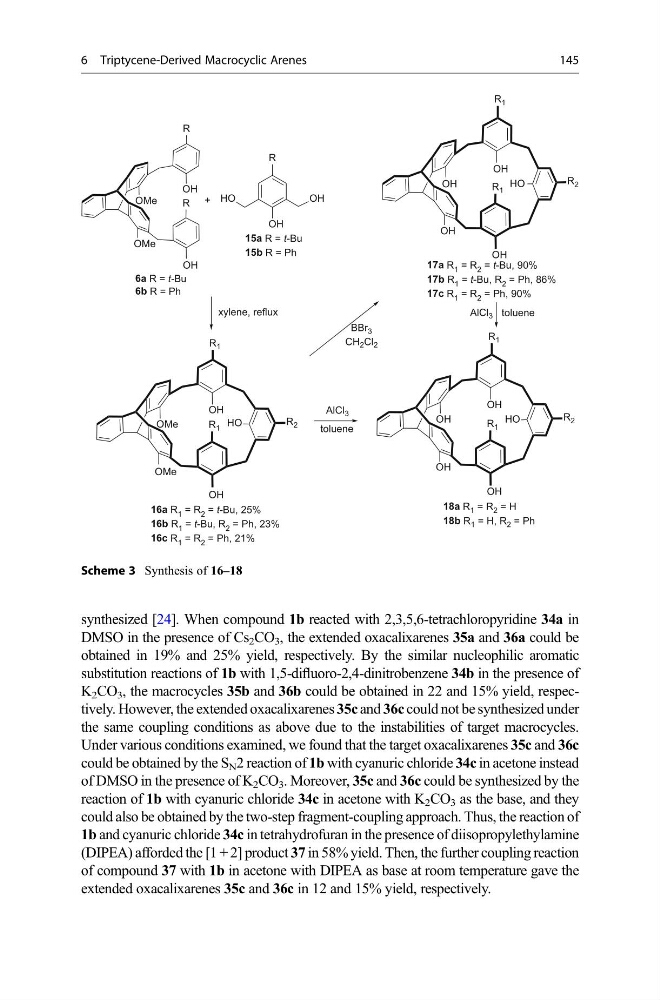
Scheme 3 Synthesis of 16–18
6 Triptycene-Derived Macrocyclic Arenes
145
DMSO in the presence of Cs 2 CO 3 , the extended oxacalixarenes 35a and 36a could be
obtained in 19% and 25% yield, respectively. By the similar nucleophilic aromatic
substitution reactions of 1b with 1,5-difluoro-2,4-dinitrobenzene 34b in the presence of
K 2 CO 3 , the macrocycles 35b and 36b could be obtained in 22 and 15% yield, respectively. However, the extended oxacalixarenes 35c and 36c could not be synthesized under
the same coupling conditions as above due to the instabilities of target macrocycles.
Under various conditions examined, we found that the target oxacalixarenes 35c and 36c
could be obtained by the S N 2 reaction of 1b with cyanuric chloride 34c in acetone instead
of DMSO in the presence of K 2 CO 3 . Moreover, 35c and 36c could be synthesized by the
reaction of 1b with cyanuric chloride 34c in acetone with K 2 CO 3 as the base, and they
could also be obtained by the two-step fragment-coupling approach. Thus, the reaction of
1b and cyanuric chloride 34c in tetrahydrofuran in the presence of diisopropylethylamine
(DIPEA) afforded the [1 + 2] product 37 in 58% yield. Then, the further coupling reaction
of compound 37 with 1b in acetone with DIPEA as base at room temperature gave the
extended oxacalixarenes 35c and 36c in 12 and 15% yield, respectively.
R 1
R 1
OH
OMe
OMe
OH
HO
R 2
xylene, reflux
R
OH
OH
HO
16a R 1 = R 2 = t-Bu, 25%
16b R 1 = t-Bu, R 2 = Ph, 23%
16c R 1 = R 2 = Ph, 21%
17a R 1 = R 2 = t-Bu, 90%
17b R 1 = t-Bu, R 2 = Ph, 86%
17c R 1 = R 2 = Ph, 90%
BBr 3
CH 2 Cl 2
R 1
R 1
OH
OH
OH
OH
HO
R 2
15a R = t-Bu
15b R = Ph
+
18a R 1 = R 2 = H
18b R 1 = H, R 2 = Ph
R 1
R 1
OH
OH
OH
OH
HO
R 2
AlCl 3
toluene
R
R
OH
OMe
OMe
OH
6a R = t-Bu
6b R = Ph
AlCl 3 toluene
Scheme 3 Synthesis of 16–18
6 Triptycene-Derived Macrocyclic Arenes
145