

Similarly, oxacalixarene 35d containing two triptycene subunits and two
naphthyridine subunits was conveniently synthesized in 37% yield by one-pot
reaction of 33 and 34d in refluxed 1,4-dioxane in the presence of Cs 2 CO 3 [25].
When the reaction of 33 and 34d was carried out in DMSO at 105
C with Cs 2 CO 3 as
the base, 35d and 36d were isolated in 17 and 9% yield, respectively [26]. By twostep fragment-coupling approach, 38a was synthesized in good yield with paraquat
as a template. Reaction of 38a with aniline in acetone in the presence of K 2 CO 3 gave
38b in 78% yield (Scheme 8c) [27].
Compared with oxacalixarenes, homooxacalixarenes are a class of heterocalixarene analogues with the heteroatoms partly or completely replaced by
CH 2 OCH 2 groups, which could have bigger cavities and show different recognition
properties. With the increased cavity sizes, homoheterocalixarenes can show different recognition properties and a wide field of applications. Recently, we [28]
conveniently synthesized triptycene-derived homooxacalixarene analogues 39a–d
OMe
OMe
OMe
OMe
Ph
Ph
OH
OH
Br
Br
20
p-hydroxydiphenyl
p-TsOH
toluene
Ph
Ph
OH
OMe
OH
HO
Ph
xylene
K 2 CO 3 , Pd(PPh 3 ) 4 , DMF
Br
Br
Ph
Ph
OH
OMe
OH
HO
Ph
Ph
Ph
15b
21
22
(CH 3 ) 2 SO 4
K 2 CO 3
acetone
23a
B(OH) 2
80%
19%
81%
85%
Ph
OMe
OMe
OMe
Ph
Ph
Ph
OMe
OMe
Ph
OMe
OMe
Br
Br
19
OH
HO
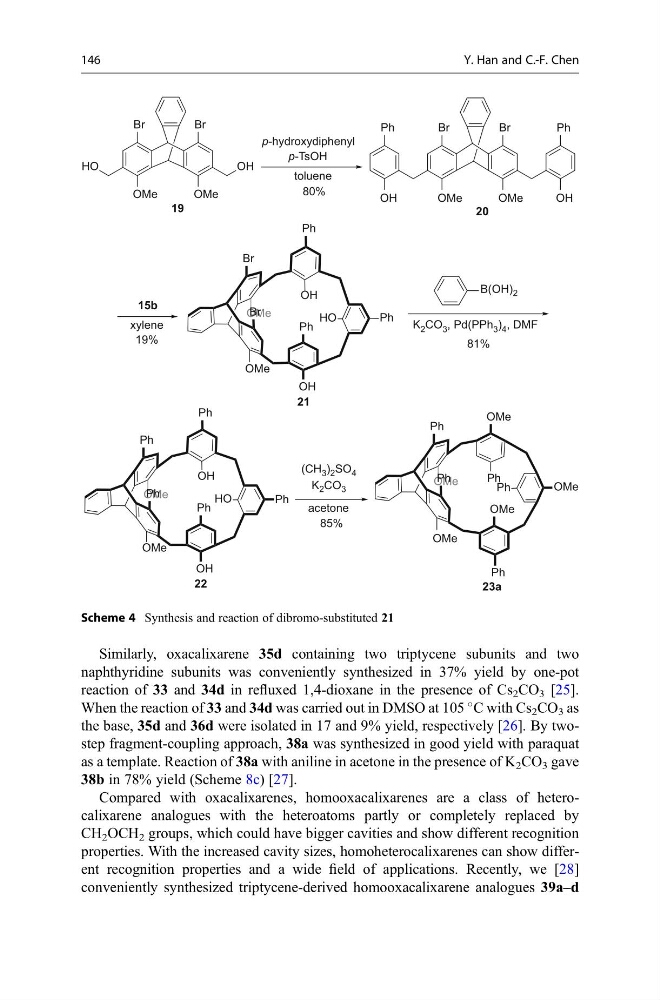
Scheme 4 Synthesis and reaction of dibromo-substituted 21
146
Y. Han and C.-F. Chen
naphthyridine subunits was conveniently synthesized in 37% yield by one-pot
reaction of 33 and 34d in refluxed 1,4-dioxane in the presence of Cs 2 CO 3 [25].
When the reaction of 33 and 34d was carried out in DMSO at 105
C with Cs 2 CO 3 as
the base, 35d and 36d were isolated in 17 and 9% yield, respectively [26]. By twostep fragment-coupling approach, 38a was synthesized in good yield with paraquat
as a template. Reaction of 38a with aniline in acetone in the presence of K 2 CO 3 gave
38b in 78% yield (Scheme 8c) [27].
Compared with oxacalixarenes, homooxacalixarenes are a class of heterocalixarene analogues with the heteroatoms partly or completely replaced by
CH 2 OCH 2 groups, which could have bigger cavities and show different recognition
properties. With the increased cavity sizes, homoheterocalixarenes can show different recognition properties and a wide field of applications. Recently, we [28]
conveniently synthesized triptycene-derived homooxacalixarene analogues 39a–d
OMe
OMe
OMe
OMe
Ph
Ph
OH
OH
Br
Br
20
p-hydroxydiphenyl
p-TsOH
toluene
Ph
Ph
OH
OMe
OH
HO
Ph
xylene
K 2 CO 3 , Pd(PPh 3 ) 4 , DMF
Br
Br
Ph
Ph
OH
OMe
OH
HO
Ph
Ph
Ph
15b
21
22
(CH 3 ) 2 SO 4
K 2 CO 3
acetone
23a
B(OH) 2
80%
19%
81%
85%
Ph
OMe
OMe
OMe
Ph
Ph
Ph
OMe
OMe
Ph
OMe
OMe
Br
Br
19
OH
HO
Scheme 4 Synthesis and reaction of dibromo-substituted 21
146
Y. Han and C.-F. Chen