

we first prepared precursor 29 in two steps, which then reacted with p-substitutedphenols in the presence of p-toluenesulfonic acid to give 30a–c. Treatment of
30a–c with equimolar amount of 29 in o-dichlorobenzene in the presence of
p-toluenesulfonic acid produced calixresorcinarenes 31a–c. Similarly, the
corresponding demethylated macrocycles 32a–c could be obtained in high yields
by BBr 3 in CH 2 Cl 2 .
6.2.1.2 Triptycene-Derived Heteracalixarene and Analogues
2,7-Dihydroxyltriptycene 1b could also be utilized as the nucleophilic reagent for the
design and synthesis of oxacalixarenes by the nucleophilic aromatic substitution reactions. As shown in Scheme 7, by one-pot reaction of 2,7-dihydroxytriptycene 1b and
electrophilic reagents 34a–c in DMSO with Cs 2 CO 3 or K 2 CO 3 as the base,
oxacalixarenes 35a–c and 36a–c with extended cavities could be conveniently
R'O
OR'
OMe
OMe
OR'
R
R'O
R'O
R
OR'
or TsOH
R'O
OR'
OR'
R'O
R'O
OR'
OR'
R'O
R
R
OMe
OMe
OMe
OMe
OMe
OMe
OMe
OMe
R
R
+
OMe
OMe
OH
HO
+
9a R = R' = Me
9b R = OMe; R' = Me
9c R = Br; R' = Me
9d R = Me; R' = H
R
2
2
BF 3 ·Et 2 O
HO
OH
OH
HO
HO
OH
OH
HO
OH
OH
OH
OH
OH
OH
OH
OH
13 (86%) from 11a
13 (90%) from 11d
14 (83%) from 12a
14 (86%) from 12d
BBr 3 , CH 2 Cl 2
R = Me
10a R = R' = Me (76%)
10b R = OMe; R' = Me (71%)
10c R = Br; R' = Me (68%)
10d R = Me; R' = H (76%)
11a R = R' = Me (29%)
11b R = OMe; R' = Me (21%)
11c R = Br; R' = Me (20%)
11d R = Me; R' = H (15%)
12a R = R' = Me (23%)
12b R = OMe; R' = Me (18%)
12c R = Br; R' = Me (15%)
12d R = Me; R' = H (11%)
BF 3 ·Et 2 O or TsOH
+
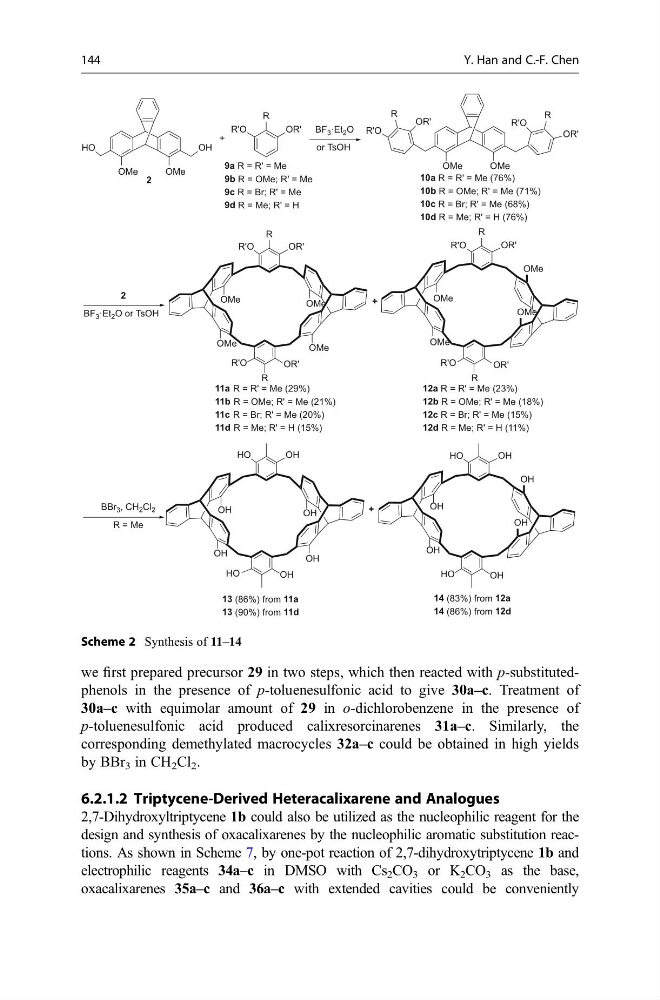
Scheme 2 Synthesis of 11–14
144
Y. Han and C.-F. Chen
30a–c with equimolar amount of 29 in o-dichlorobenzene in the presence of
p-toluenesulfonic acid produced calixresorcinarenes 31a–c. Similarly, the
corresponding demethylated macrocycles 32a–c could be obtained in high yields
by BBr 3 in CH 2 Cl 2 .
6.2.1.2 Triptycene-Derived Heteracalixarene and Analogues
2,7-Dihydroxyltriptycene 1b could also be utilized as the nucleophilic reagent for the
design and synthesis of oxacalixarenes by the nucleophilic aromatic substitution reactions. As shown in Scheme 7, by one-pot reaction of 2,7-dihydroxytriptycene 1b and
electrophilic reagents 34a–c in DMSO with Cs 2 CO 3 or K 2 CO 3 as the base,
oxacalixarenes 35a–c and 36a–c with extended cavities could be conveniently
R'O
OR'
OMe
OMe
OR'
R
R'O
R'O
R
OR'
or TsOH
R'O
OR'
OR'
R'O
R'O
OR'
OR'
R'O
R
R
OMe
OMe
OMe
OMe
OMe
OMe
OMe
OMe
R
R
+
OMe
OMe
OH
HO
+
9a R = R' = Me
9b R = OMe; R' = Me
9c R = Br; R' = Me
9d R = Me; R' = H
R
2
2
BF 3 ·Et 2 O
HO
OH
OH
HO
HO
OH
OH
HO
OH
OH
OH
OH
OH
OH
OH
OH
13 (86%) from 11a
13 (90%) from 11d
14 (83%) from 12a
14 (86%) from 12d
BBr 3 , CH 2 Cl 2
R = Me
10a R = R' = Me (76%)
10b R = OMe; R' = Me (71%)
10c R = Br; R' = Me (68%)
10d R = Me; R' = H (76%)
11a R = R' = Me (29%)
11b R = OMe; R' = Me (21%)
11c R = Br; R' = Me (20%)
11d R = Me; R' = H (15%)
12a R = R' = Me (23%)
12b R = OMe; R' = Me (18%)
12c R = Br; R' = Me (15%)
12d R = Me; R' = H (11%)
BF 3 ·Et 2 O or TsOH
+
Scheme 2 Synthesis of 11–14
144
Y. Han and C.-F. Chen