

According to the similar synthetic approach as that of calix[6]arenes, a series of
novel calix[5]arenes 16a–c containing one 1,8-dimethoxytriptycene moiety could
also be obtained by the heat-induced fragment-coupling reactions. When 6a or 6b
reacted with 2,6-dihydroxymethylphenols 15a–b in refluxed xylene for 2 days,
triptycene-derived calix[5]arenes or calix[1]triptycene[3]arenes 16a–c were
obtained in 25, 21, and 23% yield, respectively (Scheme 3). Treatment of 16a–c
with BBr 3 gave the corresponding demethylated products 17a–c in 86–90% yields.
De-tert-butylated products 18a and 18b were obtained by treatment of 17a and 17b
with AlCl 3 in 82 and 75% yields, respectively. Under the same conditions, 16a and
16b could be simultaneously de-tert-butylated and demethylated to give 18a and
18b in high yields [21].
Dibromo-substituted calix[5]arene 21 was obtained from 19 by the similar
synthetic strategy as above (Scheme 4) [22]. Then calix[5]arene 22 with a deeper
cavity could be easily synthesized by Suzuki coupling reaction of 21 with
phenylboronic acid. Treatment of 22 with dimethyl sulfate in the presence of
potassium carbonate gave full methyl etherified calix[5]arene 23a in 85% yield.
Due to the lack of the intramolecular hydrogen bonds, 23a adopted a 1,2-alternate
conformation, which is different from 22 with cone conformation.
By treatment of 16a with excess bromine in CH 2 Cl 2 , it was interestingly found
pentabromo-substituted calix[5]arene 24 in cone conformation was obtained in 92%
yield (Scheme 5). Treatment of 24 with dimethyl sulfate in the presence of potassium
carbonate gave 25 in 72% yield, which also adopted 1,2-alternate conformation.
Furthermore, by Suzuki coupling reactions of 25 with arylboronic acids in the
presence of Pd(PPh 3 ) 4 and anhydrous potassium carbonate, calix[5]arene derivatives
23a–b with deep cavities were obtained in good yields [22].
Calixresorcinarenes or resorcinarenes are a class of well-defined macrocyclic
compounds related to calixarenes. We [23] recently synthesized a series of calix[6]
resorcinarene-like hosts containing two triptycene moieties and two p-substituted
phenol moieties. As shown in Scheme 6, starting from 2,7-dimethoxyltriptycene 27,
R
OH
OH
OH
OH
OH
R
OH
R
R
OH
OH
OH
OH
OH
OH
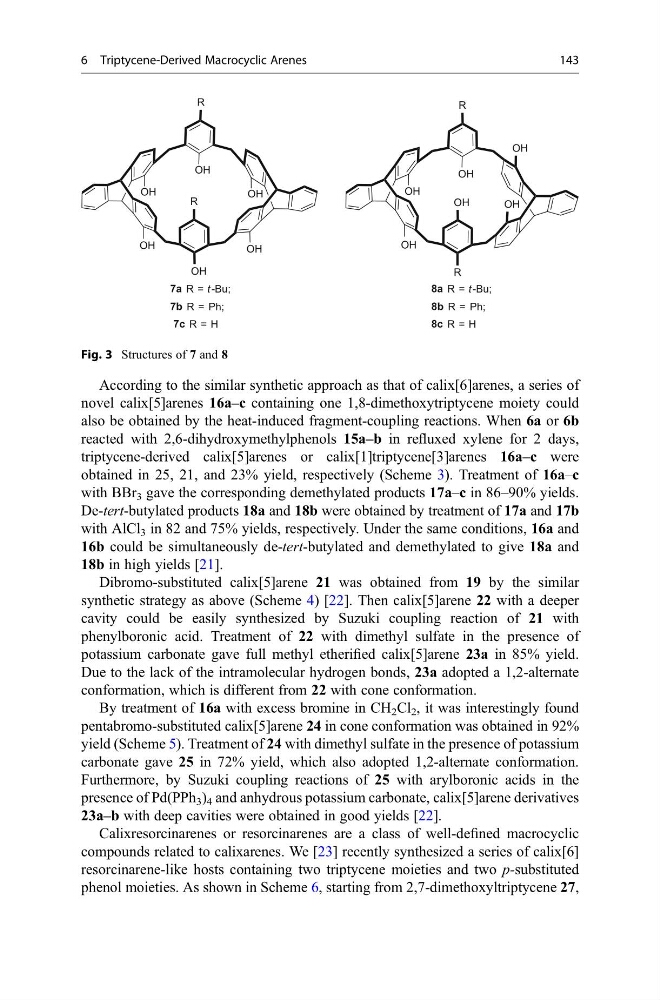
7a R = t -Bu;
7b R = Ph;
7c R = H
8a R = t -Bu;
8b R = Ph;
8c R = H
Fig. 3 Structures of 7 and 8
6 Triptycene-Derived Macrocyclic Arenes
143
novel calix[5]arenes 16a–c containing one 1,8-dimethoxytriptycene moiety could
also be obtained by the heat-induced fragment-coupling reactions. When 6a or 6b
reacted with 2,6-dihydroxymethylphenols 15a–b in refluxed xylene for 2 days,
triptycene-derived calix[5]arenes or calix[1]triptycene[3]arenes 16a–c were
obtained in 25, 21, and 23% yield, respectively (Scheme 3). Treatment of 16a–c
with BBr 3 gave the corresponding demethylated products 17a–c in 86–90% yields.
De-tert-butylated products 18a and 18b were obtained by treatment of 17a and 17b
with AlCl 3 in 82 and 75% yields, respectively. Under the same conditions, 16a and
16b could be simultaneously de-tert-butylated and demethylated to give 18a and
18b in high yields [21].
Dibromo-substituted calix[5]arene 21 was obtained from 19 by the similar
synthetic strategy as above (Scheme 4) [22]. Then calix[5]arene 22 with a deeper
cavity could be easily synthesized by Suzuki coupling reaction of 21 with
phenylboronic acid. Treatment of 22 with dimethyl sulfate in the presence of
potassium carbonate gave full methyl etherified calix[5]arene 23a in 85% yield.
Due to the lack of the intramolecular hydrogen bonds, 23a adopted a 1,2-alternate
conformation, which is different from 22 with cone conformation.
By treatment of 16a with excess bromine in CH 2 Cl 2 , it was interestingly found
pentabromo-substituted calix[5]arene 24 in cone conformation was obtained in 92%
yield (Scheme 5). Treatment of 24 with dimethyl sulfate in the presence of potassium
carbonate gave 25 in 72% yield, which also adopted 1,2-alternate conformation.
Furthermore, by Suzuki coupling reactions of 25 with arylboronic acids in the
presence of Pd(PPh 3 ) 4 and anhydrous potassium carbonate, calix[5]arene derivatives
23a–b with deep cavities were obtained in good yields [22].
Calixresorcinarenes or resorcinarenes are a class of well-defined macrocyclic
compounds related to calixarenes. We [23] recently synthesized a series of calix[6]
resorcinarene-like hosts containing two triptycene moieties and two p-substituted
phenol moieties. As shown in Scheme 6, starting from 2,7-dimethoxyltriptycene 27,
R
OH
OH
OH
OH
OH
R
OH
R
R
OH
OH
OH
OH
OH
OH
7a R = t -Bu;
7b R = Ph;
7c R = H
8a R = t -Bu;
8b R = Ph;
8c R = H
Fig. 3 Structures of 7 and 8
6 Triptycene-Derived Macrocyclic Arenes
143