

Although triptycene-derived macrocyclic hosts 4 and 5 could be conveniently
obtained by one-pot approach, the relatively low yields limited their practical
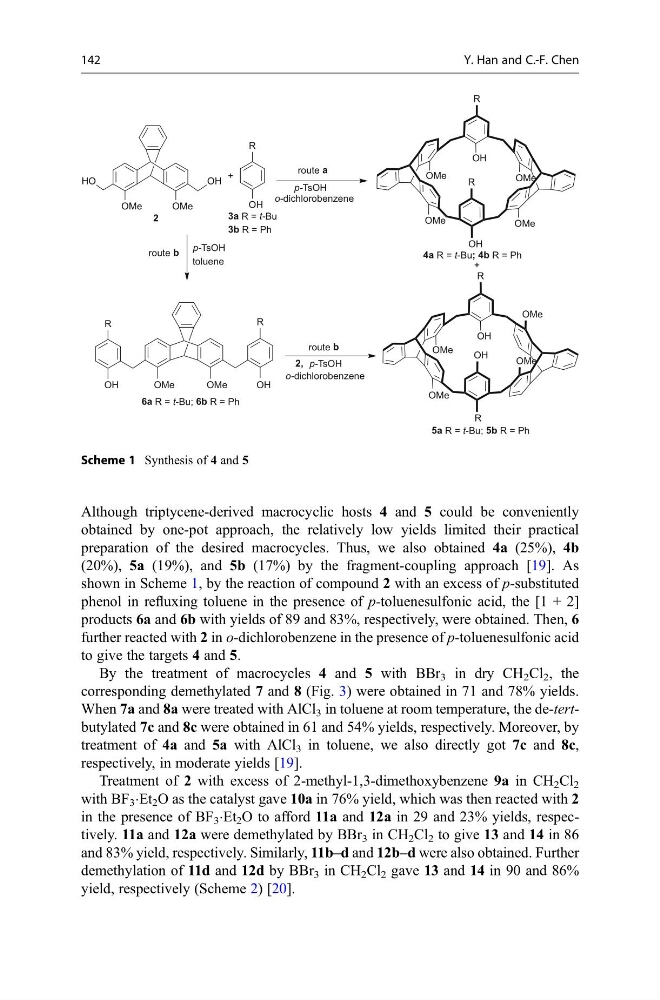
preparation of the desired macrocycles. Thus, we also obtained 4a (25%), 4b
(20%), 5a (19%), and 5b (17%) by the fragment-coupling approach [19]. As
shown in Scheme 1, by the reaction of compound 2 with an excess of p-substituted
phenol in refluxing toluene in the presence of p-toluenesulfonic acid, the [1 + 2]
products 6a and 6b with yields of 89 and 83%, respectively, were obtained. Then, 6
further reacted with 2 in o-dichlorobenzene in the presence of p-toluenesulfonic acid
to give the targets 4 and 5.
By the treatment of macrocycles 4 and 5 with BBr 3 in dry CH 2 Cl 2 , the
corresponding demethylated 7 and 8 (Fig. 3) were obtained in 71 and 78% yields.
When 7a and 8a were treated with AlCl 3 in toluene at room temperature, the de-tertbutylated 7c and 8c were obtained in 61 and 54% yields, respectively. Moreover, by
treatment of 4a and 5a with AlCl 3 in toluene, we also directly got 7c and 8c,
respectively, in moderate yields [19].
Treatment of 2 with excess of 2-methyl-1,3-dimethoxybenzene 9a in CH 2 Cl 2
with BF 3 ÁEt 2 O as the catalyst gave 10a in 76% yield, which was then reacted with 2
in the presence of BF 3 ÁEt 2 O to afford 11a and 12a in 29 and 23% yields, respectively. 11a and 12a were demethylated by BBr 3 in CH 2 Cl 2 to give 13 and 14 in 86
and 83% yield, respectively. Similarly, 11b–d and 12b–d were also obtained. Further
demethylation of 11d and 12d by BBr 3 in CH 2 Cl 2 gave 13 and 14 in 90 and 86%
yield, respectively (Scheme 2) [20].
OMe
OMe
R
R
OH
OH
6a R = t-Bu; 6b R = Ph
o-dichlorobenzene
p-TsOH
R
R
OH
OMe
OMe
OMe
OMe
OH
R
OH
OMe
OMe
OMe
OMe
R
OH
4a R = t-Bu; 4b R = Ph
5a R = t-Bu; 5b R = Ph
OMe
OMe
OH
HO
+
R
OH
3a R = t-Bu
3b R = Ph
2
toluene
p-TsOH
o-dichlorobenzene
p-TsOH
route a
route b
2,
route b
+
Scheme 1 Synthesis of 4 and 5
142
Y. Han and C.-F. Chen
obtained by one-pot approach, the relatively low yields limited their practical
preparation of the desired macrocycles. Thus, we also obtained 4a (25%), 4b
(20%), 5a (19%), and 5b (17%) by the fragment-coupling approach [19]. As
shown in Scheme 1, by the reaction of compound 2 with an excess of p-substituted
phenol in refluxing toluene in the presence of p-toluenesulfonic acid, the [1 + 2]
products 6a and 6b with yields of 89 and 83%, respectively, were obtained. Then, 6
further reacted with 2 in o-dichlorobenzene in the presence of p-toluenesulfonic acid
to give the targets 4 and 5.
By the treatment of macrocycles 4 and 5 with BBr 3 in dry CH 2 Cl 2 , the
corresponding demethylated 7 and 8 (Fig. 3) were obtained in 71 and 78% yields.
When 7a and 8a were treated with AlCl 3 in toluene at room temperature, the de-tertbutylated 7c and 8c were obtained in 61 and 54% yields, respectively. Moreover, by
treatment of 4a and 5a with AlCl 3 in toluene, we also directly got 7c and 8c,
respectively, in moderate yields [19].
Treatment of 2 with excess of 2-methyl-1,3-dimethoxybenzene 9a in CH 2 Cl 2
with BF 3 ÁEt 2 O as the catalyst gave 10a in 76% yield, which was then reacted with 2
in the presence of BF 3 ÁEt 2 O to afford 11a and 12a in 29 and 23% yields, respectively. 11a and 12a were demethylated by BBr 3 in CH 2 Cl 2 to give 13 and 14 in 86
and 83% yield, respectively. Similarly, 11b–d and 12b–d were also obtained. Further
demethylation of 11d and 12d by BBr 3 in CH 2 Cl 2 gave 13 and 14 in 90 and 86%
yield, respectively (Scheme 2) [20].
OMe
OMe
R
R
OH
OH
6a R = t-Bu; 6b R = Ph
o-dichlorobenzene
p-TsOH
R
R
OH
OMe
OMe
OMe
OMe
OH
R
OH
OMe
OMe
OMe
OMe
R
OH
4a R = t-Bu; 4b R = Ph
5a R = t-Bu; 5b R = Ph
OMe
OMe
OH
HO
+
R
OH
3a R = t-Bu
3b R = Ph
2
toluene
p-TsOH
o-dichlorobenzene
p-TsOH
route a
route b
2,
route b
+
Scheme 1 Synthesis of 4 and 5
142
Y. Han and C.-F. Chen