

facilitates the hosts to adjust their conformation for the encapsulated guests. These
specific structural features make the hosts show the diversified complexations with
different kinds of guests, especially, multiple stimuli responsive complexation, which
will be useful for the design and construction of functionalized supramolecular assemblies. Recently, we also applied the tritopic triptycene-derived tri(crown ethers) into the
design and construction of molecular switches and machines [15, 16].
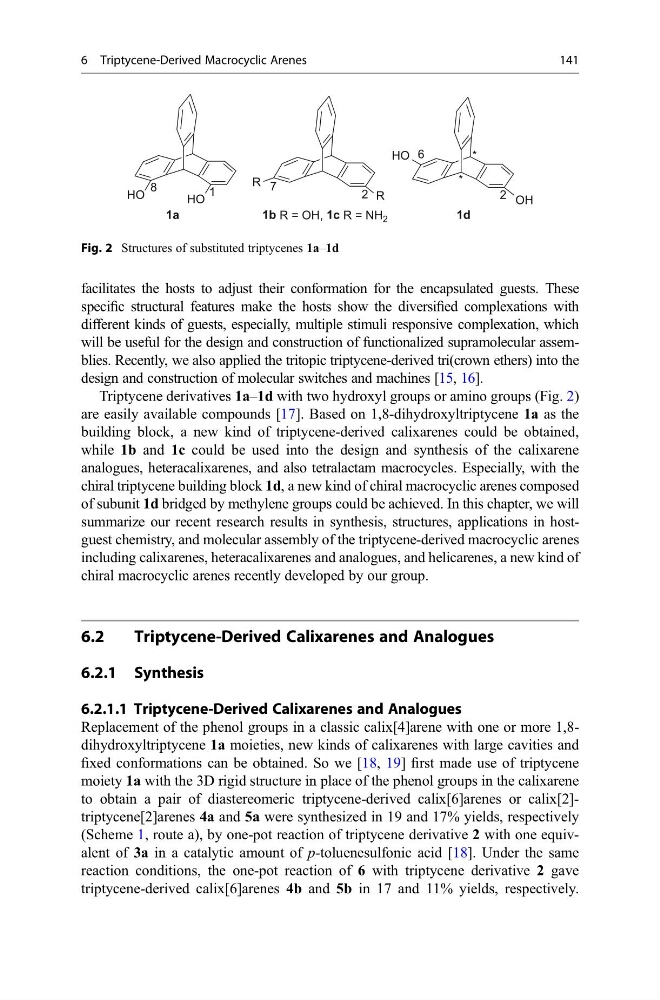
Triptycene derivatives 1a–1d with two hydroxyl groups or amino groups (Fig. 2)
are easily available compounds [17]. Based on 1,8-dihydroxyltriptycene 1a as the
building block, a new kind of triptycene-derived calixarenes could be obtained,
while 1b and 1c could be used into the design and synthesis of the calixarene
analogues, heteracalixarenes, and also tetralactam macrocycles. Especially, with the
chiral triptycene building block 1d, a new kind of chiral macrocyclic arenes composed
of subunit 1d bridged by methylene groups could be achieved. In this chapter, we will
summarize our recent research results in synthesis, structures, applications in hostguest chemistry, and molecular assembly of the triptycene-derived macrocyclic arenes
including calixarenes, heteracalixarenes and analogues, and helicarenes, a new kind of
chiral macrocyclic arenes recently developed by our group.
6.2
Triptycene-Derived Calixarenes and Analogues
6.2.1 Synthesis
6.2.1.1 Triptycene-Derived Calixarenes and Analogues
Replacement of the phenol groups in a classic calix[4]arene with one or more 1,8dihydroxyltriptycene 1a moieties, new kinds of calixarenes with large cavities and
fixed conformations can be obtained. So we [18, 19] first made use of triptycene
moiety 1a with the 3D rigid structure in place of the phenol groups in the calixarene
to obtain a pair of diastereomeric triptycene-derived calix[6]arenes or calix[2]triptycene[2]arenes 4a and 5a were synthesized in 19 and 17% yields, respectively
(Scheme 1, route a), by one-pot reaction of triptycene derivative 2 with one equivalent of 3a in a catalytic amount of p-toluenesulfonic acid [18]. Under the same
reaction conditions, the one-pot reaction of 6 with triptycene derivative 2 gave
triptycene-derived calix[6]arenes 4b and 5b in 17 and 11% yields, respectively.
HO
HO
R
R
*
*
1a
1d
OH
HO
1
2
6
7
8
2
1b R = OH, 1c R = NH 2
Fig. 2 Structures of substituted triptycenes 1a–1d
6 Triptycene-Derived Macrocyclic Arenes
141
specific structural features make the hosts show the diversified complexations with
different kinds of guests, especially, multiple stimuli responsive complexation, which
will be useful for the design and construction of functionalized supramolecular assemblies. Recently, we also applied the tritopic triptycene-derived tri(crown ethers) into the
design and construction of molecular switches and machines [15, 16].
Triptycene derivatives 1a–1d with two hydroxyl groups or amino groups (Fig. 2)
are easily available compounds [17]. Based on 1,8-dihydroxyltriptycene 1a as the
building block, a new kind of triptycene-derived calixarenes could be obtained,
while 1b and 1c could be used into the design and synthesis of the calixarene
analogues, heteracalixarenes, and also tetralactam macrocycles. Especially, with the
chiral triptycene building block 1d, a new kind of chiral macrocyclic arenes composed
of subunit 1d bridged by methylene groups could be achieved. In this chapter, we will
summarize our recent research results in synthesis, structures, applications in hostguest chemistry, and molecular assembly of the triptycene-derived macrocyclic arenes
including calixarenes, heteracalixarenes and analogues, and helicarenes, a new kind of
chiral macrocyclic arenes recently developed by our group.
6.2
Triptycene-Derived Calixarenes and Analogues
6.2.1 Synthesis
6.2.1.1 Triptycene-Derived Calixarenes and Analogues
Replacement of the phenol groups in a classic calix[4]arene with one or more 1,8dihydroxyltriptycene 1a moieties, new kinds of calixarenes with large cavities and
fixed conformations can be obtained. So we [18, 19] first made use of triptycene
moiety 1a with the 3D rigid structure in place of the phenol groups in the calixarene
to obtain a pair of diastereomeric triptycene-derived calix[6]arenes or calix[2]triptycene[2]arenes 4a and 5a were synthesized in 19 and 17% yields, respectively
(Scheme 1, route a), by one-pot reaction of triptycene derivative 2 with one equivalent of 3a in a catalytic amount of p-toluenesulfonic acid [18]. Under the same
reaction conditions, the one-pot reaction of 6 with triptycene derivative 2 gave
triptycene-derived calix[6]arenes 4b and 5b in 17 and 11% yields, respectively.
HO
HO
R
R
*
*
1a
1d
OH
HO
1
2
6
7
8
2
1b R = OH, 1c R = NH 2
Fig. 2 Structures of substituted triptycenes 1a–1d
6 Triptycene-Derived Macrocyclic Arenes
141