

cucurbiturils, calixpyrroles, cyclopeptides, and others have been reported, and these
hosts have undoubtedly played a very important role in the emergence and development process of both host-guest chemistry and supramolecular chemistry.
In the known synthetic macrocycles, calixarenes have become one of most
important macrocyclic hosts and thus found wide applications on supramolecular
chemistry. Since calixarenes were first efficiently synthesized and named by Gutsche
and coworkers in the late 1970s, they and their analogues including resorcinarenes,
cyclotriveratrylenes, pillararenes, and others have attracted much attention during
the last decades. So calixarenes were also called as “the third generation of host
molecules” after crown ethers and cyclodextrins. Since calixarenes and their analogues are all composed of substituted aromatic rings bridged by methylene or
methenyl groups, we can also call them as a type of macrocyclic arenes.
Actually, the known macrocyclic hosts are all composed of building blocks with
specific structures and reactivity. Undoubtedly, exploration of new building block is
important for design and synthesis of novel macrocyclic hosts with specific structure
and properties. Iptycenes [5, 6] are a class of aromatic compounds with arene units
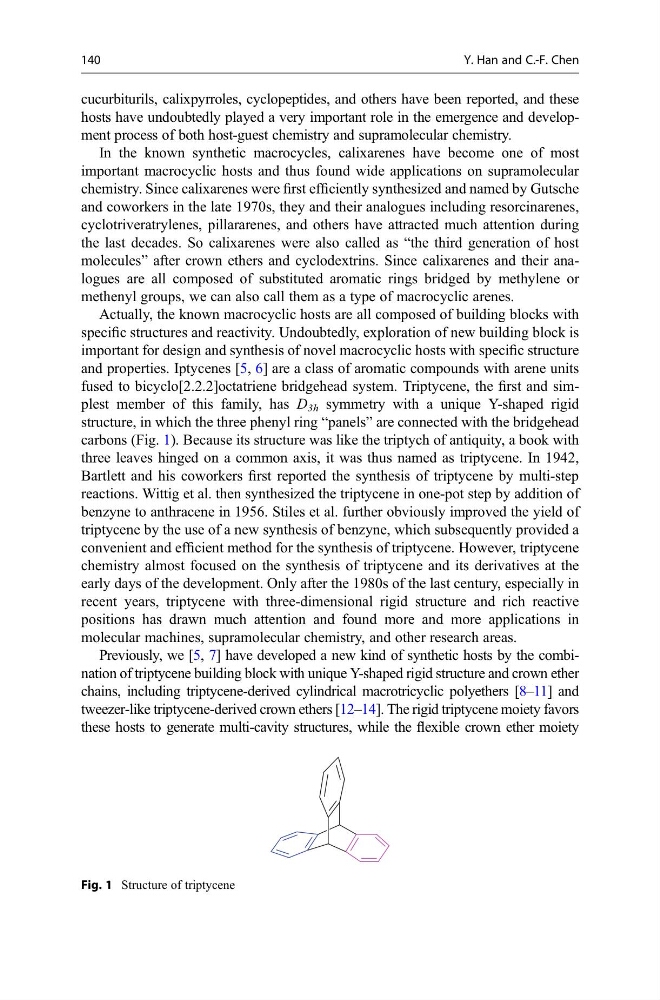
fused to bicyclo[2.2.2]octatriene bridgehead system. Triptycene, the first and simplest member of this family, has D 3h symmetry with a unique Y-shaped rigid
structure, in which the three phenyl ring “panels” are connected with the bridgehead
carbons (Fig. 1). Because its structure was like the triptych of antiquity, a book with
three leaves hinged on a common axis, it was thus named as triptycene. In 1942,
Bartlett and his coworkers first reported the synthesis of triptycene by multi-step
reactions. Wittig et al. then synthesized the triptycene in one-pot step by addition of
benzyne to anthracene in 1956. Stiles et al. further obviously improved the yield of
triptycene by the use of a new synthesis of benzyne, which subsequently provided a
convenient and efficient method for the synthesis of triptycene. However, triptycene
chemistry almost focused on the synthesis of triptycene and its derivatives at the
early days of the development. Only after the 1980s of the last century, especially in
recent years, triptycene with three-dimensional rigid structure and rich reactive
positions has drawn much attention and found more and more applications in
molecular machines, supramolecular chemistry, and other research areas.
Previously, we [5, 7] have developed a new kind of synthetic hosts by the combination of triptycene building block with unique Y-shaped rigid structure and crown ether
chains, including triptycene-derived cylindrical macrotricyclic polyethers [8–11] and
tweezer-like triptycene-derived crown ethers [12–14]. The rigid triptycene moiety favors
these hosts to generate multi-cavity structures, while the flexible crown ether moiety
Fig. 1 Structure of triptycene
140
Y. Han and C.-F. Chen
hosts have undoubtedly played a very important role in the emergence and development process of both host-guest chemistry and supramolecular chemistry.
In the known synthetic macrocycles, calixarenes have become one of most
important macrocyclic hosts and thus found wide applications on supramolecular
chemistry. Since calixarenes were first efficiently synthesized and named by Gutsche
and coworkers in the late 1970s, they and their analogues including resorcinarenes,
cyclotriveratrylenes, pillararenes, and others have attracted much attention during
the last decades. So calixarenes were also called as “the third generation of host
molecules” after crown ethers and cyclodextrins. Since calixarenes and their analogues are all composed of substituted aromatic rings bridged by methylene or
methenyl groups, we can also call them as a type of macrocyclic arenes.
Actually, the known macrocyclic hosts are all composed of building blocks with
specific structures and reactivity. Undoubtedly, exploration of new building block is
important for design and synthesis of novel macrocyclic hosts with specific structure
and properties. Iptycenes [5, 6] are a class of aromatic compounds with arene units
fused to bicyclo[2.2.2]octatriene bridgehead system. Triptycene, the first and simplest member of this family, has D 3h symmetry with a unique Y-shaped rigid
structure, in which the three phenyl ring “panels” are connected with the bridgehead
carbons (Fig. 1). Because its structure was like the triptych of antiquity, a book with
three leaves hinged on a common axis, it was thus named as triptycene. In 1942,
Bartlett and his coworkers first reported the synthesis of triptycene by multi-step
reactions. Wittig et al. then synthesized the triptycene in one-pot step by addition of
benzyne to anthracene in 1956. Stiles et al. further obviously improved the yield of
triptycene by the use of a new synthesis of benzyne, which subsequently provided a
convenient and efficient method for the synthesis of triptycene. However, triptycene
chemistry almost focused on the synthesis of triptycene and its derivatives at the
early days of the development. Only after the 1980s of the last century, especially in
recent years, triptycene with three-dimensional rigid structure and rich reactive
positions has drawn much attention and found more and more applications in
molecular machines, supramolecular chemistry, and other research areas.
Previously, we [5, 7] have developed a new kind of synthetic hosts by the combination of triptycene building block with unique Y-shaped rigid structure and crown ether
chains, including triptycene-derived cylindrical macrotricyclic polyethers [8–11] and
tweezer-like triptycene-derived crown ethers [12–14]. The rigid triptycene moiety favors
these hosts to generate multi-cavity structures, while the flexible crown ether moiety
Fig. 1 Structure of triptycene
140
Y. Han and C.-F. Chen