

modular functional supramolecular polymer materials. Likewise, Stang et al. [66]
recently reported the fabrication of a multifunctional metallacage-core supramolecular gel via orthogonal metal-coordination-driven self-assembly of cis-Pt(PEt 3 ) 2 -
(OTf) 2 , TPE-based sodium benzoate ligands and linear dipyridyl ligands containing
21C7 units (Fig. 23b). Threading a guest, incorporating a dialkylammonium binding
site, into the free 21C7 moieties within the metallacage by host-guest interactions,
resulted in the formation of a supramolecular polymer network, which further
formed a supramolecular gel at relatively high concentrations. Interestingly, the
supramolecular polymer gel showed an excellent fluorescence emission, deriving
from the AIE properties of TPE derivatives. The employment of noncovalent bond
to construct supramolecular polymer gel suggested that the gel network could
respond to multiple stimuli and possess outstanding self-healing properties. Moreover, rheological results revealed that the rigidity of the metallacages enhanced the
stiffness of the gel. This novel multiple-functional supramolecular polymer network
based on orthogonal self-assembly could open an avenue for the fabrication of
supramolecular gels with stimuli-responsive and self-healing properties as smart
materials.
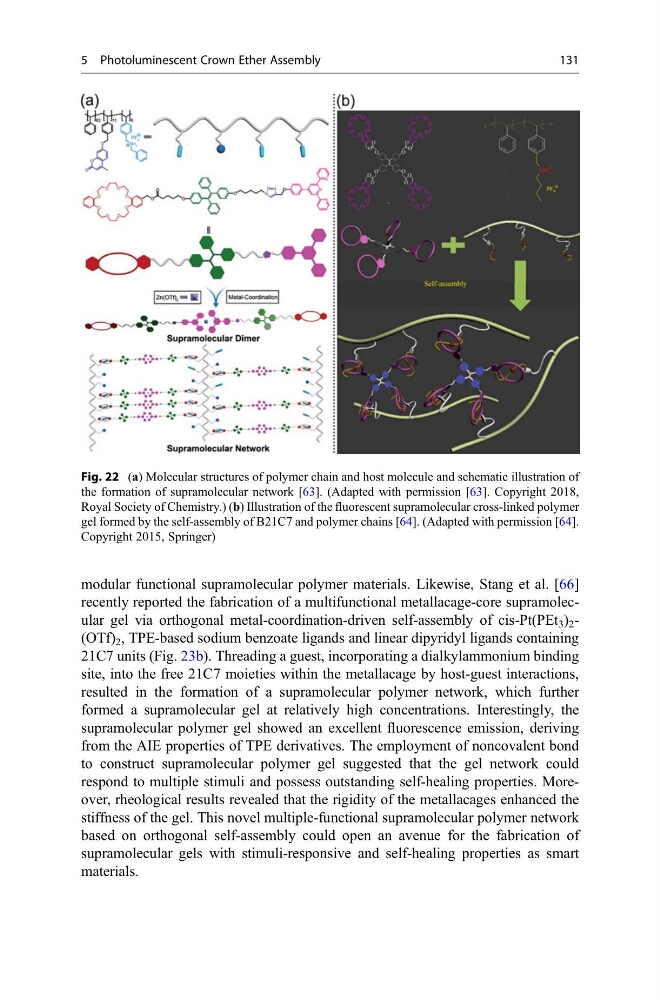
Fig. 22 (a) Molecular structures of polymer chain and host molecule and schematic illustration of
the formation of supramolecular network [63]. (Adapted with permission [63]. Copyright 2018,
Royal Society of Chemistry.) (b) Illustration of the fluorescent supramolecular cross-linked polymer
gel formed by the self-assembly of B21C7 and polymer chains [64]. (Adapted with permission [64].
Copyright 2015, Springer)
5 Photoluminescent Crown Ether Assembly
131
recently reported the fabrication of a multifunctional metallacage-core supramolecular gel via orthogonal metal-coordination-driven self-assembly of cis-Pt(PEt 3 ) 2 -
(OTf) 2 , TPE-based sodium benzoate ligands and linear dipyridyl ligands containing
21C7 units (Fig. 23b). Threading a guest, incorporating a dialkylammonium binding
site, into the free 21C7 moieties within the metallacage by host-guest interactions,
resulted in the formation of a supramolecular polymer network, which further
formed a supramolecular gel at relatively high concentrations. Interestingly, the
supramolecular polymer gel showed an excellent fluorescence emission, deriving
from the AIE properties of TPE derivatives. The employment of noncovalent bond
to construct supramolecular polymer gel suggested that the gel network could
respond to multiple stimuli and possess outstanding self-healing properties. Moreover, rheological results revealed that the rigidity of the metallacages enhanced the
stiffness of the gel. This novel multiple-functional supramolecular polymer network
based on orthogonal self-assembly could open an avenue for the fabrication of
supramolecular gels with stimuli-responsive and self-healing properties as smart
materials.
Fig. 22 (a) Molecular structures of polymer chain and host molecule and schematic illustration of
the formation of supramolecular network [63]. (Adapted with permission [63]. Copyright 2018,
Royal Society of Chemistry.) (b) Illustration of the fluorescent supramolecular cross-linked polymer
gel formed by the self-assembly of B21C7 and polymer chains [64]. (Adapted with permission [64].
Copyright 2015, Springer)
5 Photoluminescent Crown Ether Assembly
131