

5.5
Conclusion
In conclusion, recent developments in the designation and construction of photoluminescent crown ether assembly have been discussed. These complicated structures fabricated via self-assembly at the molecular scale provided many
opportunities for the preparation of new smart luminescent supramolecular materials. Various noncovalent interactions, such as metal-ligand coordination, hydrogen
bonding, and host-guest interactions, were the essential characteristics of these
materials. Ingeniously, the combination of functional units (i.e., DAE, TPE, and
anthracene) and the dynamic noncovalent interactions endowed the luminescent
materials with multistimuli-responsive and self-healing features. The fluorescence
intensity of the systems could be reversibly modulated upon external stimuli, like
light, pH, temperature, etc. Moreover, these luminescent materials could be further
used in sensors, light harvesting, and bio-imaging.
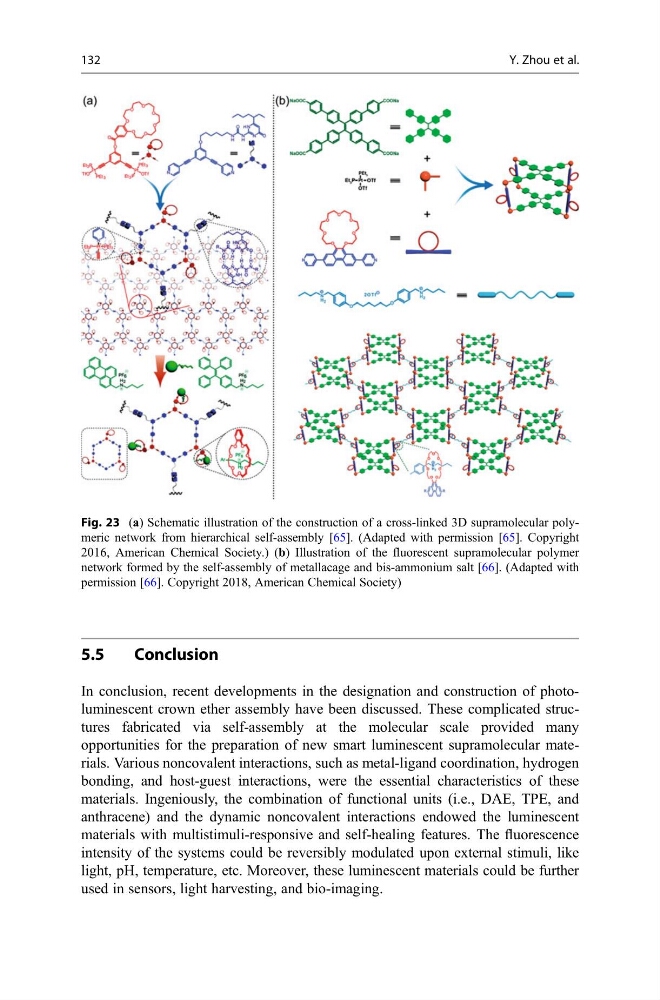
Fig. 23 (a) Schematic illustration of the construction of a cross-linked 3D supramolecular polymeric network from hierarchical self-assembly [65]. (Adapted with permission [65]. Copyright
2016, American Chemical Society.) (b) Illustration of the fluorescent supramolecular polymer
network formed by the self-assembly of metallacage and bis-ammonium salt [66]. (Adapted with
permission [66]. Copyright 2018, American Chemical Society)
132
Y. Zhou et al.
Conclusion
In conclusion, recent developments in the designation and construction of photoluminescent crown ether assembly have been discussed. These complicated structures fabricated via self-assembly at the molecular scale provided many
opportunities for the preparation of new smart luminescent supramolecular materials. Various noncovalent interactions, such as metal-ligand coordination, hydrogen
bonding, and host-guest interactions, were the essential characteristics of these
materials. Ingeniously, the combination of functional units (i.e., DAE, TPE, and
anthracene) and the dynamic noncovalent interactions endowed the luminescent
materials with multistimuli-responsive and self-healing features. The fluorescence
intensity of the systems could be reversibly modulated upon external stimuli, like
light, pH, temperature, etc. Moreover, these luminescent materials could be further
used in sensors, light harvesting, and bio-imaging.
Fig. 23 (a) Schematic illustration of the construction of a cross-linked 3D supramolecular polymeric network from hierarchical self-assembly [65]. (Adapted with permission [65]. Copyright
2016, American Chemical Society.) (b) Illustration of the fluorescent supramolecular polymer
network formed by the self-assembly of metallacage and bis-ammonium salt [66]. (Adapted with
permission [66]. Copyright 2018, American Chemical Society)
132
Y. Zhou et al.