

practical applications. In 2001, the concept of aggregation-induced emission (AIE)
was first put forward [58]. Luminescent materials with AIE can efficiently solve the
self-quenching problem of traditional fluorescent materials. AIE has received considerable attention due to their potential applications for photoelectronic devices,
chemo- and biosensors, and bio-imaging. Tetraphenylethene (TPE) is a typical AIEactive molecule. The marriage of TPE and crown ether system provides new smart
function materials with unique fluorescent properties. Liu and coworkers [59]
reported a highly sensitive and selective K
+ probe, constructed via AIE and hostguest molecular recognition. Four benzo-15-crown-5 (B15C5) macrocycles were
docked with TPE molecule, endowing the system with the AIE-active motif and
supramolecular K
+
-recognizing functionalities. Supramolecular polymer was
obtained by the formation of K
+ /B15C5 1:2 sandwich complex, accompanied by
the turned-on fluorescence via AIE effect, whereas the fluorescence emission
changes were negligible in the presence of competitive ions (Li
+
, Na
+
, NH 4
+
, Ca
2+
,
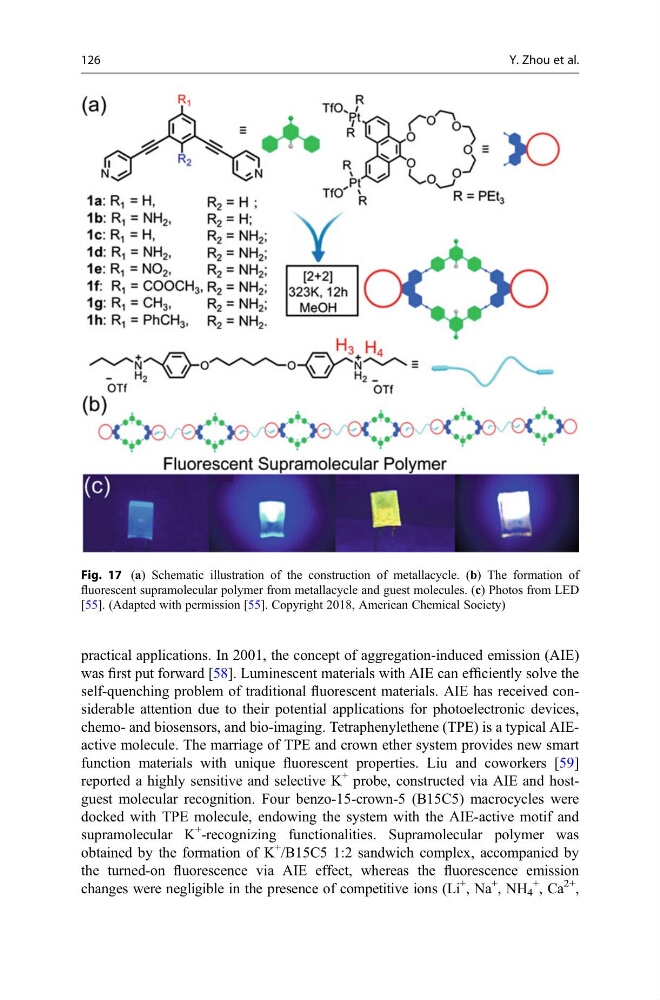
Fig. 17 (a) Schematic illustration of the construction of metallacycle. (b) The formation of
fluorescent supramolecular polymer from metallacycle and guest molecules. (c) Photos from LED
[55]. (Adapted with permission [55]. Copyright 2018, American Chemical Society)
126
Y. Zhou et al.
was first put forward [58]. Luminescent materials with AIE can efficiently solve the
self-quenching problem of traditional fluorescent materials. AIE has received considerable attention due to their potential applications for photoelectronic devices,
chemo- and biosensors, and bio-imaging. Tetraphenylethene (TPE) is a typical AIEactive molecule. The marriage of TPE and crown ether system provides new smart
function materials with unique fluorescent properties. Liu and coworkers [59]
reported a highly sensitive and selective K
+ probe, constructed via AIE and hostguest molecular recognition. Four benzo-15-crown-5 (B15C5) macrocycles were
docked with TPE molecule, endowing the system with the AIE-active motif and
supramolecular K
+
-recognizing functionalities. Supramolecular polymer was
obtained by the formation of K
+ /B15C5 1:2 sandwich complex, accompanied by
the turned-on fluorescence via AIE effect, whereas the fluorescence emission
changes were negligible in the presence of competitive ions (Li
+
, Na
+
, NH 4
+
, Ca
2+
,
Fig. 17 (a) Schematic illustration of the construction of metallacycle. (b) The formation of
fluorescent supramolecular polymer from metallacycle and guest molecules. (c) Photos from LED
[55]. (Adapted with permission [55]. Copyright 2018, American Chemical Society)
126
Y. Zhou et al.