

switching phenomena through controlling the self-assembly process in different
ways, suggesting its potential application as advanced intelligent materials.
Huang et al. [57] fabricated a novel supramolecular cross-linked network via the
host-guest interactions between the pendent DB24C8 units of a conjugated polymer
and a bis-ammonium cross-linker (Fig. 19). However, the supramolecular crosslinked network showed a weak fluorescence, compared with conjugated polymer,
originating from the aggregation of polymer chains, whereas the fluorescence
intensity of this network increased obviously through inputting external stimulus
signals, containing potassium cation, chloride anion, pH increase, and heating,
attributed to the disassembly process of the supramolecular cross-linked network.
In addition, the thin films were prepared by spin-coating the solution of the supramolecular cross-linked network. Interestingly, the fluorescence intensity of the thin
films showed an obvious increase when the film was exposed to the vapor of
ammonia. This system will pay the way for designing multiple fluorescent sensor
materials.
The abovementioned supramolecular polymers not only possess the dynamic
characteristic but also regulate their fluorescence by various external stimuli. However, all of them undergo an inescapable process of aggregation-caused quenching
(ACQ) due to the formation of excimers and exciplexes, which seriously limits their
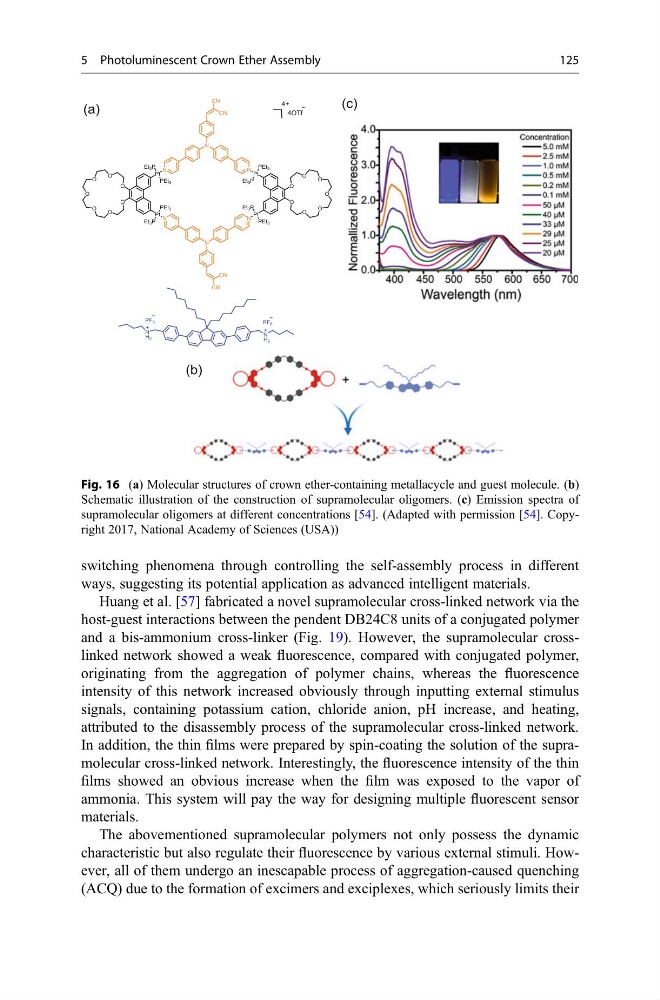
Fig. 16 (a) Molecular structures of crown ether-containing metallacycle and guest molecule. (b)
Schematic illustration of the construction of supramolecular oligomers. (c) Emission spectra of
supramolecular oligomers at different concentrations [54]. (Adapted with permission [54]. Copyright 2017, National Academy of Sciences (USA))
5 Photoluminescent Crown Ether Assembly
125
ways, suggesting its potential application as advanced intelligent materials.
Huang et al. [57] fabricated a novel supramolecular cross-linked network via the
host-guest interactions between the pendent DB24C8 units of a conjugated polymer
and a bis-ammonium cross-linker (Fig. 19). However, the supramolecular crosslinked network showed a weak fluorescence, compared with conjugated polymer,
originating from the aggregation of polymer chains, whereas the fluorescence
intensity of this network increased obviously through inputting external stimulus
signals, containing potassium cation, chloride anion, pH increase, and heating,
attributed to the disassembly process of the supramolecular cross-linked network.
In addition, the thin films were prepared by spin-coating the solution of the supramolecular cross-linked network. Interestingly, the fluorescence intensity of the thin
films showed an obvious increase when the film was exposed to the vapor of
ammonia. This system will pay the way for designing multiple fluorescent sensor
materials.
The abovementioned supramolecular polymers not only possess the dynamic
characteristic but also regulate their fluorescence by various external stimuli. However, all of them undergo an inescapable process of aggregation-caused quenching
(ACQ) due to the formation of excimers and exciplexes, which seriously limits their
Fig. 16 (a) Molecular structures of crown ether-containing metallacycle and guest molecule. (b)
Schematic illustration of the construction of supramolecular oligomers. (c) Emission spectra of
supramolecular oligomers at different concentrations [54]. (Adapted with permission [54]. Copyright 2017, National Academy of Sciences (USA))
5 Photoluminescent Crown Ether Assembly
125