

emission was obtained at a concentration of 29 μM (Fig. 16c). This study provided
an effective strategy for the fabrication supramolecular assemblies with tunable
emissive properties. Subsequently, they reported a novel kind of supramolecular
polymers taking advantage of host-guest binding between P21C7-containing metallacycles and bis-ammonium salt (Fig. 17) [55]. By modification of the substituents
on the metallacycle precursor, the supramolecular polymers showed extraordinary
abilities to regulate the fluorescent emission. Then, when coating a yellow-emitting
supramolecular polymer thin film onto a blue-light LED, a white-light-emitting LED
was obtained (Fig. 17c), indicating the potential of the supramolecular polymers for
the construction of photoelectronic materials.
Recently, luminescent supramolecular polymer gels, which combine the elasticity
of solid, the fluidity of liquid, and the inherent optoelectronic properties, have
become an interesting research field. Significant work on luminescent supramolecular polymer gel has been reported by the group of Wong and coworkers [56]. The
assembly of three metal ligands, appended to a benzo-21-crown-7 (B21C7) macrocycle, resulted in a Zn
2+ complex exhibiting a strong yellow fluorescence (Fig. 18).
Threading of a guest, including a bis-ammonium salt binding site, into the B21C7,
resulted in the formation of a [3]pseudorotaxane with weak blue fluorescence. The
supramolecular polymer gels were constructed successfully by threading of the bisammonium salt into the Zn
2+ complex, accompanying with weak yellow fluorescence. Moreover, the supramolecular polymer gels showed an excellent multiresponsive performance. The reversible sol-gel transition could be triggered by
temperature, pH, and cation. Therefore, the gel could display diverse fluorescent
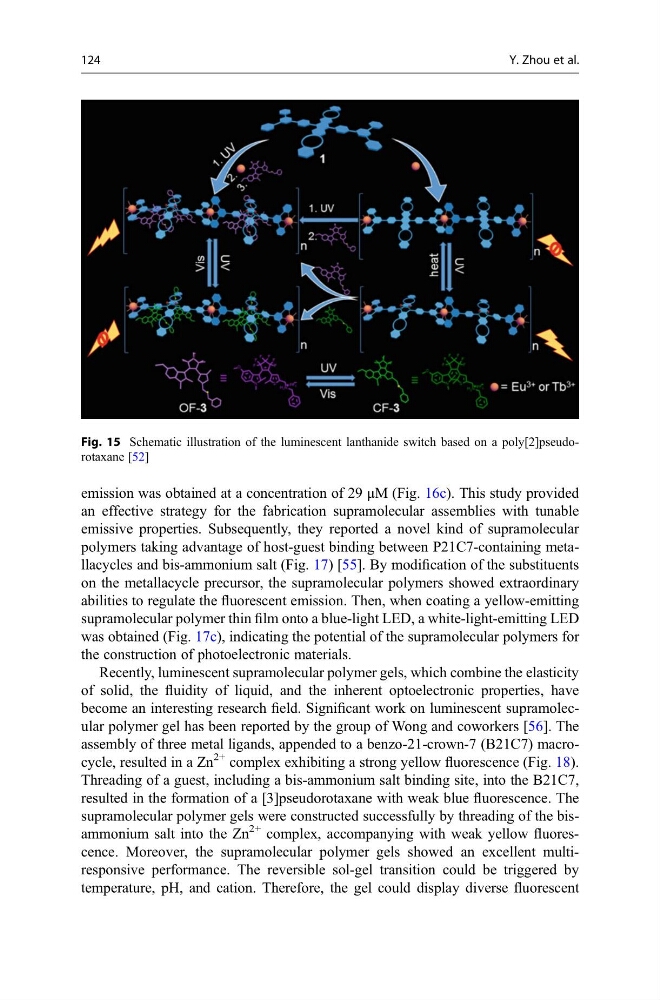
Fig. 15 Schematic illustration of the luminescent lanthanide switch based on a poly[2]pseudorotaxane [52]
124
Y. Zhou et al.
an effective strategy for the fabrication supramolecular assemblies with tunable
emissive properties. Subsequently, they reported a novel kind of supramolecular
polymers taking advantage of host-guest binding between P21C7-containing metallacycles and bis-ammonium salt (Fig. 17) [55]. By modification of the substituents
on the metallacycle precursor, the supramolecular polymers showed extraordinary
abilities to regulate the fluorescent emission. Then, when coating a yellow-emitting
supramolecular polymer thin film onto a blue-light LED, a white-light-emitting LED
was obtained (Fig. 17c), indicating the potential of the supramolecular polymers for
the construction of photoelectronic materials.
Recently, luminescent supramolecular polymer gels, which combine the elasticity
of solid, the fluidity of liquid, and the inherent optoelectronic properties, have
become an interesting research field. Significant work on luminescent supramolecular polymer gel has been reported by the group of Wong and coworkers [56]. The
assembly of three metal ligands, appended to a benzo-21-crown-7 (B21C7) macrocycle, resulted in a Zn
2+ complex exhibiting a strong yellow fluorescence (Fig. 18).
Threading of a guest, including a bis-ammonium salt binding site, into the B21C7,
resulted in the formation of a [3]pseudorotaxane with weak blue fluorescence. The
supramolecular polymer gels were constructed successfully by threading of the bisammonium salt into the Zn
2+ complex, accompanying with weak yellow fluorescence. Moreover, the supramolecular polymer gels showed an excellent multiresponsive performance. The reversible sol-gel transition could be triggered by
temperature, pH, and cation. Therefore, the gel could display diverse fluorescent
Fig. 15 Schematic illustration of the luminescent lanthanide switch based on a poly[2]pseudorotaxane [52]
124
Y. Zhou et al.