

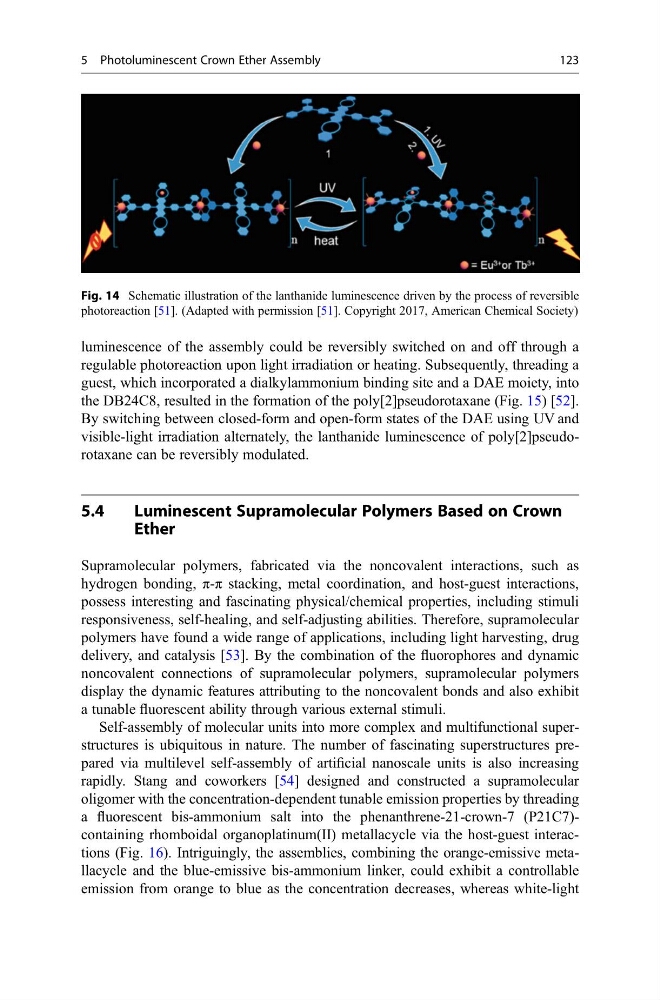
luminescence of the assembly could be reversibly switched on and off through a
regulable photoreaction upon light irradiation or heating. Subsequently, threading a
guest, which incorporated a dialkylammonium binding site and a DAE moiety, into
the DB24C8, resulted in the formation of the poly[2]pseudorotaxane (Fig. 15) [52].
By switching between closed-form and open-form states of the DAE using UV and
visible-light irradiation alternately, the lanthanide luminescence of poly[2]pseudorotaxane can be reversibly modulated.
5.4
Luminescent Supramolecular Polymers Based on Crown
Ether
Supramolecular polymers, fabricated via the noncovalent interactions, such as
hydrogen bonding, π-π stacking, metal coordination, and host-guest interactions,
possess interesting and fascinating physical/chemical properties, including stimuli
responsiveness, self-healing, and self-adjusting abilities. Therefore, supramolecular
polymers have found a wide range of applications, including light harvesting, drug
delivery, and catalysis [53]. By the combination of the fluorophores and dynamic
noncovalent connections of supramolecular polymers, supramolecular polymers
display the dynamic features attributing to the noncovalent bonds and also exhibit
a tunable fluorescent ability through various external stimuli.
Self-assembly of molecular units into more complex and multifunctional superstructures is ubiquitous in nature. The number of fascinating superstructures prepared via multilevel self-assembly of artificial nanoscale units is also increasing
rapidly. Stang and coworkers [54] designed and constructed a supramolecular
oligomer with the concentration-dependent tunable emission properties by threading
a fluorescent bis-ammonium salt into the phenanthrene-21-crown-7 (P21C7)containing rhomboidal organoplatinum(II) metallacycle via the host-guest interactions (Fig. 16). Intriguingly, the assemblies, combining the orange-emissive metallacycle and the blue-emissive bis-ammonium linker, could exhibit a controllable
emission from orange to blue as the concentration decreases, whereas white-light
Fig. 14 Schematic illustration of the lanthanide luminescence driven by the process of reversible
photoreaction [51]. (Adapted with permission [51]. Copyright 2017, American Chemical Society)
5 Photoluminescent Crown Ether Assembly
123
regulable photoreaction upon light irradiation or heating. Subsequently, threading a
guest, which incorporated a dialkylammonium binding site and a DAE moiety, into
the DB24C8, resulted in the formation of the poly[2]pseudorotaxane (Fig. 15) [52].
By switching between closed-form and open-form states of the DAE using UV and
visible-light irradiation alternately, the lanthanide luminescence of poly[2]pseudorotaxane can be reversibly modulated.
5.4
Luminescent Supramolecular Polymers Based on Crown
Ether
Supramolecular polymers, fabricated via the noncovalent interactions, such as
hydrogen bonding, π-π stacking, metal coordination, and host-guest interactions,
possess interesting and fascinating physical/chemical properties, including stimuli
responsiveness, self-healing, and self-adjusting abilities. Therefore, supramolecular
polymers have found a wide range of applications, including light harvesting, drug
delivery, and catalysis [53]. By the combination of the fluorophores and dynamic
noncovalent connections of supramolecular polymers, supramolecular polymers
display the dynamic features attributing to the noncovalent bonds and also exhibit
a tunable fluorescent ability through various external stimuli.
Self-assembly of molecular units into more complex and multifunctional superstructures is ubiquitous in nature. The number of fascinating superstructures prepared via multilevel self-assembly of artificial nanoscale units is also increasing
rapidly. Stang and coworkers [54] designed and constructed a supramolecular
oligomer with the concentration-dependent tunable emission properties by threading
a fluorescent bis-ammonium salt into the phenanthrene-21-crown-7 (P21C7)containing rhomboidal organoplatinum(II) metallacycle via the host-guest interactions (Fig. 16). Intriguingly, the assemblies, combining the orange-emissive metallacycle and the blue-emissive bis-ammonium linker, could exhibit a controllable
emission from orange to blue as the concentration decreases, whereas white-light
Fig. 14 Schematic illustration of the lanthanide luminescence driven by the process of reversible
photoreaction [51]. (Adapted with permission [51]. Copyright 2017, American Chemical Society)
5 Photoluminescent Crown Ether Assembly
123