

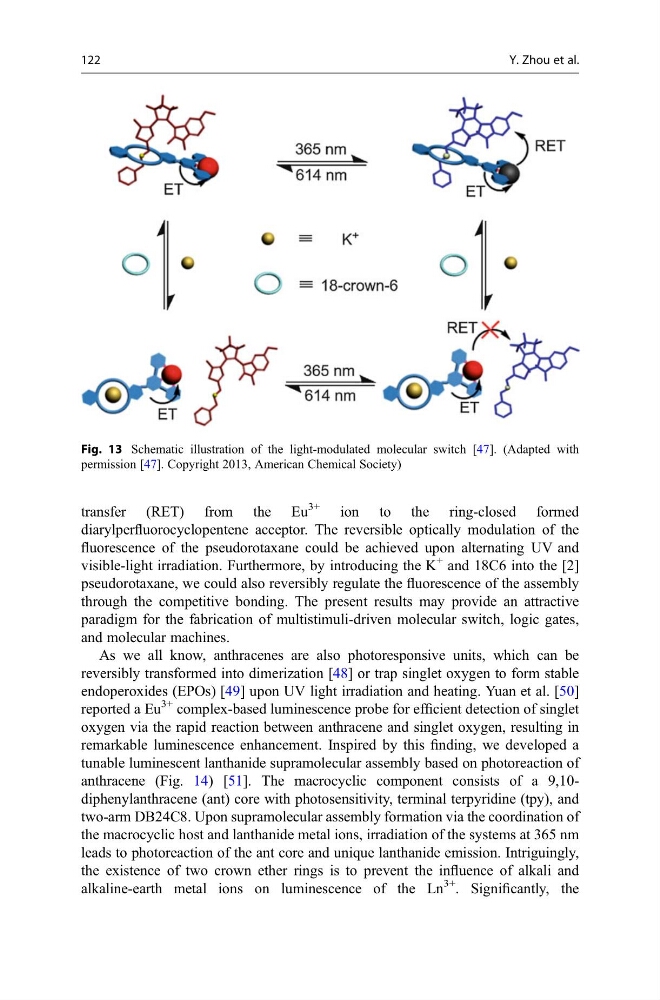
transfer (RET) from the Eu
3+
ion to the ring-closed formed
diarylperfluorocyclopentene acceptor. The reversible optically modulation of the
fluorescence of the pseudorotaxane could be achieved upon alternating UV and
visible-light irradiation. Furthermore, by introducing the K
+ and 18C6 into the [2]
pseudorotaxane, we could also reversibly regulate the fluorescence of the assembly
through the competitive bonding. The present results may provide an attractive
paradigm for the fabrication of multistimuli-driven molecular switch, logic gates,
and molecular machines.
As we all know, anthracenes are also photoresponsive units, which can be
reversibly transformed into dimerization [48] or trap singlet oxygen to form stable
endoperoxides (EPOs) [49] upon UV light irradiation and heating. Yuan et al. [50]
reported a Eu
3+ complex-based luminescence probe for efficient detection of singlet
oxygen via the rapid reaction between anthracene and singlet oxygen, resulting in
remarkable luminescence enhancement. Inspired by this finding, we developed a
tunable luminescent lanthanide supramolecular assembly based on photoreaction of
anthracene (Fig. 14) [51]. The macrocyclic component consists of a 9,10diphenylanthracene (ant) core with photosensitivity, terminal terpyridine (tpy), and
two-arm DB24C8. Upon supramolecular assembly formation via the coordination of
the macrocyclic host and lanthanide metal ions, irradiation of the systems at 365 nm
leads to photoreaction of the ant core and unique lanthanide emission. Intriguingly,
the existence of two crown ether rings is to prevent the influence of alkali and
alkaline-earth metal ions on luminescence of the Ln
3+ . Significantly, the
Fig. 13 Schematic illustration of the light-modulated molecular switch [47]. (Adapted with
permission [47]. Copyright 2013, American Chemical Society)
122
Y. Zhou et al.
3+
ion to the ring-closed formed
diarylperfluorocyclopentene acceptor. The reversible optically modulation of the
fluorescence of the pseudorotaxane could be achieved upon alternating UV and
visible-light irradiation. Furthermore, by introducing the K
+ and 18C6 into the [2]
pseudorotaxane, we could also reversibly regulate the fluorescence of the assembly
through the competitive bonding. The present results may provide an attractive
paradigm for the fabrication of multistimuli-driven molecular switch, logic gates,
and molecular machines.
As we all know, anthracenes are also photoresponsive units, which can be
reversibly transformed into dimerization [48] or trap singlet oxygen to form stable
endoperoxides (EPOs) [49] upon UV light irradiation and heating. Yuan et al. [50]
reported a Eu
3+ complex-based luminescence probe for efficient detection of singlet
oxygen via the rapid reaction between anthracene and singlet oxygen, resulting in
remarkable luminescence enhancement. Inspired by this finding, we developed a
tunable luminescent lanthanide supramolecular assembly based on photoreaction of
anthracene (Fig. 14) [51]. The macrocyclic component consists of a 9,10diphenylanthracene (ant) core with photosensitivity, terminal terpyridine (tpy), and
two-arm DB24C8. Upon supramolecular assembly formation via the coordination of
the macrocyclic host and lanthanide metal ions, irradiation of the systems at 365 nm
leads to photoreaction of the ant core and unique lanthanide emission. Intriguingly,
the existence of two crown ether rings is to prevent the influence of alkali and
alkaline-earth metal ions on luminescence of the Ln
3+ . Significantly, the
Fig. 13 Schematic illustration of the light-modulated molecular switch [47]. (Adapted with
permission [47]. Copyright 2013, American Chemical Society)
122
Y. Zhou et al.