

The group of Tang [32] has also focused on developing sensing systems based on
crown ether and lanthanide metal, allowing for highly selective detection of Hg
2+ .
They designed and synthesized a benzo crown ether host, 4,5-bis{[(2
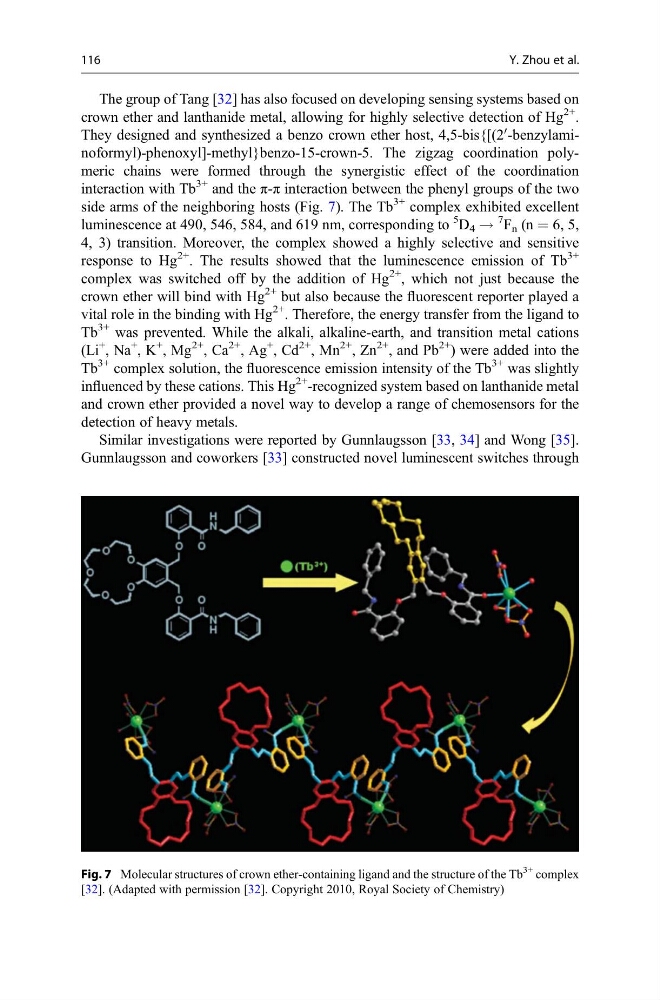
0 -benzylaminoformyl)-phenoxyl]-methyl}benzo-15-crown-5. The zigzag coordination polymeric chains were formed through the synergistic effect of the coordination
interaction with Tb
3+ and the π-π interaction between the phenyl groups of the two
side arms of the neighboring hosts (Fig. 7). The Tb
3+ complex exhibited excellent
luminescence at 490, 546, 584, and 619 nm, corresponding to
5 D 4 !
7 F n (n = 6, 5,
4, 3) transition. Moreover, the complex showed a highly selective and sensitive
response to Hg
2+ . The results showed that the luminescence emission of Tb
3+
complex was switched off by the addition of Hg
2+ , which not just because the
crown ether will bind with Hg
2+ but also because the fluorescent reporter played a
vital role in the binding with Hg
2+ . Therefore, the energy transfer from the ligand to
Tb
3+ was prevented. While the alkali, alkaline-earth, and transition metal cations
(Li
+
, Na
+
, K
+
, Mg
2+ , Ca
2+ , Ag
+ , Cd
2+ , Mn
2+ , Zn
2+ , and Pb
2+ ) were added into the
Tb
3+ complex solution, the fluorescence emission intensity of the Tb
3+ was slightly
influenced by these cations. This Hg
2+ -recognized system based on lanthanide metal
and crown ether provided a novel way to develop a range of chemosensors for the
detection of heavy metals.
Similar investigations were reported by Gunnlaugsson [33, 34] and Wong [35].
Gunnlaugsson and coworkers [33] constructed novel luminescent switches through
Fig. 7 Molecular structures of crown ether-containing ligand and the structure of the Tb
3+ complex
[32]. (Adapted with permission [32]. Copyright 2010, Royal Society of Chemistry)
116
Y. Zhou et al.
crown ether and lanthanide metal, allowing for highly selective detection of Hg
2+ .
They designed and synthesized a benzo crown ether host, 4,5-bis{[(2
0 -benzylaminoformyl)-phenoxyl]-methyl}benzo-15-crown-5. The zigzag coordination polymeric chains were formed through the synergistic effect of the coordination
interaction with Tb
3+ and the π-π interaction between the phenyl groups of the two
side arms of the neighboring hosts (Fig. 7). The Tb
3+ complex exhibited excellent
luminescence at 490, 546, 584, and 619 nm, corresponding to
5 D 4 !
7 F n (n = 6, 5,
4, 3) transition. Moreover, the complex showed a highly selective and sensitive
response to Hg
2+ . The results showed that the luminescence emission of Tb
3+
complex was switched off by the addition of Hg
2+ , which not just because the
crown ether will bind with Hg
2+ but also because the fluorescent reporter played a
vital role in the binding with Hg
2+ . Therefore, the energy transfer from the ligand to
Tb
3+ was prevented. While the alkali, alkaline-earth, and transition metal cations
(Li
+
, Na
+
, K
+
, Mg
2+ , Ca
2+ , Ag
+ , Cd
2+ , Mn
2+ , Zn
2+ , and Pb
2+ ) were added into the
Tb
3+ complex solution, the fluorescence emission intensity of the Tb
3+ was slightly
influenced by these cations. This Hg
2+ -recognized system based on lanthanide metal
and crown ether provided a novel way to develop a range of chemosensors for the
detection of heavy metals.
Similar investigations were reported by Gunnlaugsson [33, 34] and Wong [35].
Gunnlaugsson and coworkers [33] constructed novel luminescent switches through
Fig. 7 Molecular structures of crown ether-containing ligand and the structure of the Tb
3+ complex
[32]. (Adapted with permission [32]. Copyright 2010, Royal Society of Chemistry)
116
Y. Zhou et al.