

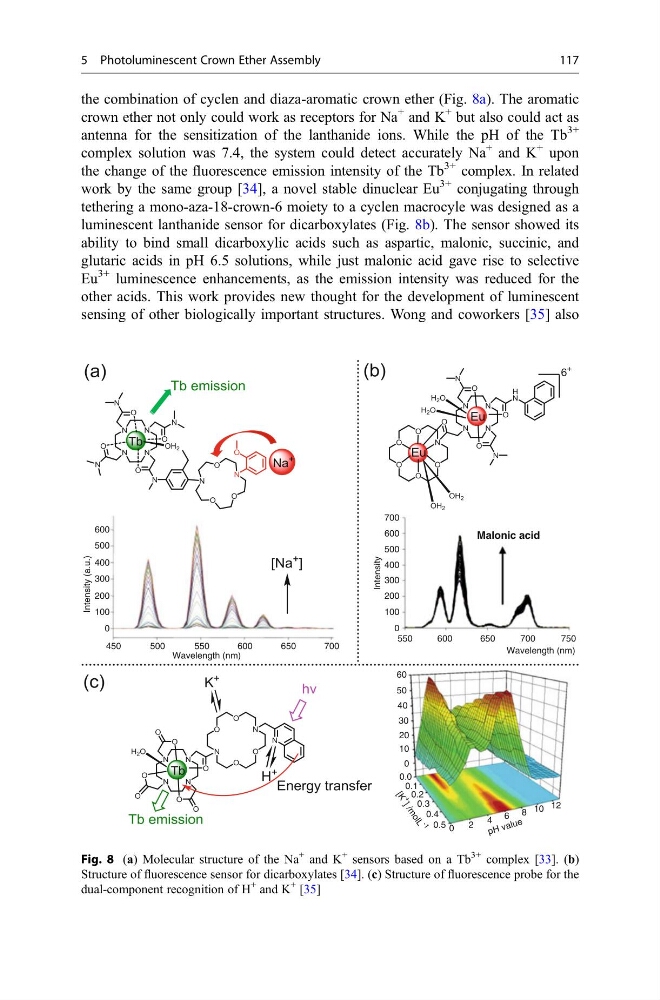
the combination of cyclen and diaza-aromatic crown ether (Fig. 8a). The aromatic
crown ether not only could work as receptors for Na
+ and K
+ but also could act as
antenna for the sensitization of the lanthanide ions. While the pH of the Tb
3+
complex solution was 7.4, the system could detect accurately Na
+ and K
+ upon
the change of the fluorescence emission intensity of the Tb
3+ complex. In related
work by the same group [34], a novel stable dinuclear Eu
3+ conjugating through
tethering a mono-aza-18-crown-6 moiety to a cyclen macrocyle was designed as a
luminescent lanthanide sensor for dicarboxylates (Fig. 8b). The sensor showed its
ability to bind small dicarboxylic acids such as aspartic, malonic, succinic, and
glutaric acids in pH 6.5 solutions, while just malonic acid gave rise to selective
Eu
3+ luminescence enhancements, as the emission intensity was reduced for the
other acids. This work provides new thought for the development of luminescent
sensing of other biologically important structures. Wong and coworkers [35] also
450
0
100
200
300
Intensity (a.u.)
400
500
600
0
100
200
300
400
Intensity
500
600
700
500
550
600
Wavelength (nm)
650
700
550
600
650
60
50
40
30
20
10
0
0.0
0.1
0.2
0.4
0.5 0
2
4 6 8
pH va lu e
[K
+
]
/m
o
lL
-1
10 12
0.3
700
Wavelength (nm)
Malonic acid
750
Fig. 8 (a) Molecular structure of the Na
+ and K
+ sensors based on a Tb
3+ complex [33]. (b)
Structure of fluorescence sensor for dicarboxylates [34]. (c) Structure of fluorescence probe for the
dual-component recognition of H
+ and K
+ [35]
5 Photoluminescent Crown Ether Assembly
117
crown ether not only could work as receptors for Na
+ and K
+ but also could act as
antenna for the sensitization of the lanthanide ions. While the pH of the Tb
3+
complex solution was 7.4, the system could detect accurately Na
+ and K
+ upon
the change of the fluorescence emission intensity of the Tb
3+ complex. In related
work by the same group [34], a novel stable dinuclear Eu
3+ conjugating through
tethering a mono-aza-18-crown-6 moiety to a cyclen macrocyle was designed as a
luminescent lanthanide sensor for dicarboxylates (Fig. 8b). The sensor showed its
ability to bind small dicarboxylic acids such as aspartic, malonic, succinic, and
glutaric acids in pH 6.5 solutions, while just malonic acid gave rise to selective
Eu
3+ luminescence enhancements, as the emission intensity was reduced for the
other acids. This work provides new thought for the development of luminescent
sensing of other biologically important structures. Wong and coworkers [35] also
450
0
100
200
300
Intensity (a.u.)
400
500
600
0
100
200
300
400
Intensity
500
600
700
500
550
600
Wavelength (nm)
650
700
550
600
650
60
50
40
30
20
10
0
0.0
0.1
0.2
0.4
0.5 0
2
4 6 8
pH va lu e
[K
+
]
/m
o
lL
-1
10 12
0.3
700
Wavelength (nm)
Malonic acid
750
Fig. 8 (a) Molecular structure of the Na
+ and K
+ sensors based on a Tb
3+ complex [33]. (b)
Structure of fluorescence sensor for dicarboxylates [34]. (c) Structure of fluorescence probe for the
dual-component recognition of H
+ and K
+ [35]
5 Photoluminescent Crown Ether Assembly
117