

Therefore, the elaborate designed supramolecular assembly containing lanthanide
metals could function as molecular switches, sensing platforms, and molecular
machines. In the following part, we will briefly introduce the recent progresses on
functions and applications of the lanthanide luminescent crown ether assembly.
5.3.1 A Highly Selective Luminescent Sensor
How to build a platform for the sensitive and selective detection of potassium to
achieve the accurate clinical disease diagnosis (such as hypertension, stroke, and
seizures) is still a considerable challenge.
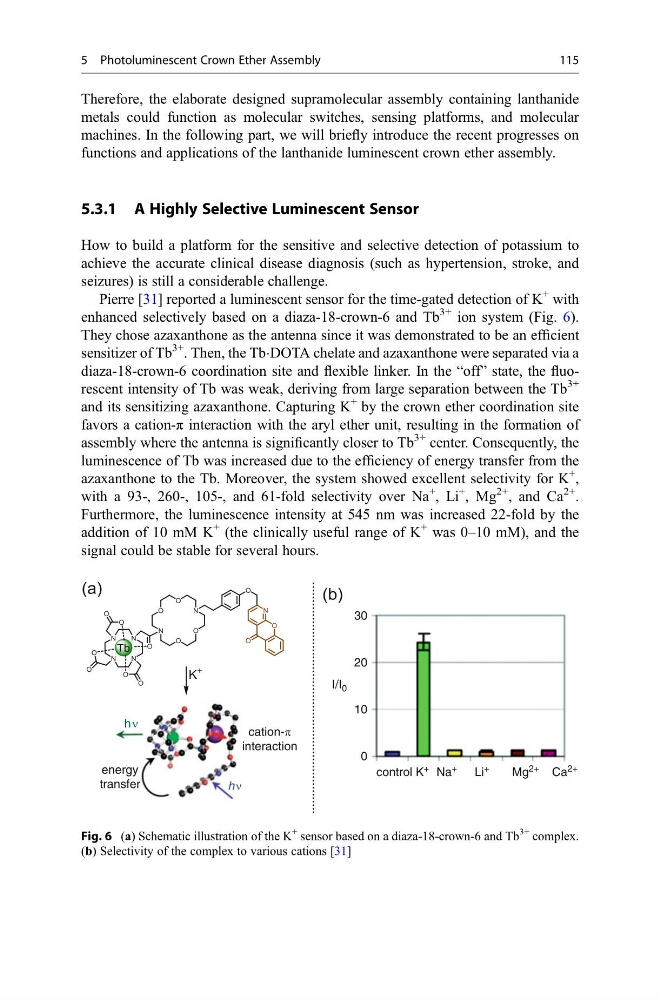
Pierre [31] reported a luminescent sensor for the time-gated detection of K
+ with
enhanced selectively based on a diaza-18-crown-6 and Tb
3+ ion system (Fig. 6).
They chose azaxanthone as the antenna since it was demonstrated to be an efficient
sensitizer of Tb
3+ . Then, the TbÁDOTA chelate and azaxanthone were separated via a
diaza-18-crown-6 coordination site and flexible linker. In the “off” state, the fluorescent intensity of Tb was weak, deriving from large separation between the Tb
3+
and its sensitizing azaxanthone. Capturing K
+ by the crown ether coordination site
favors a cation-π interaction with the aryl ether unit, resulting in the formation of
assembly where the antenna is significantly closer to Tb
3+ center. Consequently, the
luminescence of Tb was increased due to the efficiency of energy transfer from the
azaxanthone to the Tb. Moreover, the system showed excellent selectivity for K
+
,
with a 93-, 260-, 105-, and 61-fold selectivity over Na
+
, Li
+
, Mg
2+ , and Ca
2+ .
Furthermore, the luminescence intensity at 545 nm was increased 22-fold by the
addition of 10 mM K
+ (the clinically useful range of K
+ was 0–10 mM), and the
signal could be stable for several hours.
energy
transfer
cation-π
interaction
hν
hν
I/I 0
30
20
10
0
control K + Na
+
Li
+
Mg
2+ Ca
2+
Fig. 6 (a) Schematic illustration of the K
+ sensor based on a diaza-18-crown-6 and Tb
3+ complex.
(b) Selectivity of the complex to various cations [31]
5 Photoluminescent Crown Ether Assembly
115
metals could function as molecular switches, sensing platforms, and molecular
machines. In the following part, we will briefly introduce the recent progresses on
functions and applications of the lanthanide luminescent crown ether assembly.
5.3.1 A Highly Selective Luminescent Sensor
How to build a platform for the sensitive and selective detection of potassium to
achieve the accurate clinical disease diagnosis (such as hypertension, stroke, and
seizures) is still a considerable challenge.
Pierre [31] reported a luminescent sensor for the time-gated detection of K
+ with
enhanced selectively based on a diaza-18-crown-6 and Tb
3+ ion system (Fig. 6).
They chose azaxanthone as the antenna since it was demonstrated to be an efficient
sensitizer of Tb
3+ . Then, the TbÁDOTA chelate and azaxanthone were separated via a
diaza-18-crown-6 coordination site and flexible linker. In the “off” state, the fluorescent intensity of Tb was weak, deriving from large separation between the Tb
3+
and its sensitizing azaxanthone. Capturing K
+ by the crown ether coordination site
favors a cation-π interaction with the aryl ether unit, resulting in the formation of
assembly where the antenna is significantly closer to Tb
3+ center. Consequently, the
luminescence of Tb was increased due to the efficiency of energy transfer from the
azaxanthone to the Tb. Moreover, the system showed excellent selectivity for K
+
,
with a 93-, 260-, 105-, and 61-fold selectivity over Na
+
, Li
+
, Mg
2+ , and Ca
2+ .
Furthermore, the luminescence intensity at 545 nm was increased 22-fold by the
addition of 10 mM K
+ (the clinically useful range of K
+ was 0–10 mM), and the
signal could be stable for several hours.
energy
transfer
cation-π
interaction
hν
hν
I/I 0
30
20
10
0
control K + Na
+
Li
+
Mg
2+ Ca
2+
Fig. 6 (a) Schematic illustration of the K
+ sensor based on a diaza-18-crown-6 and Tb
3+ complex.
(b) Selectivity of the complex to various cations [31]
5 Photoluminescent Crown Ether Assembly
115