

self-inclusion to make the intriguing [1]rotaxane conveniently and provided a
novel idea for the preparation of amazing mechanically self-locked architecture.
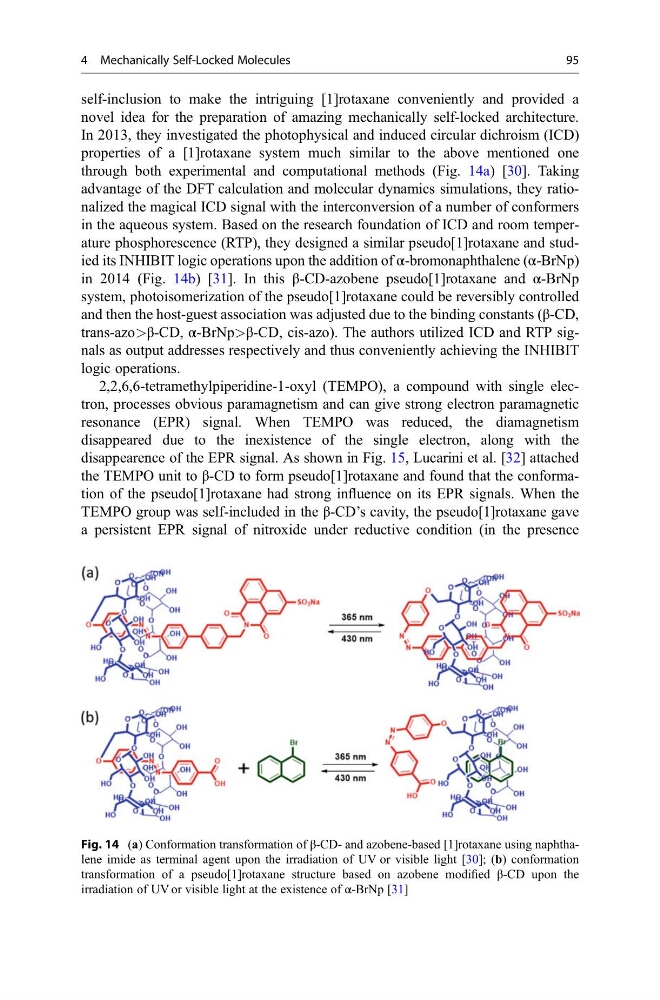
In 2013, they investigated the photophysical and induced circular dichroism (ICD)
properties of a [1]rotaxane system much similar to the above mentioned one
through both experimental and computational methods (Fig. 14a) [30]. Taking
advantage of the DFT calculation and molecular dynamics simulations, they rationalized the magical ICD signal with the interconversion of a number of conformers
in the aqueous system. Based on the research foundation of ICD and room temperature phosphorescence (RTP), they designed a similar pseudo[1]rotaxane and studied its INHIBIT logic operations upon the addition of α-bromonaphthalene (α-BrNp)
in 2014 (Fig. 14b) [31]. In this β-CD-azobene pseudo[1]rotaxane and α-BrNp
system, photoisomerization of the pseudo[1]rotaxane could be reversibly controlled
and then the host-guest association was adjusted due to the binding constants (β-CD,
trans-azo>β-CD, α-BrNp>β-CD, cis-azo). The authors utilized ICD and RTP signals as output addresses respectively and thus conveniently achieving the INHIBIT
logic operations.
2,2,6,6-tetramethylpiperidine-1-oxyl (TEMPO), a compound with single electron, processes obvious paramagnetism and can give strong electron paramagnetic
resonance (EPR) signal. When TEMPO was reduced, the diamagnetism
disappeared due to the inexistence of the single electron, along with the
disappearence of the EPR signal. As shown in Fig. 15, Lucarini et al. [32] attached
the TEMPO unit to β-CD to form pseudo[1]rotaxane and found that the conformation of the pseudo[1]rotaxane had strong influence on its EPR signals. When the
TEMPO group was self-included in the β-CD’s cavity, the pseudo[1]rotaxane gave
a persistent EPR signal of nitroxide under reductive condition (in the presence
Fig. 14 (a) Conformation transformation of β-CD- and azobene-based [1]rotaxane using naphthalene imide as terminal agent upon the irradiation of UV or visible light [30]; (b) conformation
transformation of a pseudo[1]rotaxane structure based on azobene modified β-CD upon the
irradiation of UV or visible light at the existence of α-BrNp [31]
4 Mechanically Self-Locked Molecules
95
novel idea for the preparation of amazing mechanically self-locked architecture.
In 2013, they investigated the photophysical and induced circular dichroism (ICD)
properties of a [1]rotaxane system much similar to the above mentioned one
through both experimental and computational methods (Fig. 14a) [30]. Taking
advantage of the DFT calculation and molecular dynamics simulations, they rationalized the magical ICD signal with the interconversion of a number of conformers
in the aqueous system. Based on the research foundation of ICD and room temperature phosphorescence (RTP), they designed a similar pseudo[1]rotaxane and studied its INHIBIT logic operations upon the addition of α-bromonaphthalene (α-BrNp)
in 2014 (Fig. 14b) [31]. In this β-CD-azobene pseudo[1]rotaxane and α-BrNp
system, photoisomerization of the pseudo[1]rotaxane could be reversibly controlled
and then the host-guest association was adjusted due to the binding constants (β-CD,
trans-azo>β-CD, α-BrNp>β-CD, cis-azo). The authors utilized ICD and RTP signals as output addresses respectively and thus conveniently achieving the INHIBIT
logic operations.
2,2,6,6-tetramethylpiperidine-1-oxyl (TEMPO), a compound with single electron, processes obvious paramagnetism and can give strong electron paramagnetic
resonance (EPR) signal. When TEMPO was reduced, the diamagnetism
disappeared due to the inexistence of the single electron, along with the
disappearence of the EPR signal. As shown in Fig. 15, Lucarini et al. [32] attached
the TEMPO unit to β-CD to form pseudo[1]rotaxane and found that the conformation of the pseudo[1]rotaxane had strong influence on its EPR signals. When the
TEMPO group was self-included in the β-CD’s cavity, the pseudo[1]rotaxane gave
a persistent EPR signal of nitroxide under reductive condition (in the presence
Fig. 14 (a) Conformation transformation of β-CD- and azobene-based [1]rotaxane using naphthalene imide as terminal agent upon the irradiation of UV or visible light [30]; (b) conformation
transformation of a pseudo[1]rotaxane structure based on azobene modified β-CD upon the
irradiation of UV or visible light at the existence of α-BrNp [31]
4 Mechanically Self-Locked Molecules
95