

cyclization provide a new idea for the synthesis of cyclic polymers at a large scale,
regardless of the concentration or side reactions (macrocyclization and polymerpolymer reactions).
4.2.3 Cyclodextrin (CD)-Based Pseudo[1]rotaxanes
As the first discovered macrocyclic host molecule, CDs and their single modified
derivatives have been extensively studied due to their easy synthesis and more
importantly the complexation interaction with hydrophobic guest. When the size
and shape of the unit modified on CD matched with the CD’s cavity, the molecule
tended to form a self-included complex. While the modified unit could pass through
the cavity of CD, a [1]rotaxane based on CD would be significantly constructed.
4.2.3.1 Pseudo[1]rotaxanes Related to Pyranose-Based CDs
In 2003, the first pseudo[1]rotaxane structure based on CD was reported by Easton
et al. [27] Several [2]rotaxanes were firstly prepared, including α-CD as the rotor
and stilbene as the axle, and trinitrophenyl group as terminal agents.
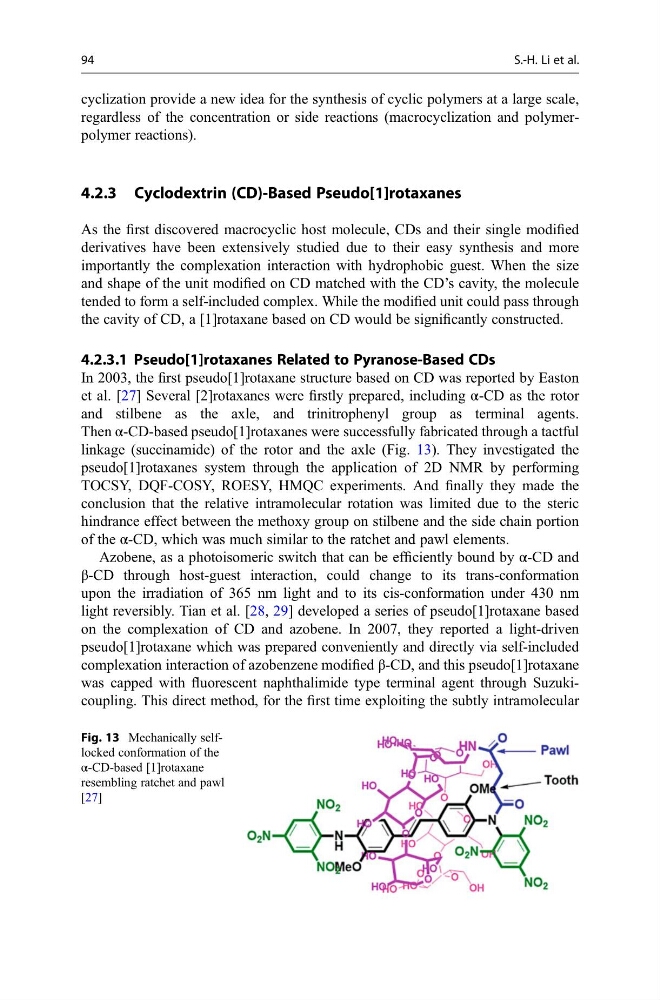
Then α-CD-based pseudo[1]rotaxanes were successfully fabricated through a tactful
linkage (succinamide) of the rotor and the axle (Fig. 13). They investigated the
pseudo[1]rotaxanes system through the application of 2D NMR by performing
TOCSY, DQF-COSY, ROESY, HMQC experiments. And finally they made the
conclusion that the relative intramolecular rotation was limited due to the steric
hindrance effect between the methoxy group on stilbene and the side chain portion
of the α-CD, which was much similar to the ratchet and pawl elements.
Azobene, as a photoisomeric switch that can be efficiently bound by α-CD and
β-CD through host-guest interaction, could change to its trans-conformation
upon the irradiation of 365 nm light and to its cis-conformation under 430 nm
light reversibly. Tian et al. [28, 29] developed a series of pseudo[1]rotaxane based
on the complexation of CD and azobene. In 2007, they reported a light-driven
pseudo[1]rotaxane which was prepared conveniently and directly via self-included
complexation interaction of azobenzene modified β-CD, and this pseudo[1]rotaxane
was capped with fluorescent naphthalimide type terminal agent through Suzukicoupling. This direct method, for the first time exploiting the subtly intramolecular
Fig. 13 Mechanically selflocked conformation of the
α-CD-based [1]rotaxane
resembling ratchet and pawl
[27]
94
S.-H. Li et al.
regardless of the concentration or side reactions (macrocyclization and polymerpolymer reactions).
4.2.3 Cyclodextrin (CD)-Based Pseudo[1]rotaxanes
As the first discovered macrocyclic host molecule, CDs and their single modified
derivatives have been extensively studied due to their easy synthesis and more
importantly the complexation interaction with hydrophobic guest. When the size
and shape of the unit modified on CD matched with the CD’s cavity, the molecule
tended to form a self-included complex. While the modified unit could pass through
the cavity of CD, a [1]rotaxane based on CD would be significantly constructed.
4.2.3.1 Pseudo[1]rotaxanes Related to Pyranose-Based CDs
In 2003, the first pseudo[1]rotaxane structure based on CD was reported by Easton
et al. [27] Several [2]rotaxanes were firstly prepared, including α-CD as the rotor
and stilbene as the axle, and trinitrophenyl group as terminal agents.
Then α-CD-based pseudo[1]rotaxanes were successfully fabricated through a tactful
linkage (succinamide) of the rotor and the axle (Fig. 13). They investigated the
pseudo[1]rotaxanes system through the application of 2D NMR by performing
TOCSY, DQF-COSY, ROESY, HMQC experiments. And finally they made the
conclusion that the relative intramolecular rotation was limited due to the steric
hindrance effect between the methoxy group on stilbene and the side chain portion
of the α-CD, which was much similar to the ratchet and pawl elements.
Azobene, as a photoisomeric switch that can be efficiently bound by α-CD and
β-CD through host-guest interaction, could change to its trans-conformation
upon the irradiation of 365 nm light and to its cis-conformation under 430 nm
light reversibly. Tian et al. [28, 29] developed a series of pseudo[1]rotaxane based
on the complexation of CD and azobene. In 2007, they reported a light-driven
pseudo[1]rotaxane which was prepared conveniently and directly via self-included
complexation interaction of azobenzene modified β-CD, and this pseudo[1]rotaxane
was capped with fluorescent naphthalimide type terminal agent through Suzukicoupling. This direct method, for the first time exploiting the subtly intramolecular
Fig. 13 Mechanically selflocked conformation of the
α-CD-based [1]rotaxane
resembling ratchet and pawl
[27]
94
S.-H. Li et al.