

497
Sources of Weather and Climate Information and Means of Access
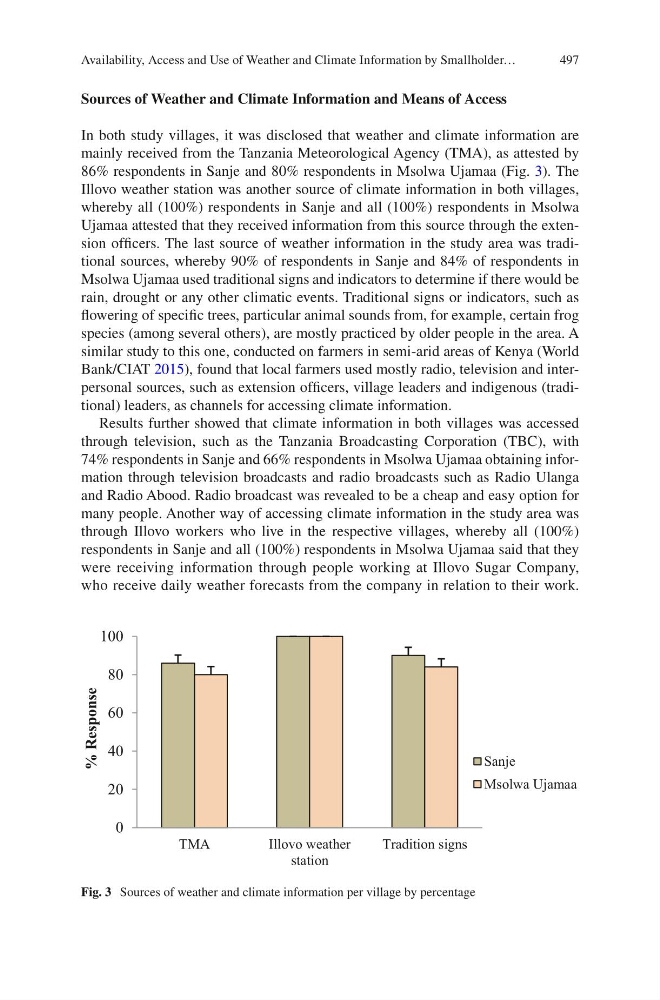
In both study villages, it was disclosed that weather and climate information are
mainly received from the Tanzania Meteorological Agency (TMA), as attested by
86% respondents in Sanje and 80% respondents in Msolwa Ujamaa (Fig. 3). The
Illovo weather station was another source of climate information in both villages,
whereby all (100%) respondents in Sanje and all (100%) respondents in Msolwa
Ujamaa attested that they received information from this source through the extension officers. The last source of weather information in the study area was traditional sources, whereby 90% of respondents in Sanje and 84% of respondents in
Msolwa Ujamaa used traditional signs and indicators to determine if there would be
rain, drought or any other climatic events. Traditional signs or indicators, such as
flowering of specific trees, particular animal sounds from, for example, certain frog
species (among several others), are mostly practiced by older people in the area. A
similar study to this one, conducted on farmers in semi-arid areas of Kenya (World
Bank/CIAT 2015), found that local farmers used mostly radio, television and interpersonal sources, such as extension officers, village leaders and indigenous (traditional) leaders, as channels for accessing climate information.
Results further showed that climate information in both villages was accessed
through television, such as the Tanzania Broadcasting Corporation (TBC), with
74% respondents in Sanje and 66% respondents in Msolwa Ujamaa obtaining information through television broadcasts and radio broadcasts such as Radio Ulanga
and Radio Abood. Radio broadcast was revealed to be a cheap and easy option for
many people. Another way of accessing climate information in the study area was
through Illovo workers who live in the respective villages, whereby all (100%)
respondents in Sanje and all (100%) respondents in Msolwa Ujamaa said that they
were receiving information through people working at Illovo Sugar Company,
who receive daily weather forecasts from the company in relation to their work.
0
20
40
60
80
100
TMA
Illovo weather
station
Tradition signs
% Response
Sanje
Msolwa Ujamaa
Fig. 3 Sources of weather and climate information per village by percentage
Availability, Access and Use of Weather and Climate Information by Smallholder…
Sources of Weather and Climate Information and Means of Access
In both study villages, it was disclosed that weather and climate information are
mainly received from the Tanzania Meteorological Agency (TMA), as attested by
86% respondents in Sanje and 80% respondents in Msolwa Ujamaa (Fig. 3). The
Illovo weather station was another source of climate information in both villages,
whereby all (100%) respondents in Sanje and all (100%) respondents in Msolwa
Ujamaa attested that they received information from this source through the extension officers. The last source of weather information in the study area was traditional sources, whereby 90% of respondents in Sanje and 84% of respondents in
Msolwa Ujamaa used traditional signs and indicators to determine if there would be
rain, drought or any other climatic events. Traditional signs or indicators, such as
flowering of specific trees, particular animal sounds from, for example, certain frog
species (among several others), are mostly practiced by older people in the area. A
similar study to this one, conducted on farmers in semi-arid areas of Kenya (World
Bank/CIAT 2015), found that local farmers used mostly radio, television and interpersonal sources, such as extension officers, village leaders and indigenous (traditional) leaders, as channels for accessing climate information.
Results further showed that climate information in both villages was accessed
through television, such as the Tanzania Broadcasting Corporation (TBC), with
74% respondents in Sanje and 66% respondents in Msolwa Ujamaa obtaining information through television broadcasts and radio broadcasts such as Radio Ulanga
and Radio Abood. Radio broadcast was revealed to be a cheap and easy option for
many people. Another way of accessing climate information in the study area was
through Illovo workers who live in the respective villages, whereby all (100%)
respondents in Sanje and all (100%) respondents in Msolwa Ujamaa said that they
were receiving information through people working at Illovo Sugar Company,
who receive daily weather forecasts from the company in relation to their work.
0
20
40
60
80
100
TMA
Illovo weather
station
Tradition signs
% Response
Sanje
Msolwa Ujamaa
Fig. 3 Sources of weather and climate information per village by percentage
Availability, Access and Use of Weather and Climate Information by Smallholder…