

498
Use of Illovo climatic data was the most common way of receiving information
because the villages are in close proximity to Illovo Sugar Company and most farmers grow sugarcane to sell at Illovo. Illovo is dependent on sugarcane from nearby
villages, giving the company an incentive to ensure that villagers receive relevant
climate information. Farmers also received climate information from extension officers, with 76% respondents in Sanje and 66% respondents in Msolwa Ujamaa
receiving information from them.
Other methods of receiving climate information included the use of the traditional signs. Traditional signs were mostly used by older farmers, who were also
found to have limited awareness about technical information services such as mobile
phone, radio and television, as they had limited access to information via such communication channels compared to the younger members of their communities.
These findings are in line with previous studies (Abubakar et al. 2009; Manyozo
2009), which found that access to agricultural information in most developing countries was provided through radio, television and mobile phone. The high usage of
radio to access agricultural information in the area was due to a high number of
radio stations broadcasting to the study area, low cost and appropriate airing time.
Such information assisted in planning and decision-making regarding what and
when to cultivate, to deal with any shortages of rainfall or other situations caused by
climate variability.
Use of Weather Information in Agriculture
Findings from the study revealed that climate information had various uses in the
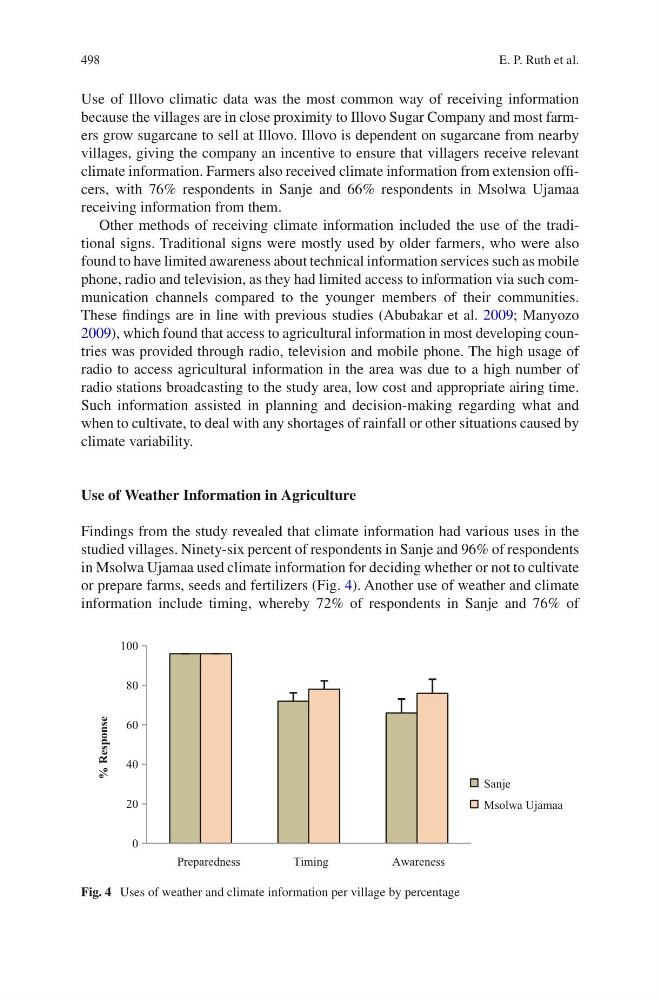
studied villages. Ninety-six percent of respondents in Sanje and 96% of respondents
in Msolwa Ujamaa used climate information for deciding whether or not to cultivate
or prepare farms, seeds and fertilizers (Fig. 4). Another use of weather and climate
information include timing, whereby 72% of respondents in Sanje and 76% of
0
20
40
60
80
100
Preparedness
Timing
Awareness
% Response
Sanje
Msolwa Ujamaa
Fig. 4 Uses of weather and climate information per village by percentage
E. P. Ruth et al.
Use of Illovo climatic data was the most common way of receiving information
because the villages are in close proximity to Illovo Sugar Company and most farmers grow sugarcane to sell at Illovo. Illovo is dependent on sugarcane from nearby
villages, giving the company an incentive to ensure that villagers receive relevant
climate information. Farmers also received climate information from extension officers, with 76% respondents in Sanje and 66% respondents in Msolwa Ujamaa
receiving information from them.
Other methods of receiving climate information included the use of the traditional signs. Traditional signs were mostly used by older farmers, who were also
found to have limited awareness about technical information services such as mobile
phone, radio and television, as they had limited access to information via such communication channels compared to the younger members of their communities.
These findings are in line with previous studies (Abubakar et al. 2009; Manyozo
2009), which found that access to agricultural information in most developing countries was provided through radio, television and mobile phone. The high usage of
radio to access agricultural information in the area was due to a high number of
radio stations broadcasting to the study area, low cost and appropriate airing time.
Such information assisted in planning and decision-making regarding what and
when to cultivate, to deal with any shortages of rainfall or other situations caused by
climate variability.
Use of Weather Information in Agriculture
Findings from the study revealed that climate information had various uses in the
studied villages. Ninety-six percent of respondents in Sanje and 96% of respondents
in Msolwa Ujamaa used climate information for deciding whether or not to cultivate
or prepare farms, seeds and fertilizers (Fig. 4). Another use of weather and climate
information include timing, whereby 72% of respondents in Sanje and 76% of
0
20
40
60
80
100
Preparedness
Timing
Awareness
% Response
Sanje
Msolwa Ujamaa
Fig. 4 Uses of weather and climate information per village by percentage
E. P. Ruth et al.