

496
3.2 Available Climate Services to Smallholder Farmers
and Their Accessibility and Use
Available Weather Services and Sources
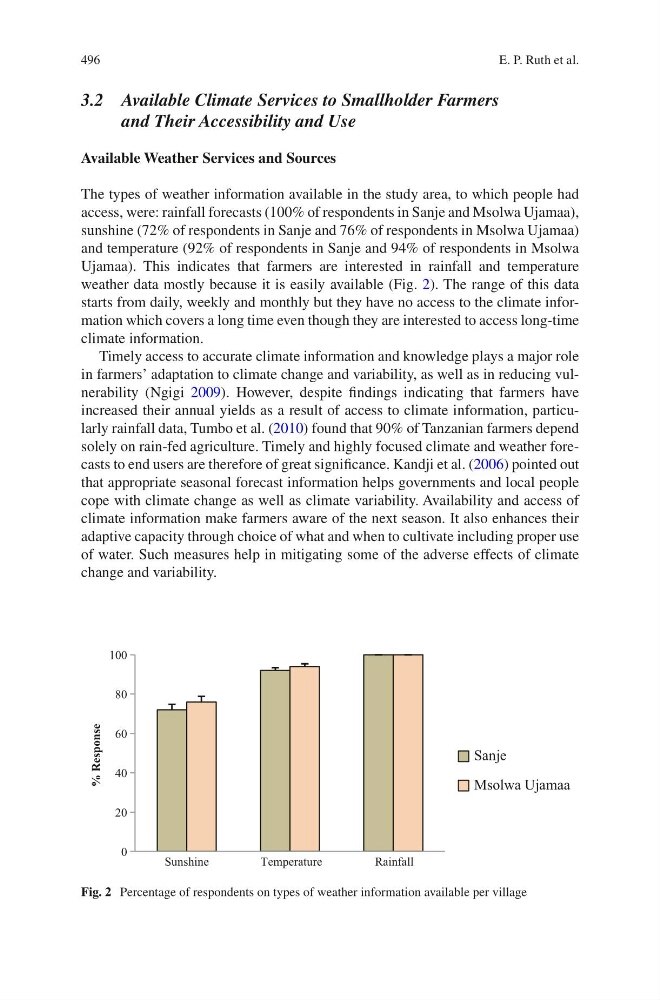
The types of weather information available in the study area, to which people had
access, were: rainfall forecasts (100% of respondents in Sanje and Msolwa Ujamaa),
sunshine (72% of respondents in Sanje and 76% of respondents in Msolwa Ujamaa)
and temperature (92% of respondents in Sanje and 94% of respondents in Msolwa
Ujamaa). This indicates that farmers are interested in rainfall and temperature
weather data mostly because it is easily available (Fig. 2). The range of this data
starts from daily, weekly and monthly but they have no access to the climate information which covers a long time even though they are interested to access long-time
climate information.
Timely access to accurate climate information and knowledge plays a major role
in farmers’ adaptation to climate change and variability, as well as in reducing vulnerability (Ngigi 2009). However, despite findings indicating that farmers have
increased their annual yields as a result of access to climate information, particularly rainfall data, Tumbo et al. (2010) found that 90% of Tanzanian farmers depend
solely on rain-fed agriculture. Timely and highly focused climate and weather forecasts to end users are therefore of great significance. Kandji et al. (2006) pointed out
that appropriate seasonal forecast information helps governments and local people
cope with climate change as well as climate variability. Availability and access of
climate information make farmers aware of the next season. It also enhances their
adaptive capacity through choice of what and when to cultivate including proper use
of water. Such measures help in mitigating some of the adverse effects of climate
change and variability.
0
20
40
60
80
100
Sunshine
Temperature
Rainfall
% Response
Sanje
Msolwa Ujamaa
Fig. 2 Percentage of respondents on types of weather information available per village
E. P. Ruth et al.
3.2 Available Climate Services to Smallholder Farmers
and Their Accessibility and Use
Available Weather Services and Sources
The types of weather information available in the study area, to which people had
access, were: rainfall forecasts (100% of respondents in Sanje and Msolwa Ujamaa),
sunshine (72% of respondents in Sanje and 76% of respondents in Msolwa Ujamaa)
and temperature (92% of respondents in Sanje and 94% of respondents in Msolwa
Ujamaa). This indicates that farmers are interested in rainfall and temperature
weather data mostly because it is easily available (Fig. 2). The range of this data
starts from daily, weekly and monthly but they have no access to the climate information which covers a long time even though they are interested to access long-time
climate information.
Timely access to accurate climate information and knowledge plays a major role
in farmers’ adaptation to climate change and variability, as well as in reducing vulnerability (Ngigi 2009). However, despite findings indicating that farmers have
increased their annual yields as a result of access to climate information, particularly rainfall data, Tumbo et al. (2010) found that 90% of Tanzanian farmers depend
solely on rain-fed agriculture. Timely and highly focused climate and weather forecasts to end users are therefore of great significance. Kandji et al. (2006) pointed out
that appropriate seasonal forecast information helps governments and local people
cope with climate change as well as climate variability. Availability and access of
climate information make farmers aware of the next season. It also enhances their
adaptive capacity through choice of what and when to cultivate including proper use
of water. Such measures help in mitigating some of the adverse effects of climate
change and variability.
0
20
40
60
80
100
Sunshine
Temperature
Rainfall
% Response
Sanje
Msolwa Ujamaa
Fig. 2 Percentage of respondents on types of weather information available per village
E. P. Ruth et al.