

482
small amounts of the dye to give a pale pink to pink appearance. In addition, some
species have been observed to produce orange to deep pink colonies due to absorption of Congo red stain (Ondieki et al. 2017).
Cluster Analysis of the Nodule Isolates Based on Morphological
Characteristics
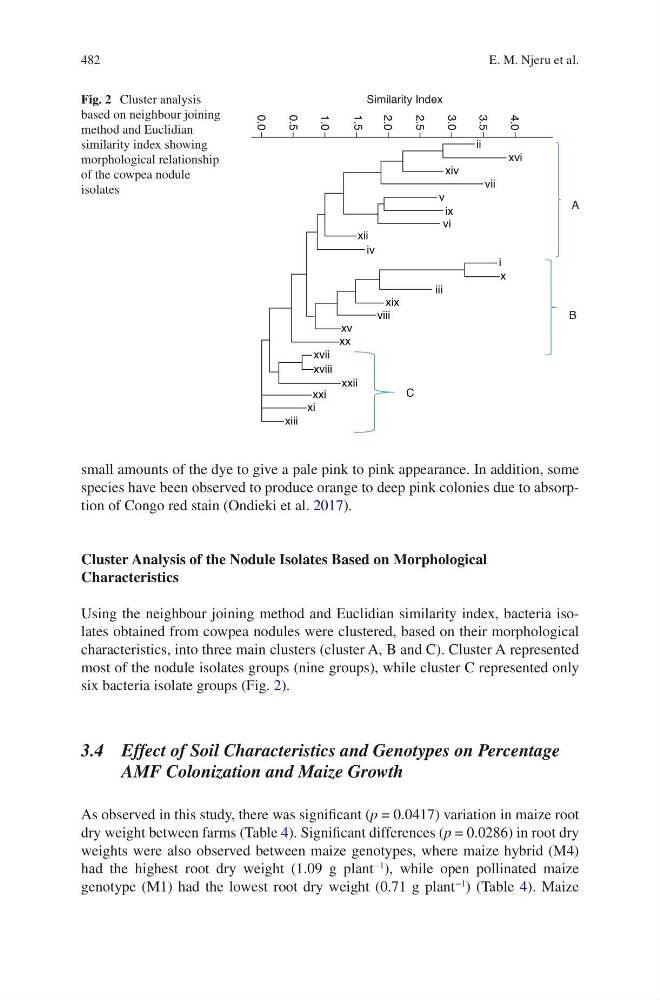
Using the neighbour joining method and Euclidian similarity index, bacteria isolates obtained from cowpea nodules were clustered, based on their morphological
characteristics, into three main clusters (cluster A, B and C). Cluster A represented
most of the nodule isolates groups (nine groups), while cluster C represented only
six bacteria isolate groups (Fig. 2).
3.4 Effect of Soil Characteristics and Genotypes on Percentage
AMF Colonization and Maize Growth
As observed in this study, there was significant (p = 0.0417) variation in maize root
dry weight between farms (Table 4). Significant differences (p = 0.0286) in root dry
weights were also observed between maize genotypes, where maize hybrid (M4)
had the highest root dry weight (1.09 g plant
−1
), while open pollinated maize
genotype (M1) had the lowest root dry weight (0.71 g plant
−1
) (Table 4). Maize
A
Similarity Index
B
C
4.0
3.5
3.0
2.5
2.0
1.5
1.0
0.5
0.0
ii
xvi
xiv
vii
v
ix
vi
xii
iv
i
x
iii
xix
xv
xx
xvii
xviii
xxii
xxi
xi
xiii
viii
Fig. 2 Cluster analysis
based on neighbour joining
method and Euclidian
similarity index showing
morphological relationship
of the cowpea nodule
isolates
E. M. Njeru et al.
small amounts of the dye to give a pale pink to pink appearance. In addition, some
species have been observed to produce orange to deep pink colonies due to absorption of Congo red stain (Ondieki et al. 2017).
Cluster Analysis of the Nodule Isolates Based on Morphological
Characteristics
Using the neighbour joining method and Euclidian similarity index, bacteria isolates obtained from cowpea nodules were clustered, based on their morphological
characteristics, into three main clusters (cluster A, B and C). Cluster A represented
most of the nodule isolates groups (nine groups), while cluster C represented only
six bacteria isolate groups (Fig. 2).
3.4 Effect of Soil Characteristics and Genotypes on Percentage
AMF Colonization and Maize Growth
As observed in this study, there was significant (p = 0.0417) variation in maize root
dry weight between farms (Table 4). Significant differences (p = 0.0286) in root dry
weights were also observed between maize genotypes, where maize hybrid (M4)
had the highest root dry weight (1.09 g plant
−1
), while open pollinated maize
genotype (M1) had the lowest root dry weight (0.71 g plant
−1
) (Table 4). Maize
A
Similarity Index
B
C
4.0
3.5
3.0
2.5
2.0
1.5
1.0
0.5
0.0
ii
xvi
xiv
vii
v
ix
vi
xii
iv
i
x
iii
xix
xv
xx
xvii
xviii
xxii
xxi
xi
xiii
viii
Fig. 2 Cluster analysis
based on neighbour joining
method and Euclidian
similarity index showing
morphological relationship
of the cowpea nodule
isolates
E. M. Njeru et al.