

455
2.3 Empirical Models
Determinants of ISFM Technology Adoption
In this study, adoption of a particular ISFM technology was defined as the use or
application of a particular ISFM technology or practice by the farmer for at least
two consecutive growing seasons. The 2 years were purposively chosen as it is considered minimum for the farmer to complete a full system (cycle) of maize legume
intercropping, with rotation at the centre of each system.
While other studies on adoption of ISFM (Nata et al. 2014; Yirga and Hassan
2008) have ignored the possible interrelationships between various practices, this
study applied a multivariate probit (MVP) to model (simultaneously) multiple
(dis)adoption decisions regarding ISFM technologies and/or practices. This
involved modelling the influence of a set of explanatory variables on each of the
different technologies/practices while allowing the unobserved and measured factors, accounted for by error terms, to be freely correlated. The correlations
between the technologies may be either positive or negative depending on whether
farmers consider the technologies as complements or substitutes, respectively
(Kassie et al. 2013).
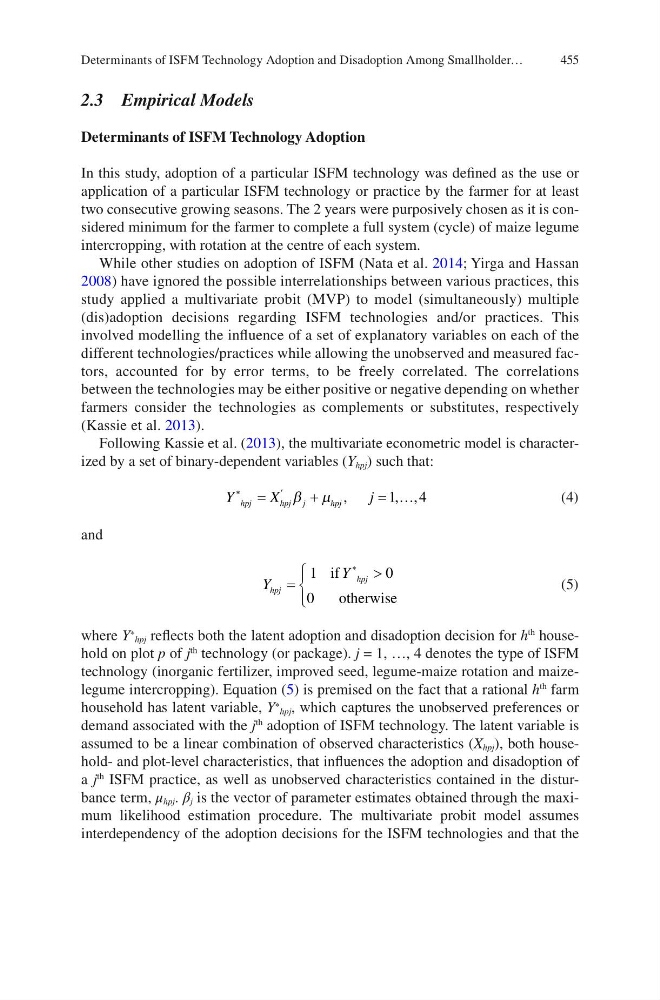
Following Kassie et al. (2013), the multivariate econometric model is characterized by a set of binary-dependent variables (Y hpj ) such that:
Y
X
j
hpj
hpj j
hpj
∗
′
=
+
= …
β µ ,
, ,
1
4
(4)
and
Y
Y
hpj
hpj
=
>
∗
1
0
0
if
otherwise
(5)
where Y
∗ hpj reflects both the latent adoption and disadoption decision for h
th
household on plot p of j
th
technology (or package). j = 1, …, 4 denotes the type of ISFM
technology (inorganic fertilizer, improved seed, legume-maize rotation and maizelegume intercropping). Equation (5) is premised on the fact that a rational h
th
farm
household has latent variable, Y
∗ hpj , which captures the unobserved preferences or
demand associated with the j
th
adoption of ISFM technology. The latent variable is
assumed to be a linear combination of observed characteristics (X hpj ), both household- and plot-level characteristics, that influences the adoption and disadoption of
a j
th
ISFM practice, as well as unobserved characteristics contained in the disturbance term, μ hpj . β j is the vector of parameter estimates obtained through the maximum likelihood estimation procedure. The multivariate probit model assumes
interdependency of the adoption decisions for the ISFM technologies and that the
Determinants of ISFM Technology Adoption and Disadoption Among Smallholder…
2.3 Empirical Models
Determinants of ISFM Technology Adoption
In this study, adoption of a particular ISFM technology was defined as the use or
application of a particular ISFM technology or practice by the farmer for at least
two consecutive growing seasons. The 2 years were purposively chosen as it is considered minimum for the farmer to complete a full system (cycle) of maize legume
intercropping, with rotation at the centre of each system.
While other studies on adoption of ISFM (Nata et al. 2014; Yirga and Hassan
2008) have ignored the possible interrelationships between various practices, this
study applied a multivariate probit (MVP) to model (simultaneously) multiple
(dis)adoption decisions regarding ISFM technologies and/or practices. This
involved modelling the influence of a set of explanatory variables on each of the
different technologies/practices while allowing the unobserved and measured factors, accounted for by error terms, to be freely correlated. The correlations
between the technologies may be either positive or negative depending on whether
farmers consider the technologies as complements or substitutes, respectively
(Kassie et al. 2013).
Following Kassie et al. (2013), the multivariate econometric model is characterized by a set of binary-dependent variables (Y hpj ) such that:
Y
X
j
hpj
hpj j
hpj
∗
′
=
+
= …
β µ ,
, ,
1
4
(4)
and
Y
Y
hpj
hpj
=
>
∗
1
0
0
if
otherwise
(5)
where Y
∗ hpj reflects both the latent adoption and disadoption decision for h
th
household on plot p of j
th
technology (or package). j = 1, …, 4 denotes the type of ISFM
technology (inorganic fertilizer, improved seed, legume-maize rotation and maizelegume intercropping). Equation (5) is premised on the fact that a rational h
th
farm
household has latent variable, Y
∗ hpj , which captures the unobserved preferences or
demand associated with the j
th
adoption of ISFM technology. The latent variable is
assumed to be a linear combination of observed characteristics (X hpj ), both household- and plot-level characteristics, that influences the adoption and disadoption of
a j
th
ISFM practice, as well as unobserved characteristics contained in the disturbance term, μ hpj . β j is the vector of parameter estimates obtained through the maximum likelihood estimation procedure. The multivariate probit model assumes
interdependency of the adoption decisions for the ISFM technologies and that the
Determinants of ISFM Technology Adoption and Disadoption Among Smallholder…