

454
Empirical Strategy
While the individual components in the set of ISFM technology adopted by the
farming households are mutually exclusive, farming households in real life apply a
mix of two or more mutually exclusive soil fertility interventions bundle (Marenya
and Barrett 2007). They do so to exploit the complementarities between alternative
interventions such as improving soil fertility and reducing run-off, among others.
Following Marenya and Barrett (2007) and Kassie et al. (2013), we employ a multivariate framework to model the joint adoption and disadoption of multiple ISFM
technologies. Consistent with the random utility model, the likelihood of adopting
a particular technology (or bundle) is such that the utility derived from that specific
alternative is greater than or equal to the utilities of all other alternative technologies
in the choice. Thus, the decision to (dis)adopt an ISFM technology (or package) is
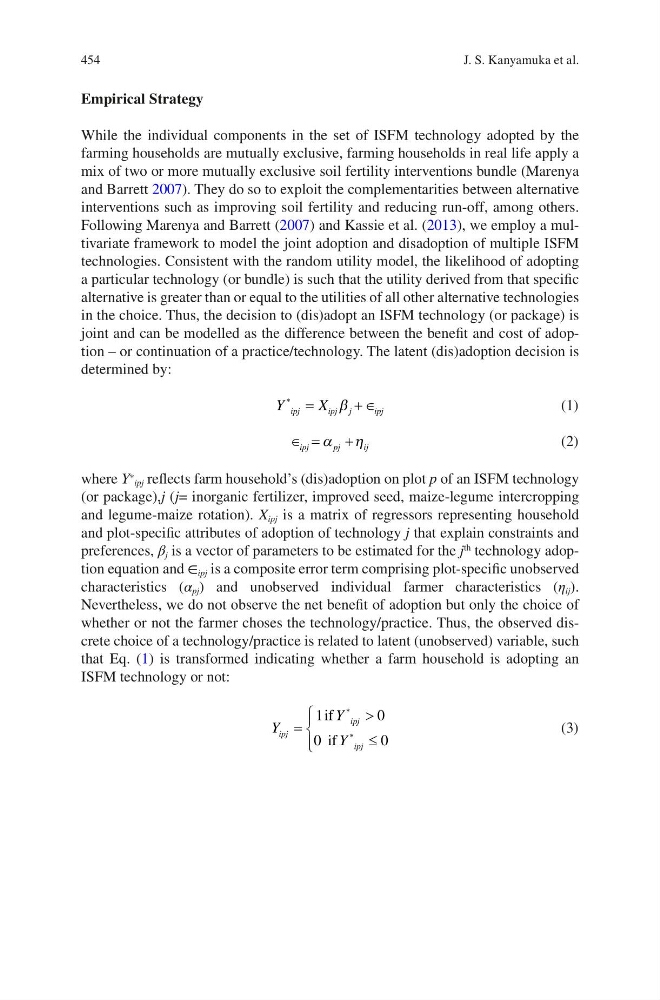
joint and can be modelled as the difference between the benefit and cost of adoption – or continuation of a practice/technology. The latent (dis)adoption decision is
determined by:
Y
X
ipj
i pj j
i pj
∗
=
+∈
β
(1)
∈ =
+
ipj
p j
i j
α η
(2)
where Y
∗ ipj reflects farm household’s (dis)adoption on plot p of an ISFM technology
(or package),j (j= inorganic fertilizer, improved seed, maize-legume intercropping
and legume-maize rotation). X ipj is a matrix of regressors representing household
and plot-specific attributes of adoption of technology j that explain constraints and
preferences, β j is a vector of parameters to be estimated for the j
th
technology adoption equation and ∈ ipj is a composite error term comprising plot-specific unobserved
characteristics (α pj ) and unobserved individual farmer characteristics (η ij ).
Nevertheless, we do not observe the net benefit of adoption but only the choice of
whether or not the farmer choses the technology/practice. Thus, the observed discrete choice of a technology/practice is related to latent (unobserved) variable, such
that Eq. (1) is transformed indicating whether a farm household is adopting an
ISFM technology or not:
Y
Y
Y
ipj
ipj
ipj
=
>
≤
∗
∗
1
0
0
0
if
if
(3)
J. S. Kanyamuka et al.
Empirical Strategy
While the individual components in the set of ISFM technology adopted by the
farming households are mutually exclusive, farming households in real life apply a
mix of two or more mutually exclusive soil fertility interventions bundle (Marenya
and Barrett 2007). They do so to exploit the complementarities between alternative
interventions such as improving soil fertility and reducing run-off, among others.
Following Marenya and Barrett (2007) and Kassie et al. (2013), we employ a multivariate framework to model the joint adoption and disadoption of multiple ISFM
technologies. Consistent with the random utility model, the likelihood of adopting
a particular technology (or bundle) is such that the utility derived from that specific
alternative is greater than or equal to the utilities of all other alternative technologies
in the choice. Thus, the decision to (dis)adopt an ISFM technology (or package) is
joint and can be modelled as the difference between the benefit and cost of adoption – or continuation of a practice/technology. The latent (dis)adoption decision is
determined by:
Y
X
ipj
i pj j
i pj
∗
=
+∈
β
(1)
∈ =
+
ipj
p j
i j
α η
(2)
where Y
∗ ipj reflects farm household’s (dis)adoption on plot p of an ISFM technology
(or package),j (j= inorganic fertilizer, improved seed, maize-legume intercropping
and legume-maize rotation). X ipj is a matrix of regressors representing household
and plot-specific attributes of adoption of technology j that explain constraints and
preferences, β j is a vector of parameters to be estimated for the j
th
technology adoption equation and ∈ ipj is a composite error term comprising plot-specific unobserved
characteristics (α pj ) and unobserved individual farmer characteristics (η ij ).
Nevertheless, we do not observe the net benefit of adoption but only the choice of
whether or not the farmer choses the technology/practice. Thus, the observed discrete choice of a technology/practice is related to latent (unobserved) variable, such
that Eq. (1) is transformed indicating whether a farm household is adopting an
ISFM technology or not:
Y
Y
Y
ipj
ipj
ipj
=
>
≤
∗
∗
1
0
0
0
if
if
(3)
J. S. Kanyamuka et al.