

440
method. Thus, a project would continue increasing the profit until its MRR value is
equivalent to zero. Using the dominance analysis, it was established that using
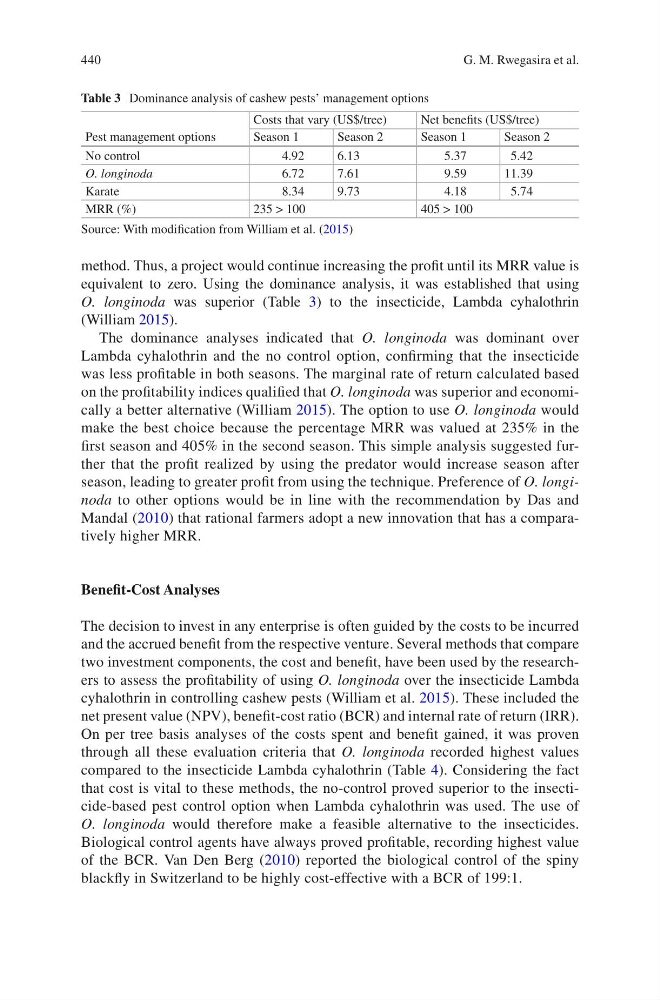
O. longinoda was superior (Table 3) to the insecticide, Lambda cyhalothrin
(William 2015).
The dominance analyses indicated that O. longinoda was dominant over
Lambda cyhalothrin and the no control option, confirming that the insecticide
was less profitable in both seasons. The marginal rate of return calculated based
on the profitability indices qualified that O. longinoda was superior and economically a better alternative (William 2015). The option to use O. longinoda would
make the best choice because the percentage MRR was valued at 235% in the
first season and 405% in the second season. This simple analysis suggested further that the profit realized by using the predator would increase season after
season, leading to greater profit from using the technique. Preference of O. longinoda to other options would be in line with the recommendation by Das and
Mandal (2010) that rational farmers adopt a new innovation that has a comparatively higher MRR.
Benefit-Cost Analyses
The decision to invest in any enterprise is often guided by the costs to be incurred
and the accrued benefit from the respective venture. Several methods that compare
two investment components, the cost and benefit, have been used by the researchers to assess the profitability of using O. longinoda over the insecticide Lambda
cyhalothrin in controlling cashew pests (William et al. 2015). These included the
net present value (NPV), benefit-cost ratio (BCR) and internal rate of return (IRR).
On per tree basis analyses of the costs spent and benefit gained, it was proven
through all these evaluation criteria that O. longinoda recorded highest values
compared to the insecticide Lambda cyhalothrin (Table 4). Considering the fact
that cost is vital to these methods, the no-control proved superior to the insecticide-based pest control option when Lambda cyhalothrin was used. The use of
O. longinoda would therefore make a feasible alternative to the insecticides.
Biological control agents have always proved profitable, recording highest value
of the BCR. Van Den Berg (2010) reported the biological control of the spiny
blackfly in Switzerland to be highly cost-effective with a BCR of 199:1.
Table 3 Dominance analysis of cashew pests’ management options
Pest management options
Costs that vary (US$/tree)
Net benefits (US$/tree)
Season 1
Season 2
Season 1
Season 2
No control
4.92
6.13
5.37
5.42
O. longinoda
6.72
7.61
9.59
11.39
Karate
8.34
9.73
4.18
5.74
MRR (%)
235 > 100
405 > 100
Source: With modification from William et al. (2015)
G. M. Rwegasira et al.
method. Thus, a project would continue increasing the profit until its MRR value is
equivalent to zero. Using the dominance analysis, it was established that using
O. longinoda was superior (Table 3) to the insecticide, Lambda cyhalothrin
(William 2015).
The dominance analyses indicated that O. longinoda was dominant over
Lambda cyhalothrin and the no control option, confirming that the insecticide
was less profitable in both seasons. The marginal rate of return calculated based
on the profitability indices qualified that O. longinoda was superior and economically a better alternative (William 2015). The option to use O. longinoda would
make the best choice because the percentage MRR was valued at 235% in the
first season and 405% in the second season. This simple analysis suggested further that the profit realized by using the predator would increase season after
season, leading to greater profit from using the technique. Preference of O. longinoda to other options would be in line with the recommendation by Das and
Mandal (2010) that rational farmers adopt a new innovation that has a comparatively higher MRR.
Benefit-Cost Analyses
The decision to invest in any enterprise is often guided by the costs to be incurred
and the accrued benefit from the respective venture. Several methods that compare
two investment components, the cost and benefit, have been used by the researchers to assess the profitability of using O. longinoda over the insecticide Lambda
cyhalothrin in controlling cashew pests (William et al. 2015). These included the
net present value (NPV), benefit-cost ratio (BCR) and internal rate of return (IRR).
On per tree basis analyses of the costs spent and benefit gained, it was proven
through all these evaluation criteria that O. longinoda recorded highest values
compared to the insecticide Lambda cyhalothrin (Table 4). Considering the fact
that cost is vital to these methods, the no-control proved superior to the insecticide-based pest control option when Lambda cyhalothrin was used. The use of
O. longinoda would therefore make a feasible alternative to the insecticides.
Biological control agents have always proved profitable, recording highest value
of the BCR. Van Den Berg (2010) reported the biological control of the spiny
blackfly in Switzerland to be highly cost-effective with a BCR of 199:1.
Table 3 Dominance analysis of cashew pests’ management options
Pest management options
Costs that vary (US$/tree)
Net benefits (US$/tree)
Season 1
Season 2
Season 1
Season 2
No control
4.92
6.13
5.37
5.42
O. longinoda
6.72
7.61
9.59
11.39
Karate
8.34
9.73
4.18
5.74
MRR (%)
235 > 100
405 > 100
Source: With modification from William et al. (2015)
G. M. Rwegasira et al.