

439
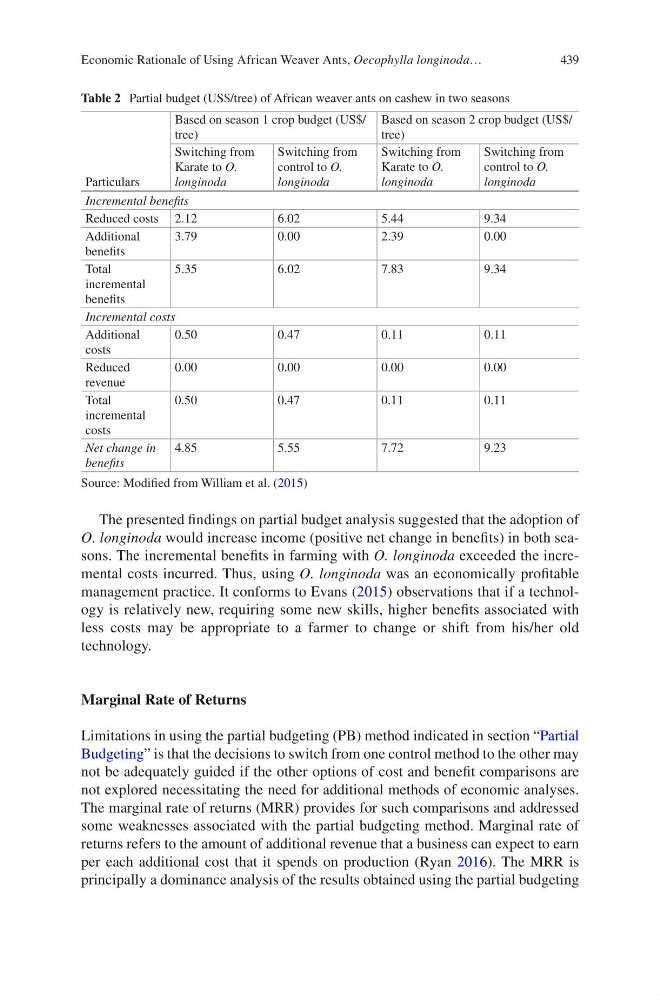
The presented findings on partial budget analysis suggested that the adoption of
O. longinoda would increase income (positive net change in benefits) in both seasons. The incremental benefits in farming with O. longinoda exceeded the incremental costs incurred. Thus, using O. longinoda was an economically profitable
management practice. It conforms to Evans (2015) observations that if a technology is relatively new, requiring some new skills, higher benefits associated with
less costs may be appropriate to a farmer to change or shift from his/her old
technology.
Marginal Rate of Returns
Limitations in using the partial budgeting (PB) method indicated in section “Partial
Budgeting” is that the decisions to switch from one control method to the other may
not be adequately guided if the other options of cost and benefit comparisons are
not explored necessitating the need for additional methods of economic analyses.
The marginal rate of returns (MRR) provides for such comparisons and addressed
some weaknesses associated with the partial budgeting method. Marginal rate of
returns refers to the amount of additional revenue that a business can expect to earn
per each additional cost that it spends on production (Ryan 2016). The MRR is
principally a dominance analysis of the results obtained using the partial budgeting
Table 2 Partial budget (US$/tree) of African weaver ants on cashew in two seasons
Particulars
Based on season 1 crop budget (US$/
tree)
Based on season 2 crop budget (US$/
tree)
Switching from
Karate to O.
longinoda
Switching from
control to O.
longinoda
Switching from
Karate to O.
longinoda
Switching from
control to O.
longinoda
Incremental benefits
Reduced costs 2.12
6.02
5.44
9.34
Additional
benefits
3.79
0.00
2.39
0.00
Total
incremental
benefits
5.35
6.02
7.83
9.34
Incremental costs
Additional
costs
0.50
0.47
0.11
0.11
Reduced
revenue
0.00
0.00
0.00
0.00
Total
incremental
costs
0.50
0.47
0.11
0.11
Net change in
benefits
4.85
5.55
7.72
9.23
Source: Modified from William et al. (2015)
Economic Rationale of Using African Weaver Ants, Oecophylla longinoda…
The presented findings on partial budget analysis suggested that the adoption of
O. longinoda would increase income (positive net change in benefits) in both seasons. The incremental benefits in farming with O. longinoda exceeded the incremental costs incurred. Thus, using O. longinoda was an economically profitable
management practice. It conforms to Evans (2015) observations that if a technology is relatively new, requiring some new skills, higher benefits associated with
less costs may be appropriate to a farmer to change or shift from his/her old
technology.
Marginal Rate of Returns
Limitations in using the partial budgeting (PB) method indicated in section “Partial
Budgeting” is that the decisions to switch from one control method to the other may
not be adequately guided if the other options of cost and benefit comparisons are
not explored necessitating the need for additional methods of economic analyses.
The marginal rate of returns (MRR) provides for such comparisons and addressed
some weaknesses associated with the partial budgeting method. Marginal rate of
returns refers to the amount of additional revenue that a business can expect to earn
per each additional cost that it spends on production (Ryan 2016). The MRR is
principally a dominance analysis of the results obtained using the partial budgeting
Table 2 Partial budget (US$/tree) of African weaver ants on cashew in two seasons
Particulars
Based on season 1 crop budget (US$/
tree)
Based on season 2 crop budget (US$/
tree)
Switching from
Karate to O.
longinoda
Switching from
control to O.
longinoda
Switching from
Karate to O.
longinoda
Switching from
control to O.
longinoda
Incremental benefits
Reduced costs 2.12
6.02
5.44
9.34
Additional
benefits
3.79
0.00
2.39
0.00
Total
incremental
benefits
5.35
6.02
7.83
9.34
Incremental costs
Additional
costs
0.50
0.47
0.11
0.11
Reduced
revenue
0.00
0.00
0.00
0.00
Total
incremental
costs
0.50
0.47
0.11
0.11
Net change in
benefits
4.85
5.55
7.72
9.23
Source: Modified from William et al. (2015)
Economic Rationale of Using African Weaver Ants, Oecophylla longinoda…