

438
user. Very impressively, the use of O. longinoda leaves neither an undesired effect
on the environment nor negative health effect to the users, as the case would be
with insecticides. The economic analyses of the profits attainable by controlling
cashew pests using the O. longinoda would be undertaken by varied methods such
as partial budgeting analysis (PBA), marginal rate of returns and benefit-cost
ratio (BCR).
Partial Budgeting
Partial budgeting is a tool for farm managers used to compare the profitability of a
new project in comparison to the current, prior to effective implementation (Tigner
2006). It helps farm owners to evaluate the financial effect of incremental changes.
It is a strong tool that provides insights into the potential investments and should
thus be used as effective analytical tool before rational decisions can be made. The
only limitations in using this method are that only resources that will be changed
are considered, the resources in the business that are left unchanged are not considered and only the change or project under consideration is evaluated for its
ability to increase or decrease income in the farm business (Tigner 2006). The
practicability of the decision to opt for O. longinoda in cashew pest management
instead of the currently recommended Lambda cyhalothrin insecticides was experimentally established by William et al. (2015) as detailed (Table 2).
a
b
b
a
b
b
2012
2013
Mean Yield (kg/tree)
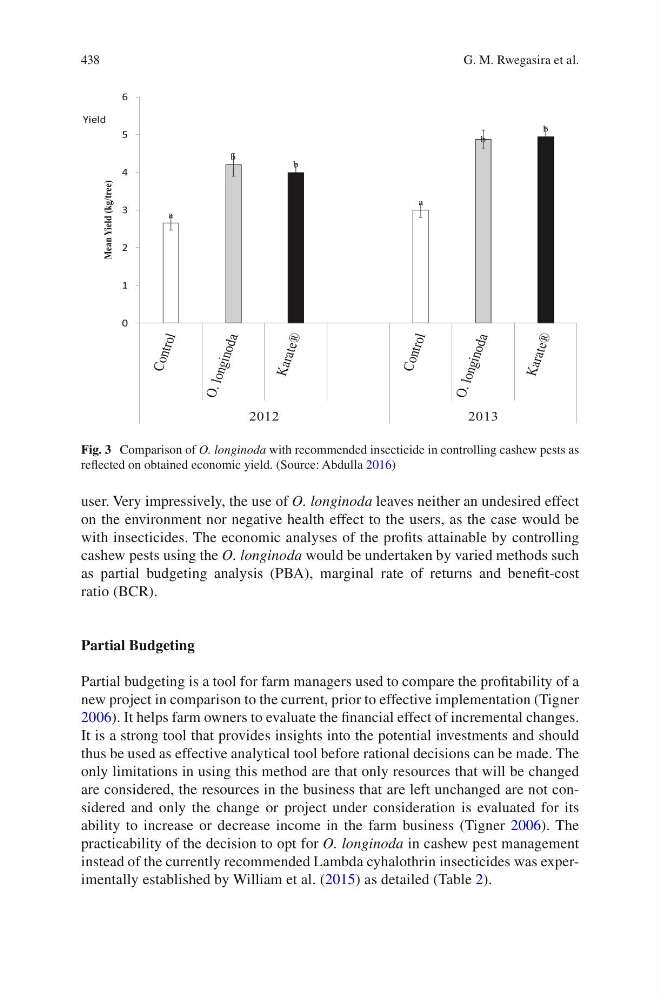
Fig. 3 Comparison of O. longinoda with recommended insecticide in controlling cashew pests as
reflected on obtained economic yield. (Source: Abdulla 2016)
G. M. Rwegasira et al.
user. Very impressively, the use of O. longinoda leaves neither an undesired effect
on the environment nor negative health effect to the users, as the case would be
with insecticides. The economic analyses of the profits attainable by controlling
cashew pests using the O. longinoda would be undertaken by varied methods such
as partial budgeting analysis (PBA), marginal rate of returns and benefit-cost
ratio (BCR).
Partial Budgeting
Partial budgeting is a tool for farm managers used to compare the profitability of a
new project in comparison to the current, prior to effective implementation (Tigner
2006). It helps farm owners to evaluate the financial effect of incremental changes.
It is a strong tool that provides insights into the potential investments and should
thus be used as effective analytical tool before rational decisions can be made. The
only limitations in using this method are that only resources that will be changed
are considered, the resources in the business that are left unchanged are not considered and only the change or project under consideration is evaluated for its
ability to increase or decrease income in the farm business (Tigner 2006). The
practicability of the decision to opt for O. longinoda in cashew pest management
instead of the currently recommended Lambda cyhalothrin insecticides was experimentally established by William et al. (2015) as detailed (Table 2).
a
b
b
a
b
b
2012
2013
Mean Yield (kg/tree)
Fig. 3 Comparison of O. longinoda with recommended insecticide in controlling cashew pests as
reflected on obtained economic yield. (Source: Abdulla 2016)
G. M. Rwegasira et al.