

437
6.1 Efficacy of Tested Insect Pest Control Methods
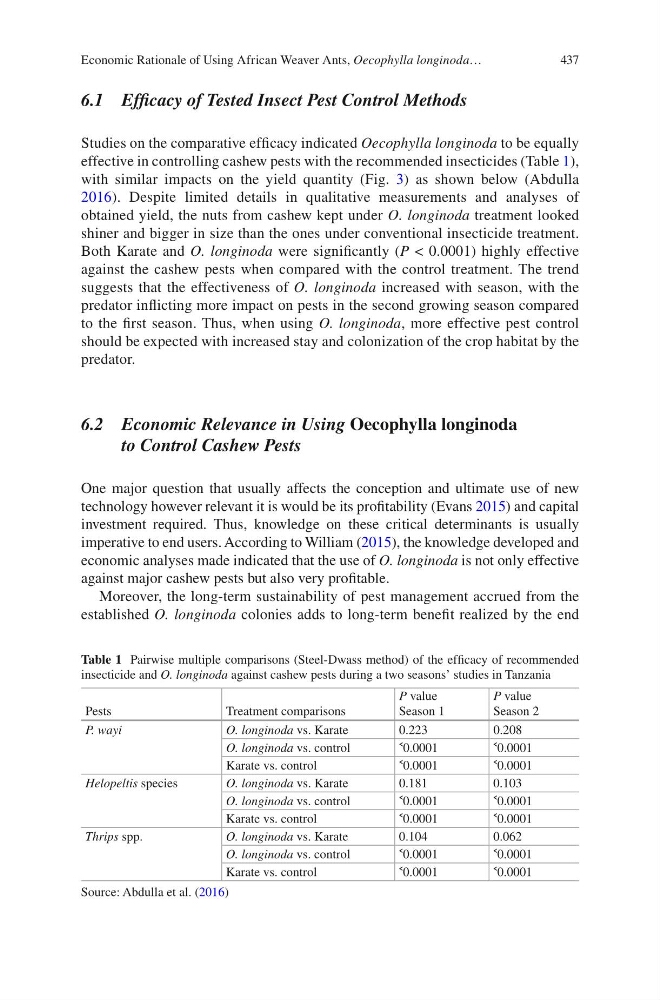
Studies on the comparative efficacy indicated Oecophylla longinoda to be equally
effective in controlling cashew pests with the recommended insecticides (Table 1),
with similar impacts on the yield quantity (Fig. 3) as shown below (Abdulla
2016). Despite limited details in qualitative measurements and analyses of
obtained yield, the nuts from cashew kept under O. longinoda treatment looked
shiner and bigger in size than the ones under conventional insecticide treatment.
Both Karate and O. longinoda were significantly (P < 0.0001) highly effective
against the cashew pests when compared with the control treatment. The trend
suggests that the effectiveness of O. longinoda increased with season, with the
predator inflicting more impact on pests in the second growing season compared
to the first season. Thus, when using O. longinoda, more effective pest control
should be expected with increased stay and colonization of the crop habitat by the
predator.
6.2 Economic Relevance in Using Oecophylla longinoda
to Control Cashew Pests
One major question that usually affects the conception and ultimate use of new
technology however relevant it is would be its profitability (Evans 2015) and capital
investment required. Thus, knowledge on these critical determinants is usually
imperative to end users. According to William (2015), the knowledge developed and
economic analyses made indicated that the use of O. longinoda is not only effective
against major cashew pests but also very profitable.
Moreover, the long-term sustainability of pest management accrued from the
established O. longinoda colonies adds to long-term benefit realized by the end
Table 1 Pairwise multiple comparisons (Steel-Dwass method) of the efficacy of recommended
insecticide and O. longinoda against cashew pests during a two seasons’ studies in Tanzania
Pests
Treatment comparisons
P value
Season 1
P value
Season 2
P. wayi
O. longinoda vs. Karate
0.223
0.208
O. longinoda vs. control
˂0.0001
˂0.0001
Karate vs. control
˂0.0001
˂0.0001
Helopeltis species
O. longinoda vs. Karate
0.181
0.103
O. longinoda vs. control
˂0.0001
˂0.0001
Karate vs. control
˂0.0001
˂0.0001
Thrips spp.
O. longinoda vs. Karate
0.104
0.062
O. longinoda vs. control
˂0.0001
˂0.0001
Karate vs. control
˂0.0001
˂0.0001
Source: Abdulla et al. (2016)
Economic Rationale of Using African Weaver Ants, Oecophylla longinoda…
6.1 Efficacy of Tested Insect Pest Control Methods
Studies on the comparative efficacy indicated Oecophylla longinoda to be equally
effective in controlling cashew pests with the recommended insecticides (Table 1),
with similar impacts on the yield quantity (Fig. 3) as shown below (Abdulla
2016). Despite limited details in qualitative measurements and analyses of
obtained yield, the nuts from cashew kept under O. longinoda treatment looked
shiner and bigger in size than the ones under conventional insecticide treatment.
Both Karate and O. longinoda were significantly (P < 0.0001) highly effective
against the cashew pests when compared with the control treatment. The trend
suggests that the effectiveness of O. longinoda increased with season, with the
predator inflicting more impact on pests in the second growing season compared
to the first season. Thus, when using O. longinoda, more effective pest control
should be expected with increased stay and colonization of the crop habitat by the
predator.
6.2 Economic Relevance in Using Oecophylla longinoda
to Control Cashew Pests
One major question that usually affects the conception and ultimate use of new
technology however relevant it is would be its profitability (Evans 2015) and capital
investment required. Thus, knowledge on these critical determinants is usually
imperative to end users. According to William (2015), the knowledge developed and
economic analyses made indicated that the use of O. longinoda is not only effective
against major cashew pests but also very profitable.
Moreover, the long-term sustainability of pest management accrued from the
established O. longinoda colonies adds to long-term benefit realized by the end
Table 1 Pairwise multiple comparisons (Steel-Dwass method) of the efficacy of recommended
insecticide and O. longinoda against cashew pests during a two seasons’ studies in Tanzania
Pests
Treatment comparisons
P value
Season 1
P value
Season 2
P. wayi
O. longinoda vs. Karate
0.223
0.208
O. longinoda vs. control
˂0.0001
˂0.0001
Karate vs. control
˂0.0001
˂0.0001
Helopeltis species
O. longinoda vs. Karate
0.181
0.103
O. longinoda vs. control
˂0.0001
˂0.0001
Karate vs. control
˂0.0001
˂0.0001
Thrips spp.
O. longinoda vs. Karate
0.104
0.062
O. longinoda vs. control
˂0.0001
˂0.0001
Karate vs. control
˂0.0001
˂0.0001
Source: Abdulla et al. (2016)
Economic Rationale of Using African Weaver Ants, Oecophylla longinoda…