

388
building here is a hindrance for increased access to and use of solar dryers and
thereby limiting transformation of the communities’ livelihood assets and political
and social structures.
The project developed an entrepreneurial model for the communities to use;
however, it was finalised towards the end of the project and was not disseminated to
the communities. The project staff in Nkhotakota also had plans to expose the FPs
in Vinthenga and Chipala to other communities that are also using the solar drying
method, so that they can appreciate the experiences of other FPs; however, these
were also not conducted. Exchange visits are described as one of the most effective
tools for increasing adoption of innovative technologies because of the encouragement that participants gain from the experiences and viewpoints of their peers
(Matras et al. 2013). The closest community from Nkhotakota is in Salima, which
is the neighbouring district.
The project staff were of the view that the communities would not be able to
construct the tent dryer on their own, precisely because they were not trained in
facility construction and economic management. Accordingly, trainings conducted
within the project were only for the contracted artisans who constructed the tent
dryers. The communities were merely informed about the technology and the benefits of solar drying. While the project staff believed that the community was capable of financing the construction of a tent dryer, he identified the lack of collective
financial initiatives amongst fisherfolk as a challenge for construction.
Supply and Demand for Smoked and Dried Fish
Despite the benefits of solar dryers, the participants told the research team that the
profit was marginal because of the inconsistent usage of the dryer and the demand
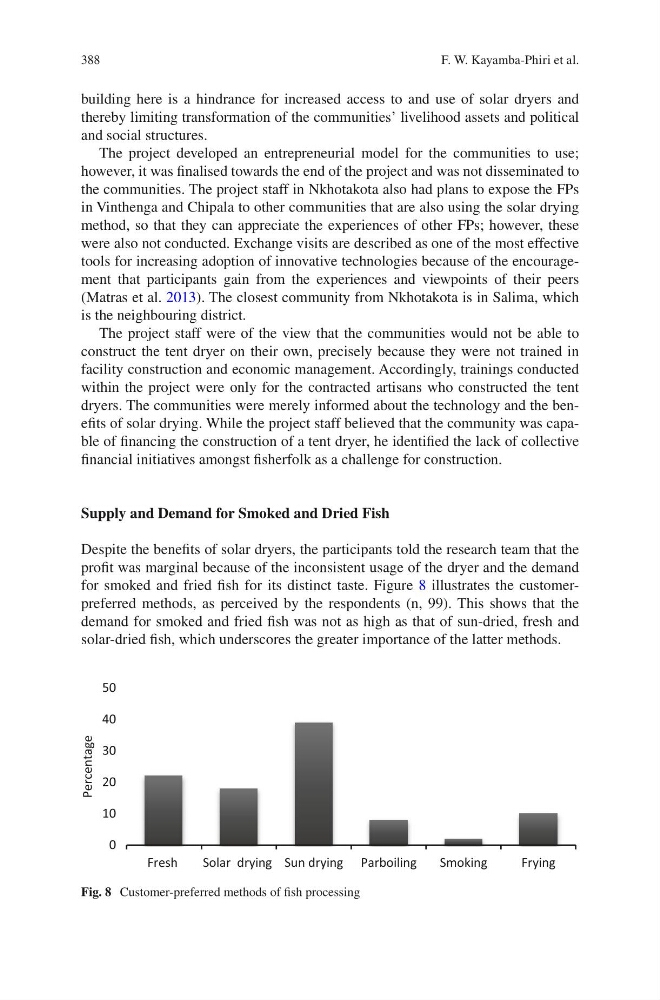
for smoked and fried fish for its distinct taste. Figure 8 illustrates the customerpreferred methods, as perceived by the respondents (n, 99). This shows that the
demand for smoked and fried fish was not as high as that of sun-dried, fresh and
solar-dried fish, which underscores the greater importance of the latter methods.
Fig. 8 Customer-preferred methods of fish processing
F. W. Kayamba-Phiri et al.
building here is a hindrance for increased access to and use of solar dryers and
thereby limiting transformation of the communities’ livelihood assets and political
and social structures.
The project developed an entrepreneurial model for the communities to use;
however, it was finalised towards the end of the project and was not disseminated to
the communities. The project staff in Nkhotakota also had plans to expose the FPs
in Vinthenga and Chipala to other communities that are also using the solar drying
method, so that they can appreciate the experiences of other FPs; however, these
were also not conducted. Exchange visits are described as one of the most effective
tools for increasing adoption of innovative technologies because of the encouragement that participants gain from the experiences and viewpoints of their peers
(Matras et al. 2013). The closest community from Nkhotakota is in Salima, which
is the neighbouring district.
The project staff were of the view that the communities would not be able to
construct the tent dryer on their own, precisely because they were not trained in
facility construction and economic management. Accordingly, trainings conducted
within the project were only for the contracted artisans who constructed the tent
dryers. The communities were merely informed about the technology and the benefits of solar drying. While the project staff believed that the community was capable of financing the construction of a tent dryer, he identified the lack of collective
financial initiatives amongst fisherfolk as a challenge for construction.
Supply and Demand for Smoked and Dried Fish
Despite the benefits of solar dryers, the participants told the research team that the
profit was marginal because of the inconsistent usage of the dryer and the demand
for smoked and fried fish for its distinct taste. Figure 8 illustrates the customerpreferred methods, as perceived by the respondents (n, 99). This shows that the
demand for smoked and fried fish was not as high as that of sun-dried, fresh and
solar-dried fish, which underscores the greater importance of the latter methods.
Fig. 8 Customer-preferred methods of fish processing
F. W. Kayamba-Phiri et al.