

316
similar traits can still be traced within government sectors in their approach to
co-management, where decisions are not entirely bottom-up. For instance, in
Chimaliro Forest Area in the northern region of Malawi, the formation of Village
Natural Resource Management Committees (VNRMCs) was done by the community
during community meetings, but ‘under the auspices of and with the advisory services
provided by the forestry department’ (Kayambazinthu 2000). The study therefore tries
to understand the levels of control that the community had or can have in their own
development process, specifically the introduction of innovative technologies such as
the dryer and smoking kilns.
2 Participation in Fisheries Postharvest Management
Participation is highly advocated by development practitioners as a means of achieving inclusion within communities, which include decision-making related to planning and resource control. There are many conceptual frameworks that have been
employed to understand participation (Chambers 1997; Agarwal 2001). This study
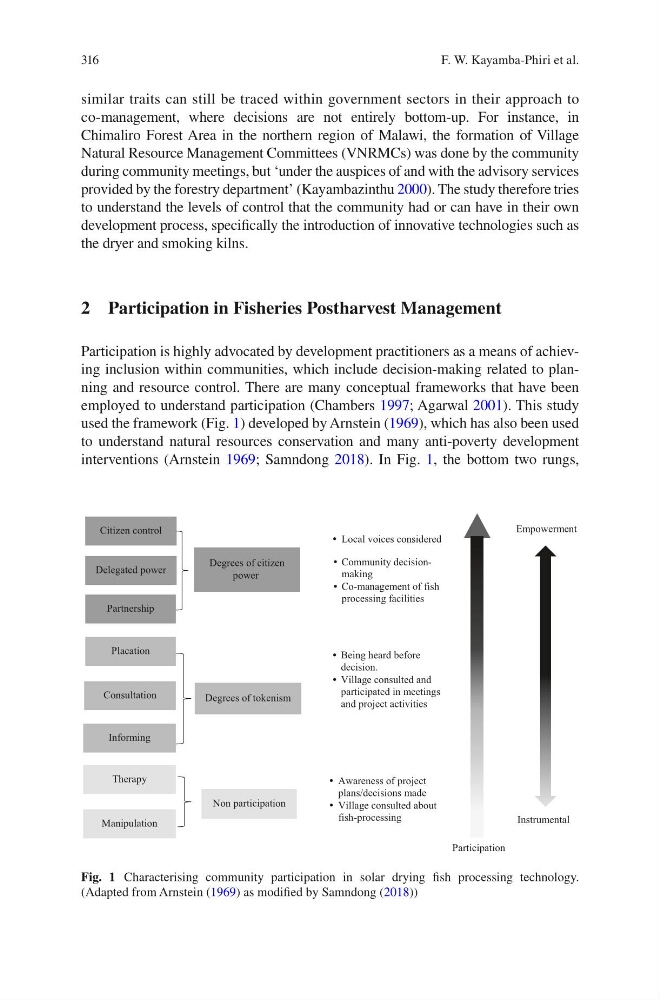
used the framework (Fig. 1) developed by Arnstein (1969), which has also been used
to understand natural resources conservation and many anti-poverty development
interventions (Arnstein 1969; Samndong 2018). In Fig. 1, the bottom two rungs,
Citizen control
Delegated power
Partnership
Placation
Consultation
Informing
Therapy
Manipulation
Degrees of citizen
power
Degrees of tokenism
Non participation
• Local voices considered
• Community decisionmaking
• Co-management of fish
processing facilities
• Being heard before
decision.
• Village consulted and
participated in meetings
and project activities
• Awareness of project
plans/decisions made
• Village consulted about
fish-processing
Participation
Empowerment
Instrumental
Fig. 1 Characterising community participation in solar drying fish processing technology.
(Adapted from Arnstein (1969) as modified by Samndong (2018))
F. W. Kayamba-Phiri et al.
similar traits can still be traced within government sectors in their approach to
co-management, where decisions are not entirely bottom-up. For instance, in
Chimaliro Forest Area in the northern region of Malawi, the formation of Village
Natural Resource Management Committees (VNRMCs) was done by the community
during community meetings, but ‘under the auspices of and with the advisory services
provided by the forestry department’ (Kayambazinthu 2000). The study therefore tries
to understand the levels of control that the community had or can have in their own
development process, specifically the introduction of innovative technologies such as
the dryer and smoking kilns.
2 Participation in Fisheries Postharvest Management
Participation is highly advocated by development practitioners as a means of achieving inclusion within communities, which include decision-making related to planning and resource control. There are many conceptual frameworks that have been
employed to understand participation (Chambers 1997; Agarwal 2001). This study
used the framework (Fig. 1) developed by Arnstein (1969), which has also been used
to understand natural resources conservation and many anti-poverty development
interventions (Arnstein 1969; Samndong 2018). In Fig. 1, the bottom two rungs,
Citizen control
Delegated power
Partnership
Placation
Consultation
Informing
Therapy
Manipulation
Degrees of citizen
power
Degrees of tokenism
Non participation
• Local voices considered
• Community decisionmaking
• Co-management of fish
processing facilities
• Being heard before
decision.
• Village consulted and
participated in meetings
and project activities
• Awareness of project
plans/decisions made
• Village consulted about
fish-processing
Participation
Empowerment
Instrumental
Fig. 1 Characterising community participation in solar drying fish processing technology.
(Adapted from Arnstein (1969) as modified by Samndong (2018))
F. W. Kayamba-Phiri et al.