

235
The difference between first calving and older cows was significant when assessed
by the log-rank test for equality of survivor functions (P = 0.003) but borderline
non-significant according to the Wald chi-square statistic (P = 0.051).
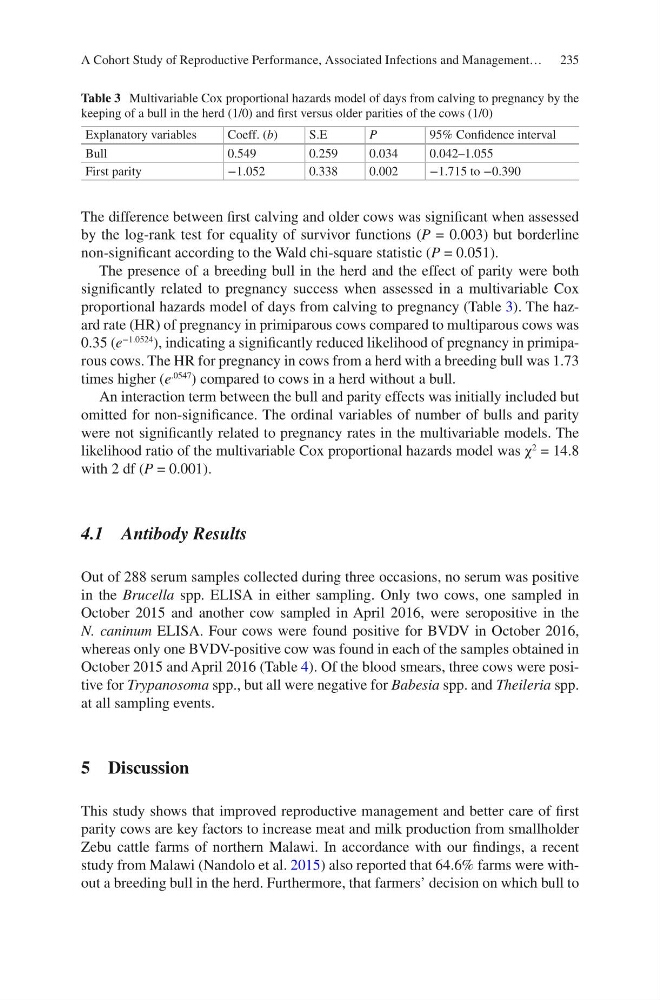
The presence of a breeding bull in the herd and the effect of parity were both
significantly related to pregnancy success when assessed in a multivariable Cox
proportional hazards model of days from calving to pregnancy (Table 3). The hazard rate (HR) of pregnancy in primiparous cows compared to multiparous cows was
0.35 (e
−1.0524
), indicating a significantly reduced likelihood of pregnancy in primiparous cows. The HR for pregnancy in cows from a herd with a breeding bull was 1.73
times higher (e
.0547
) compared to cows in a herd without a bull.
An interaction term between the bull and parity effects was initially included but
omitted for non-significance. The ordinal variables of number of bulls and parity
were not significantly related to pregnancy rates in the multivariable models. The
likelihood ratio of the multivariable Cox proportional hazards model was χ
2
= 14.8
with 2 df (P = 0.001).
4.1 Antibody Results
Out of 288 serum samples collected during three occasions, no serum was positive
in the Brucella spp. ELISA in either sampling. Only two cows, one sampled in
October 2015 and another cow sampled in April 2016, were seropositive in the
N. caninum ELISA. Four cows were found positive for BVDV in October 2016,
whereas only one BVDV-positive cow was found in each of the samples obtained in
October 2015 and April 2016 (Table 4). Of the blood smears, three cows were positive for Trypanosoma spp., but all were negative for Babesia spp. and Theileria spp.
at all sampling events.
5 Discussion
This study shows that improved reproductive management and better care of first
parity cows are key factors to increase meat and milk production from smallholder
Zebu cattle farms of northern Malawi. In accordance with our findings, a recent
study from Malawi (Nandolo et al. 2015) also reported that 64.6% farms were without a breeding bull in the herd. Furthermore, that farmers’ decision on which bull to
Table 3 Multivariable Cox proportional hazards model of days from calving to pregnancy by the
keeping of a bull in the herd (1/0) and first versus older parities of the cows (1/0)
Explanatory variables
Coeff. (b)
S.E
P
95% Confidence interval
Bull
0.549
0.259
0.034
0.042–1.055
First parity
−1.052
0.338
0.002
−1.715 to −0.390
A Cohort Study of Reproductive Performance, Associated Infections and Management…
The difference between first calving and older cows was significant when assessed
by the log-rank test for equality of survivor functions (P = 0.003) but borderline
non-significant according to the Wald chi-square statistic (P = 0.051).
The presence of a breeding bull in the herd and the effect of parity were both
significantly related to pregnancy success when assessed in a multivariable Cox
proportional hazards model of days from calving to pregnancy (Table 3). The hazard rate (HR) of pregnancy in primiparous cows compared to multiparous cows was
0.35 (e
−1.0524
), indicating a significantly reduced likelihood of pregnancy in primiparous cows. The HR for pregnancy in cows from a herd with a breeding bull was 1.73
times higher (e
.0547
) compared to cows in a herd without a bull.
An interaction term between the bull and parity effects was initially included but
omitted for non-significance. The ordinal variables of number of bulls and parity
were not significantly related to pregnancy rates in the multivariable models. The
likelihood ratio of the multivariable Cox proportional hazards model was χ
2
= 14.8
with 2 df (P = 0.001).
4.1 Antibody Results
Out of 288 serum samples collected during three occasions, no serum was positive
in the Brucella spp. ELISA in either sampling. Only two cows, one sampled in
October 2015 and another cow sampled in April 2016, were seropositive in the
N. caninum ELISA. Four cows were found positive for BVDV in October 2016,
whereas only one BVDV-positive cow was found in each of the samples obtained in
October 2015 and April 2016 (Table 4). Of the blood smears, three cows were positive for Trypanosoma spp., but all were negative for Babesia spp. and Theileria spp.
at all sampling events.
5 Discussion
This study shows that improved reproductive management and better care of first
parity cows are key factors to increase meat and milk production from smallholder
Zebu cattle farms of northern Malawi. In accordance with our findings, a recent
study from Malawi (Nandolo et al. 2015) also reported that 64.6% farms were without a breeding bull in the herd. Furthermore, that farmers’ decision on which bull to
Table 3 Multivariable Cox proportional hazards model of days from calving to pregnancy by the
keeping of a bull in the herd (1/0) and first versus older parities of the cows (1/0)
Explanatory variables
Coeff. (b)
S.E
P
95% Confidence interval
Bull
0.549
0.259
0.034
0.042–1.055
First parity
−1.052
0.338
0.002
−1.715 to −0.390
A Cohort Study of Reproductive Performance, Associated Infections and Management…