

236
keep will affect the breeding in that region because cattle are mixed freely during
the grazing period. In addition, a relatively high inbreeding rate was also estimated,
and in conclusion, the authors suggested to establish community breeding programs
(Nandolo et al. 2015). In accordance with the present study, parity has been reported
to affect reproductive performance in Tanzanian Zebu cows (Matiko et al. 2008).
This study also reported that the number of days open was significantly less in older
cows as compared to the younger cows. Herd composition (keeping older cows) is
a management strategy that may help in getting more calves and higher milk yield
on a yearly basis. Also, avoiding premature mating of heifers may be a valuable
strategy for increasing reproductive efficiency in first parity Zebu heifers (Madani
et al. 2008).
The observed median days from calving to the onset of luteal function and mean
calving interval were shorter than corresponding figures for Tanzanian Zebu cows
(Kanuya et al. 2006a), indicating better reproductive performance in this cohort of
Malawi Zebu cows.
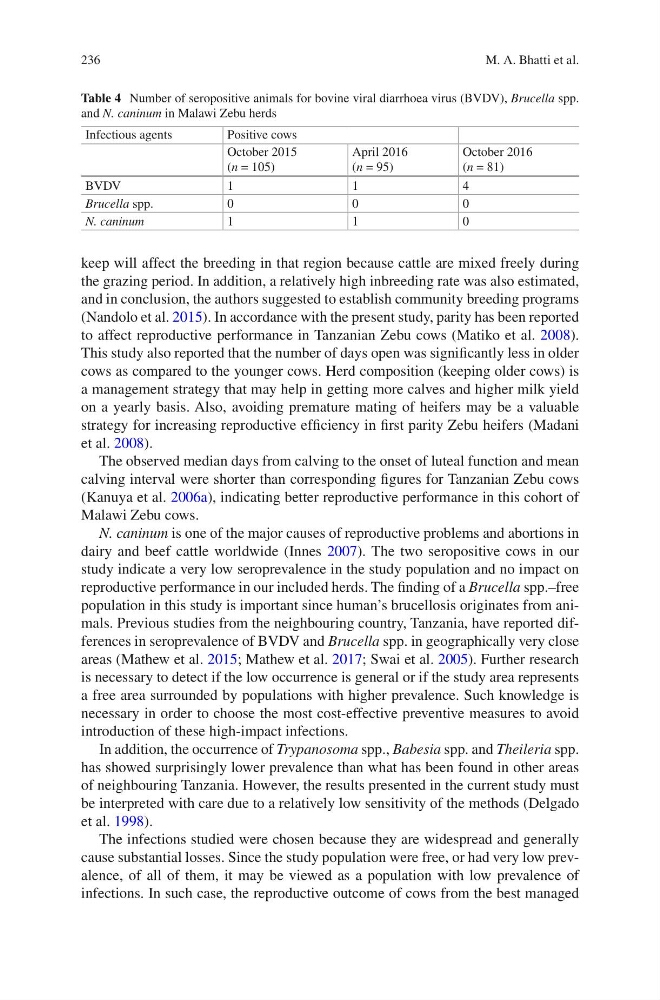
N. caninum is one of the major causes of reproductive problems and abortions in
dairy and beef cattle worldwide (Innes 2007). The two seropositive cows in our
study indicate a very low seroprevalence in the study population and no impact on
reproductive performance in our included herds. The finding of a Brucella spp.–free
population in this study is important since human’s brucellosis originates from animals. Previous studies from the neighbouring country, Tanzania, have reported differences in seroprevalence of BVDV and Brucella spp. in geographically very close
areas (Mathew et al. 2015; Mathew et al. 2017; Swai et al. 2005). Further research
is necessary to detect if the low occurrence is general or if the study area represents
a free area surrounded by populations with higher prevalence. Such knowledge is
necessary in order to choose the most cost-effective preventive measures to avoid
introduction of these high-impact infections.
In addition, the occurrence of Trypanosoma spp., Babesia spp. and Theileria spp.
has showed surprisingly lower prevalence than what has been found in other areas
of neighbouring Tanzania. However, the results presented in the current study must
be interpreted with care due to a relatively low sensitivity of the methods (Delgado
et al. 1998).
The infections studied were chosen because they are widespread and generally
cause substantial losses. Since the study population were free, or had very low prevalence, of all of them, it may be viewed as a population with low prevalence of
infections. In such case, the reproductive outcome of cows from the best managed
Table 4 Number of seropositive animals for bovine viral diarrhoea virus (BVDV), Brucella spp.
and N. caninum in Malawi Zebu herds
Infectious agents
Positive cows
October 2015
(n = 105)
April 2016
(n = 95)
October 2016
(n = 81)
BVDV
1
1
4
Brucella spp.
0
0
0
N. caninum
1
1
0
M. A. Bhatti et al.
keep will affect the breeding in that region because cattle are mixed freely during
the grazing period. In addition, a relatively high inbreeding rate was also estimated,
and in conclusion, the authors suggested to establish community breeding programs
(Nandolo et al. 2015). In accordance with the present study, parity has been reported
to affect reproductive performance in Tanzanian Zebu cows (Matiko et al. 2008).
This study also reported that the number of days open was significantly less in older
cows as compared to the younger cows. Herd composition (keeping older cows) is
a management strategy that may help in getting more calves and higher milk yield
on a yearly basis. Also, avoiding premature mating of heifers may be a valuable
strategy for increasing reproductive efficiency in first parity Zebu heifers (Madani
et al. 2008).
The observed median days from calving to the onset of luteal function and mean
calving interval were shorter than corresponding figures for Tanzanian Zebu cows
(Kanuya et al. 2006a), indicating better reproductive performance in this cohort of
Malawi Zebu cows.
N. caninum is one of the major causes of reproductive problems and abortions in
dairy and beef cattle worldwide (Innes 2007). The two seropositive cows in our
study indicate a very low seroprevalence in the study population and no impact on
reproductive performance in our included herds. The finding of a Brucella spp.–free
population in this study is important since human’s brucellosis originates from animals. Previous studies from the neighbouring country, Tanzania, have reported differences in seroprevalence of BVDV and Brucella spp. in geographically very close
areas (Mathew et al. 2015; Mathew et al. 2017; Swai et al. 2005). Further research
is necessary to detect if the low occurrence is general or if the study area represents
a free area surrounded by populations with higher prevalence. Such knowledge is
necessary in order to choose the most cost-effective preventive measures to avoid
introduction of these high-impact infections.
In addition, the occurrence of Trypanosoma spp., Babesia spp. and Theileria spp.
has showed surprisingly lower prevalence than what has been found in other areas
of neighbouring Tanzania. However, the results presented in the current study must
be interpreted with care due to a relatively low sensitivity of the methods (Delgado
et al. 1998).
The infections studied were chosen because they are widespread and generally
cause substantial losses. Since the study population were free, or had very low prevalence, of all of them, it may be viewed as a population with low prevalence of
infections. In such case, the reproductive outcome of cows from the best managed
Table 4 Number of seropositive animals for bovine viral diarrhoea virus (BVDV), Brucella spp.
and N. caninum in Malawi Zebu herds
Infectious agents
Positive cows
October 2015
(n = 105)
April 2016
(n = 95)
October 2016
(n = 81)
BVDV
1
1
4
Brucella spp.
0
0
0
N. caninum
1
1
0
M. A. Bhatti et al.