

191
nor pest management practices had a significant effect on cotton yield. The yields
observed in this study were considerably lower than the potential yield of the test
variety (UK MO8) of 2.5 Mg ha
−1
(Lukonge et al. 2007) for both seasons. For
season 1, the yield was 52% to 43% below the potential yield in the organic system
and 51% to 40% below the potential yield in the conventional system. For season 2,
the yield was 84% to 80% and 85% to 79% below the potential yield in the organic
and conventional system, respectively.
a
a
a
ab
b
c
ab
d
0
250
500
750
CF−0
CF−30
CF−60
CF−30+M
OF−0
OF−3
OF−5
OF−3+L
Fertility treatments, season 1
Land rent (US$/ha)
bcd
ab
a
abc
de
cd
abcd
e
0
250
500
750
CF−0
CF−30
CF−60
CF−30+M
OF−0
OF−3
OF−5
OF−3+L
Fertility treatments, season 2
Land rent (US$/ha)
a
ab
bc
bc
d
d
cd
d
0
250
500
750
CP−0
CP−3
CP−6
CP−3−N+CU
OP−0
OP−P
OP−N
OP−N+CU
Pesticide treatments, season 1
Land rent (US$/ha)
ab
a
a
a
c
c
abc
bc
0
250
500
750
CP−0
CP−3
CP−6
CP−3−N+CU
OP−0
OP−P
OP−N
OP−N+CU
Pesticide treatments, season 2
Land rent (US$/ha)
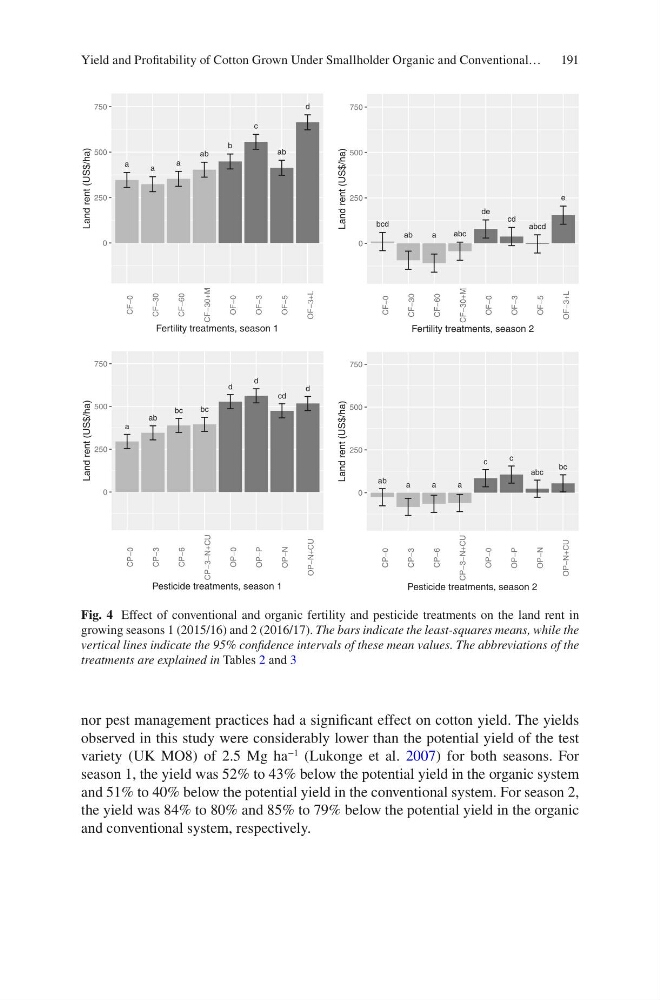
Fig. 4 Effect of conventional and organic fertility and pesticide treatments on the land rent in
growing seasons 1 (2015/16) and 2 (2016/17). The bars indicate the least-squares means, while the
vertical lines indicate the 95% confidence intervals of these mean values. The abbreviations of the
treatments are explained in Tables 2 and 3
Yield and Profitability of Cotton Grown Under Smallholder Organic and Conventional…
nor pest management practices had a significant effect on cotton yield. The yields
observed in this study were considerably lower than the potential yield of the test
variety (UK MO8) of 2.5 Mg ha
−1
(Lukonge et al. 2007) for both seasons. For
season 1, the yield was 52% to 43% below the potential yield in the organic system
and 51% to 40% below the potential yield in the conventional system. For season 2,
the yield was 84% to 80% and 85% to 79% below the potential yield in the organic
and conventional system, respectively.
a
a
a
ab
b
c
ab
d
0
250
500
750
CF−0
CF−30
CF−60
CF−30+M
OF−0
OF−3
OF−5
OF−3+L
Fertility treatments, season 1
Land rent (US$/ha)
bcd
ab
a
abc
de
cd
abcd
e
0
250
500
750
CF−0
CF−30
CF−60
CF−30+M
OF−0
OF−3
OF−5
OF−3+L
Fertility treatments, season 2
Land rent (US$/ha)
a
ab
bc
bc
d
d
cd
d
0
250
500
750
CP−0
CP−3
CP−6
CP−3−N+CU
OP−0
OP−P
OP−N
OP−N+CU
Pesticide treatments, season 1
Land rent (US$/ha)
ab
a
a
a
c
c
abc
bc
0
250
500
750
CP−0
CP−3
CP−6
CP−3−N+CU
OP−0
OP−P
OP−N
OP−N+CU
Pesticide treatments, season 2
Land rent (US$/ha)
Fig. 4 Effect of conventional and organic fertility and pesticide treatments on the land rent in
growing seasons 1 (2015/16) and 2 (2016/17). The bars indicate the least-squares means, while the
vertical lines indicate the 95% confidence intervals of these mean values. The abbreviations of the
treatments are explained in Tables 2 and 3
Yield and Profitability of Cotton Grown Under Smallholder Organic and Conventional…