

237
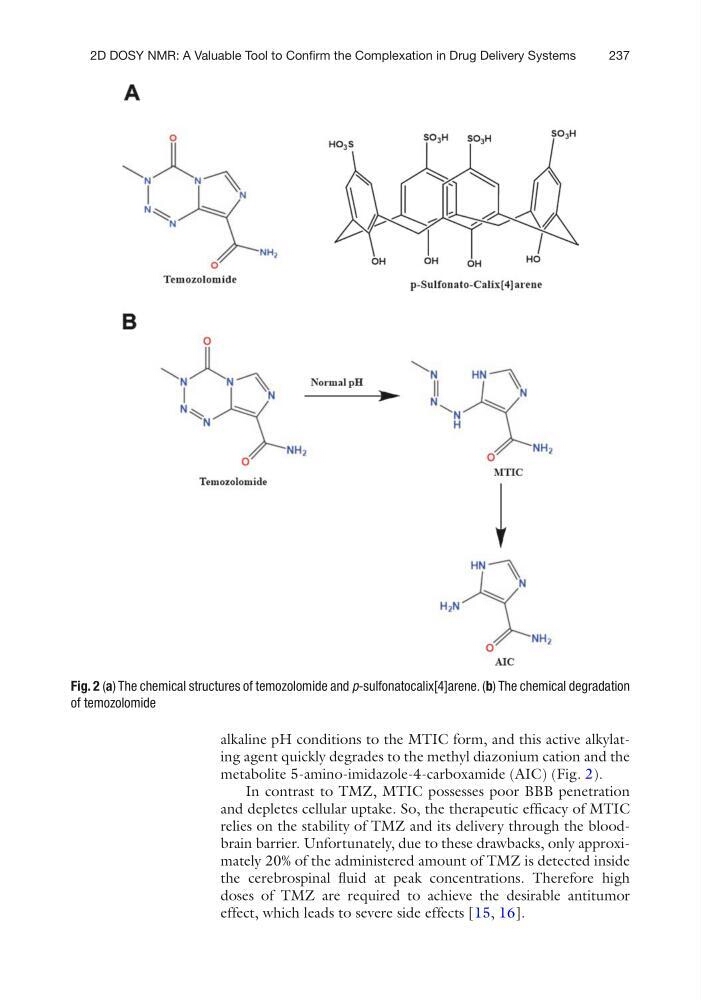
alkaline pH conditions to the MTIC form, and this active alkylating agent quickly degrades to the methyl diazonium cation and the
metabolite 5-amino-imidazole-4-carboxamide (AIC) (Fig. 2).
In contrast to TMZ, MTIC possesses poor BBB penetration
and depletes cellular uptake. So, the therapeutic efficacy of MTIC
relies on the stability of TMZ and its delivery through the bloodbrain barrier. Unfortunately, due to these drawbacks, only approximately 20% of the administered amount of TMZ is detected inside
the cerebrospinal fluid at peak concentrations. Therefore high
doses of TMZ are required to achieve the desirable antitumor
effect, which leads to severe side effects [15, 16].
Fig. 2 (a) The chemical structures of temozolomide and p-sulfonatocalix[4]arene. (b) The chemical degradation
of temozolomide
2D DOSY NMR: A Valuable Tool to Confirm the Complexation in Drug Delivery Systems
alkaline pH conditions to the MTIC form, and this active alkylating agent quickly degrades to the methyl diazonium cation and the
metabolite 5-amino-imidazole-4-carboxamide (AIC) (Fig. 2).
In contrast to TMZ, MTIC possesses poor BBB penetration
and depletes cellular uptake. So, the therapeutic efficacy of MTIC
relies on the stability of TMZ and its delivery through the bloodbrain barrier. Unfortunately, due to these drawbacks, only approximately 20% of the administered amount of TMZ is detected inside
the cerebrospinal fluid at peak concentrations. Therefore high
doses of TMZ are required to achieve the desirable antitumor
effect, which leads to severe side effects [15, 16].
Fig. 2 (a) The chemical structures of temozolomide and p-sulfonatocalix[4]arene. (b) The chemical degradation
of temozolomide
2D DOSY NMR: A Valuable Tool to Confirm the Complexation in Drug Delivery Systems