

236
aqueous solubility and hence to advance the oral bioavailability
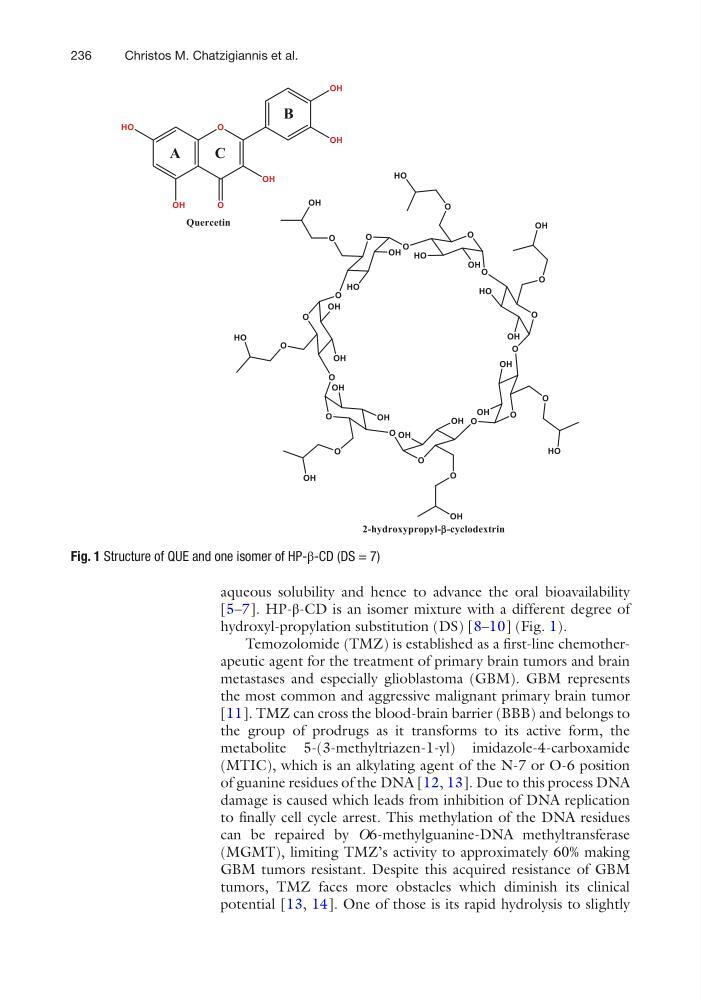
[5–7]. HP-β-CD is an isomer mixture with a different degree of
hydroxyl-propylation substitution (DS) [8–10] (Fig. 1).
Temozolomide (TMZ) is established as a first-line chemotherapeutic agent for the treatment of primary brain tumors and brain
metastases and especially glioblastoma (GBM). GBM represents
the most common and aggressive malignant primary brain tumor
[11]. TMZ can cross the blood-brain barrier (BBB) and belongs to
the group of prodrugs as it transforms to its active form, the
metabolite 5-(3-methyltriazen-1-yl) imidazole-4-carboxamide
(MTIC), which is an alkylating agent of the N-7 or O-6 position
of guanine residues of the DNA [12, 13]. Due to this process DNA
damage is caused which leads from inhibition of DNA replication
to finally cell cycle arrest. This methylation of the DNA residues
can be repaired by O6-methylguanine-DNA methyltransferase
(MGMT), limiting TMZ’s activity to approximately 60% making
GBM tumors resistant. Despite this acquired resistance of GBM
tumors, TMZ faces more obstacles which diminish its clinical
potential [13, 14]. One of those is its rapid hydrolysis to slightly
a
Fig. 1 Structure of QUE and one isomer of HP-β-CD (DS = 7)
Christos M. Chatzigiannis et al.
aqueous solubility and hence to advance the oral bioavailability
[5–7]. HP-β-CD is an isomer mixture with a different degree of
hydroxyl-propylation substitution (DS) [8–10] (Fig. 1).
Temozolomide (TMZ) is established as a first-line chemotherapeutic agent for the treatment of primary brain tumors and brain
metastases and especially glioblastoma (GBM). GBM represents
the most common and aggressive malignant primary brain tumor
[11]. TMZ can cross the blood-brain barrier (BBB) and belongs to
the group of prodrugs as it transforms to its active form, the
metabolite 5-(3-methyltriazen-1-yl) imidazole-4-carboxamide
(MTIC), which is an alkylating agent of the N-7 or O-6 position
of guanine residues of the DNA [12, 13]. Due to this process DNA
damage is caused which leads from inhibition of DNA replication
to finally cell cycle arrest. This methylation of the DNA residues
can be repaired by O6-methylguanine-DNA methyltransferase
(MGMT), limiting TMZ’s activity to approximately 60% making
GBM tumors resistant. Despite this acquired resistance of GBM
tumors, TMZ faces more obstacles which diminish its clinical
potential [13, 14]. One of those is its rapid hydrolysis to slightly
a
Fig. 1 Structure of QUE and one isomer of HP-β-CD (DS = 7)
Christos M. Chatzigiannis et al.