

238
Calixarenes belong to the family of supramolecular macrocycles and are cyclic oligomers obtained by condensation of suitable
p-functionalized phenols with formaldehyde, usually allowing for
the synthesis of the well-known small calixarenes (including up to
eight phenolic subunits). They have been mostly used in drug
encapsulations to improve the therapeutic efficacy of a drug, to
reduce the cytotoxicity in healthy tissues, to improve the pharmacokinetic profile of a drug, and to improve the bioavailability by
enhancing the aqueous solubility and slowing down the degradation rate of a therapeutic agent [16]. The main reason that these
supramolecular carriers have earned attention in medicinal chemistry is the chemical space they offer by introducing to their core
easily functional groups. The most popular types of calixarenes
consist of four, six, or eight subunits (Fig. 2) [17].
2D DOSY experiment is an accurate, noninvasive, molecular
diffusion measurement experiment useful for biofluids, complex
chemical mixtures, and multicomponent solutions. In the 2D
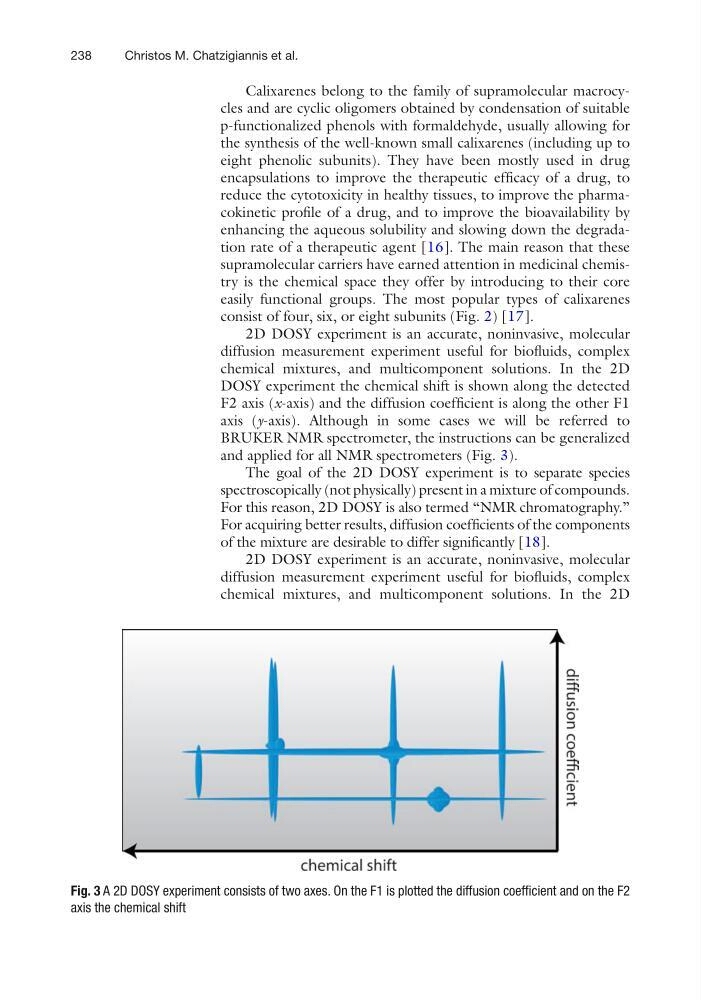
DOSY experiment the chemical shift is shown along the detected
F2 axis (x-axis) and the diffusion coefficient is along the other F1
axis (y-axis). Although in some cases we will be referred to
BRUKER NMR spectrometer, the instructions can be generalized
and applied for all NMR spectrometers (Fig. 3).
The goal of the 2D DOSY experiment is to separate species
spectroscopically (not physically) present in a mixture of compounds.
For this reason, 2D DOSY is also termed “NMR chromatography.”
For acquiring better results, diffusion coefficients of the components
of the mixture are desirable to differ significantly [18].
2D DOSY experiment is an accurate, noninvasive, molecular
diffusion measurement experiment useful for biofluids, complex
chemical mixtures, and multicomponent solutions. In the 2D
Fig. 3 A 2D DOSY experiment consists of two axes. On the F1 is plotted the diffusion coefficient and on the F2
axis the chemical shift
Christos M. Chatzigiannis et al.
Calixarenes belong to the family of supramolecular macrocycles and are cyclic oligomers obtained by condensation of suitable
p-functionalized phenols with formaldehyde, usually allowing for
the synthesis of the well-known small calixarenes (including up to
eight phenolic subunits). They have been mostly used in drug
encapsulations to improve the therapeutic efficacy of a drug, to
reduce the cytotoxicity in healthy tissues, to improve the pharmacokinetic profile of a drug, and to improve the bioavailability by
enhancing the aqueous solubility and slowing down the degradation rate of a therapeutic agent [16]. The main reason that these
supramolecular carriers have earned attention in medicinal chemistry is the chemical space they offer by introducing to their core
easily functional groups. The most popular types of calixarenes
consist of four, six, or eight subunits (Fig. 2) [17].
2D DOSY experiment is an accurate, noninvasive, molecular
diffusion measurement experiment useful for biofluids, complex
chemical mixtures, and multicomponent solutions. In the 2D
DOSY experiment the chemical shift is shown along the detected
F2 axis (x-axis) and the diffusion coefficient is along the other F1
axis (y-axis). Although in some cases we will be referred to
BRUKER NMR spectrometer, the instructions can be generalized
and applied for all NMR spectrometers (Fig. 3).
The goal of the 2D DOSY experiment is to separate species
spectroscopically (not physically) present in a mixture of compounds.
For this reason, 2D DOSY is also termed “NMR chromatography.”
For acquiring better results, diffusion coefficients of the components
of the mixture are desirable to differ significantly [18].
2D DOSY experiment is an accurate, noninvasive, molecular
diffusion measurement experiment useful for biofluids, complex
chemical mixtures, and multicomponent solutions. In the 2D
Fig. 3 A 2D DOSY experiment consists of two axes. On the F1 is plotted the diffusion coefficient and on the F2
axis the chemical shift
Christos M. Chatzigiannis et al.