

204
opment pipeline because their pharmacological and therapeutic
effects are impeded by limited cellular bioavailability, low aqueous
solubility, lack of targeting, and rapid blood clearance. However,
several strategies have been proposed to overcome these challenges
[49]. Polymeric nanoparticle technology has been extensively used
for many applications, especially in pharmaceutical formulation
[50]. This method allows small bioactive molecules to be enclosed
within an inert biocompatible core; as a result, they can enhance
pharmacokinetics, cellular bioavailability, and controlled drug
release, and have the capability to modify their surface enabling
them to reach the target location [51]. However, particle size, particle shape, size distribution, and polydispersity index (PDI) still
play an important role in determining their cellular uptake and
therapeutic effects [52]. Several polymeric nanosized drug delivery
system preparation techniques are currently available, which basically depend on the physiochemical properties of the drug and
polymer material used [53].
Nanostructure drug carriers such as polymeric nanospheres and
polymeric nanoparticles hold great promise, especially for poor
and low water-insoluble anticancer drugs. They play an important
role in many pharmaceutical applications due to their capability for
further surface modification accessibility, ability to reduce adverse
side effects, and ability to enhance pharmacokinetics [54]. Various
natural polymers have been extensively investigated and approved
for advanced drug delivery system due to their unique properties,
such as abundance, biocompatibility, and biodegradability [52].
Rosin is a natural nonvolatile resin extracted from different species
of pine tree (Fig. 2). However, natural rosin usually contains a mixture of rosin acid (90% rosin acids) compounds, such as tricyclic
diterpene carboxylic acids (abietic/pimaric), which possess two
chemical reactive centers, double bonds, and a carboxyl group, and
other nonacidic components with characteristic hydrophobic
hydrophenanthrene rings which make them excellent for film
forming [55].
1.6 Rosin Ester
Nanoparticles in Drug
Formulation
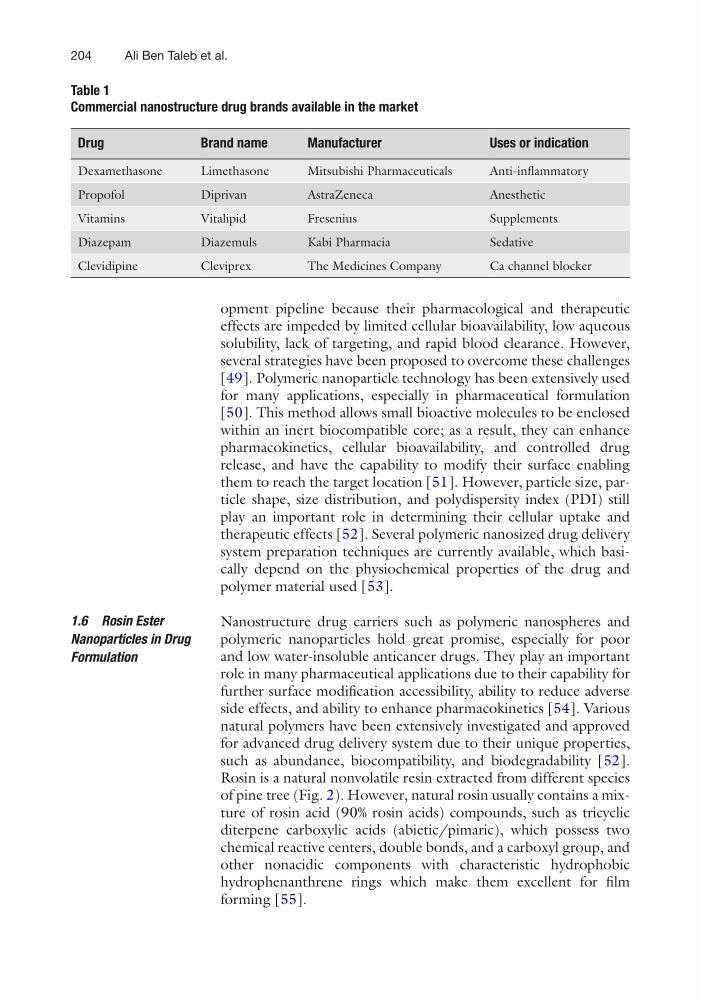
Table 1
Commercial nanostructure drug brands available in the market
Drug
Brand name
Manufacturer
Uses or indication
Dexamethasone
Limethasone
Mitsubishi Pharmaceuticals
Anti-inflammatory
Propofol
Diprivan
AstraZeneca
Anesthetic
Vitamins
Vitalipid
Fresenius
Supplements
Diazepam
Diazemuls
Kabi Pharmacia
Sedative
Clevidipine
Cleviprex
The Medicines Company
Ca channel blocker
Ali Ben Taleb et al.
opment pipeline because their pharmacological and therapeutic
effects are impeded by limited cellular bioavailability, low aqueous
solubility, lack of targeting, and rapid blood clearance. However,
several strategies have been proposed to overcome these challenges
[49]. Polymeric nanoparticle technology has been extensively used
for many applications, especially in pharmaceutical formulation
[50]. This method allows small bioactive molecules to be enclosed
within an inert biocompatible core; as a result, they can enhance
pharmacokinetics, cellular bioavailability, and controlled drug
release, and have the capability to modify their surface enabling
them to reach the target location [51]. However, particle size, particle shape, size distribution, and polydispersity index (PDI) still
play an important role in determining their cellular uptake and
therapeutic effects [52]. Several polymeric nanosized drug delivery
system preparation techniques are currently available, which basically depend on the physiochemical properties of the drug and
polymer material used [53].
Nanostructure drug carriers such as polymeric nanospheres and
polymeric nanoparticles hold great promise, especially for poor
and low water-insoluble anticancer drugs. They play an important
role in many pharmaceutical applications due to their capability for
further surface modification accessibility, ability to reduce adverse
side effects, and ability to enhance pharmacokinetics [54]. Various
natural polymers have been extensively investigated and approved
for advanced drug delivery system due to their unique properties,
such as abundance, biocompatibility, and biodegradability [52].
Rosin is a natural nonvolatile resin extracted from different species
of pine tree (Fig. 2). However, natural rosin usually contains a mixture of rosin acid (90% rosin acids) compounds, such as tricyclic
diterpene carboxylic acids (abietic/pimaric), which possess two
chemical reactive centers, double bonds, and a carboxyl group, and
other nonacidic components with characteristic hydrophobic
hydrophenanthrene rings which make them excellent for film
forming [55].
1.6 Rosin Ester
Nanoparticles in Drug
Formulation
Table 1
Commercial nanostructure drug brands available in the market
Drug
Brand name
Manufacturer
Uses or indication
Dexamethasone
Limethasone
Mitsubishi Pharmaceuticals
Anti-inflammatory
Propofol
Diprivan
AstraZeneca
Anesthetic
Vitamins
Vitalipid
Fresenius
Supplements
Diazepam
Diazemuls
Kabi Pharmacia
Sedative
Clevidipine
Cleviprex
The Medicines Company
Ca channel blocker
Ali Ben Taleb et al.