

195
ware. Based on these and the occurred enthalpy change during the experimental procedure, the calorimeter estimates the
K a value and the stoichiometry. Erroneous sample concentrations lead to invalid results and bad fitting.
4. The removal of air bubbles from the samples is crucial in the
calorimeter application as their presence can affect the measurement of the heat (absorbed or released) leading to poor
experimental outcome and also can cause difficulties in the
manual loading of the samples into the cell. Depending on the
instrumentation, the lower the volume of the sample cell, the
greater the noise effect that can be caused by air bubbles.
5. Typically, the cells are rinsed thoroughly with water. A more
drastic cleaning is achieved with detergents like Contrad 70
and Decon 90 or with 12% w/v NaOH.
6. The reference cell is usually loaded with water or buffer when
the tested samples are dissolved in a specific buffer. In most
cases water is sufficient as a control. According to most manufacturers the reference cell content has to be renewed once a
week, to avoid microbial growth. Before each run, the user has
to confirm that the reference cell is properly loaded (no air
bubbles, no low water level) as in the opposite situation the
DP can be significantly affected (lower or higher), producing
unstable baseline and consequently poor results.
7. After the sample loading into the cell, the calorimeter thermostats the cell to succeed the defined temperature. Thus, it is
recommended not to start immediately the run but wait until
it gets stabilized.
8. The syringe insertion into the sample solution may destabilize
its temperature. Thus, it is recommended to wait a few minutes (5 min are enough) before starting the experiment.
9. A control experiment, using the same ligand concentration, is
required for the estimation of the heat amount that is not
originated from the small molecule–cyclodextrin interaction.
For example, this heat may occur due to the cyclodextrin dilution into the sample cell. A titration of the supramolecule into
the water-loaded sample cell will provide the measurement of
this “noise” and the heat amount can be subtracted from the
main experiment.
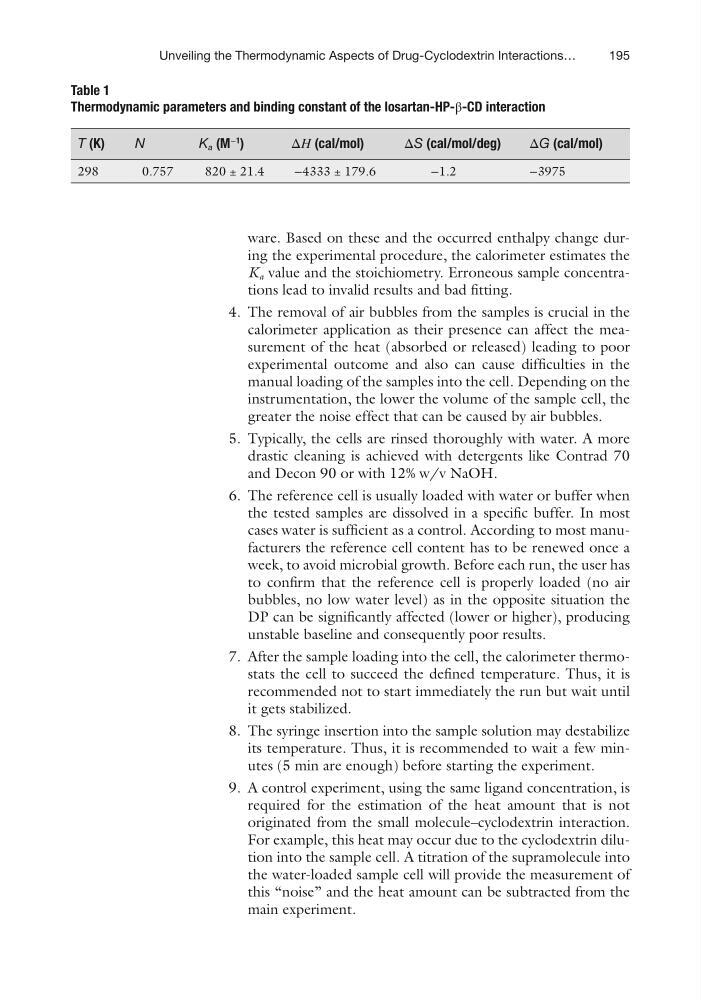
Table 1
Thermodynamic parameters and binding constant of the losartan-HP-β-CD interaction
T (K)
N
K a (M
−1
)
ΔΗ (cal/mol)
ΔS (cal/mol/deg)
ΔG (cal/mol)
298
0.757
820 ± 21.4
−4333 ± 179.6
−1.2
−3975
Unveiling the Thermodynamic Aspects of Drug-Cyclodextrin Interactions…
ware. Based on these and the occurred enthalpy change during the experimental procedure, the calorimeter estimates the
K a value and the stoichiometry. Erroneous sample concentrations lead to invalid results and bad fitting.
4. The removal of air bubbles from the samples is crucial in the
calorimeter application as their presence can affect the measurement of the heat (absorbed or released) leading to poor
experimental outcome and also can cause difficulties in the
manual loading of the samples into the cell. Depending on the
instrumentation, the lower the volume of the sample cell, the
greater the noise effect that can be caused by air bubbles.
5. Typically, the cells are rinsed thoroughly with water. A more
drastic cleaning is achieved with detergents like Contrad 70
and Decon 90 or with 12% w/v NaOH.
6. The reference cell is usually loaded with water or buffer when
the tested samples are dissolved in a specific buffer. In most
cases water is sufficient as a control. According to most manufacturers the reference cell content has to be renewed once a
week, to avoid microbial growth. Before each run, the user has
to confirm that the reference cell is properly loaded (no air
bubbles, no low water level) as in the opposite situation the
DP can be significantly affected (lower or higher), producing
unstable baseline and consequently poor results.
7. After the sample loading into the cell, the calorimeter thermostats the cell to succeed the defined temperature. Thus, it is
recommended not to start immediately the run but wait until
it gets stabilized.
8. The syringe insertion into the sample solution may destabilize
its temperature. Thus, it is recommended to wait a few minutes (5 min are enough) before starting the experiment.
9. A control experiment, using the same ligand concentration, is
required for the estimation of the heat amount that is not
originated from the small molecule–cyclodextrin interaction.
For example, this heat may occur due to the cyclodextrin dilution into the sample cell. A titration of the supramolecule into
the water-loaded sample cell will provide the measurement of
this “noise” and the heat amount can be subtracted from the
main experiment.
Table 1
Thermodynamic parameters and binding constant of the losartan-HP-β-CD interaction
T (K)
N
K a (M
−1
)
ΔΗ (cal/mol)
ΔS (cal/mol/deg)
ΔG (cal/mol)
298
0.757
820 ± 21.4
−4333 ± 179.6
−1.2
−3975
Unveiling the Thermodynamic Aspects of Drug-Cyclodextrin Interactions…