

181
4. Calculate the drug content of the sample using the standard
calibration curve.
To validate the hypothesis that encapsulations could enhance the
stability of parent drug, time-dependent studies of the degradation
of parent drug have to be conducted. The stability studies should
be performed in aqueous buffer solutions under various pH conditions according to the FDA and European Medicines Agency
(EMA) guidelines [15]. Stability could be monitored in a timedependent manner utilizing various analytical techniques such as
UV-Vis, NMR, and mass spectrometry.
1. Dilute TMZ@PSC4 in phosphate buffer (pH 7.1) to a final volume of 3 mL (100 μM).
2. Incubate at 37
ο
C in a shaking bath.
3. Remove the samples from the bath at time intervals of 0, 2, 4,
6, and 8 h.
4. Transfer the samples to cuvette for analysis.
5. Conduct the same experiments for TMZ in order to compare
the stability of TMZ@PSC4 and TMZ.
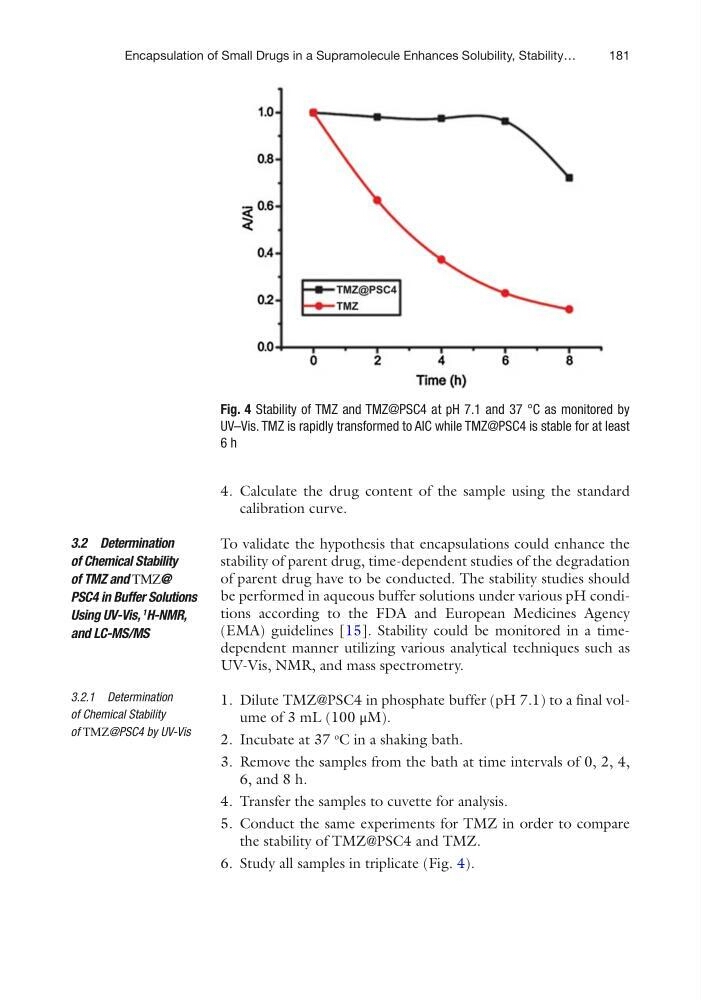
6. Study all samples in triplicate (Fig. 4).
3.2 Determination
of Chemical Stability
of TMZ and ΤΜΖ@
PSC4 in Buffer Solutions
Using UV-Vis,
1
H-NMR,
and LC-MS/MS
3.2.1 Determination
of Chemical Stability
of ΤΜΖ@PSC4 by UV-Vis
Fig. 4 Stability of TMZ and TMZ@PSC4 at pH 7.1 and 37 °C as monitored by
UV–Vis. TMZ is rapidly transformed to AIC while TMZ@PSC4 is stable for at least
6 h
Encapsulation of Small Drugs in a Supramolecule Enhances Solubility, Stability…
4. Calculate the drug content of the sample using the standard
calibration curve.
To validate the hypothesis that encapsulations could enhance the
stability of parent drug, time-dependent studies of the degradation
of parent drug have to be conducted. The stability studies should
be performed in aqueous buffer solutions under various pH conditions according to the FDA and European Medicines Agency
(EMA) guidelines [15]. Stability could be monitored in a timedependent manner utilizing various analytical techniques such as
UV-Vis, NMR, and mass spectrometry.
1. Dilute TMZ@PSC4 in phosphate buffer (pH 7.1) to a final volume of 3 mL (100 μM).
2. Incubate at 37
ο
C in a shaking bath.
3. Remove the samples from the bath at time intervals of 0, 2, 4,
6, and 8 h.
4. Transfer the samples to cuvette for analysis.
5. Conduct the same experiments for TMZ in order to compare
the stability of TMZ@PSC4 and TMZ.
6. Study all samples in triplicate (Fig. 4).
3.2 Determination
of Chemical Stability
of TMZ and ΤΜΖ@
PSC4 in Buffer Solutions
Using UV-Vis,
1
H-NMR,
and LC-MS/MS
3.2.1 Determination
of Chemical Stability
of ΤΜΖ@PSC4 by UV-Vis
Fig. 4 Stability of TMZ and TMZ@PSC4 at pH 7.1 and 37 °C as monitored by
UV–Vis. TMZ is rapidly transformed to AIC while TMZ@PSC4 is stable for at least
6 h
Encapsulation of Small Drugs in a Supramolecule Enhances Solubility, Stability…