

502
H. Rosli et al.
Table 1 Eliminate-Reduce-Raise-Create Grid (ERRC) (Abdul Razak et al. 2008)
Eliminate-Reduce-Raise-Create Grid (ERRC)
Eliminate
and/or Reduce
Raise
Create
1) Examinations
2) Lectures
3) Rote Learning
4) Apathy
1) Student-centered Curricula
2) Market Relevance
3) Alternative Assessments
4) Technology-enhanced Learning (TEL)
5) Nurturing Skills/Competencies
6) Linking Research to Learning
7) Sustainability Development (SD)
Curricula
1)Non-traditional Entry
2)Open Course Ware
(OCW)
3)Enhanced Open
Learning (EOL)
Mauborgne 2005). Universiti Sains Malaysia (USM) is a Malaysian public university
committed to mainstream the principles of sustainability in most of its core areas
that include skills, thinking, research, community engagement and best practices
in striving and sustaining the university as sustainability-led university in Malaysia
(CGSS 2018). Hence, USM has intensified itself in implementing projects in line
with sustainable transformational logic and practice as its core activities (Campbell
2015).
In its transformation towards sustainable development, USM refers to the Blue
Ocean Strategy for integrating the concept of sustainability into its higher education.
This was implemented by adopting its four key actions framework, that is, eliminate
and reduce, raise and create in most of their teaching and learning aspects. Then, these
four key actions framework was structured into the eliminate-reduce-raise-create
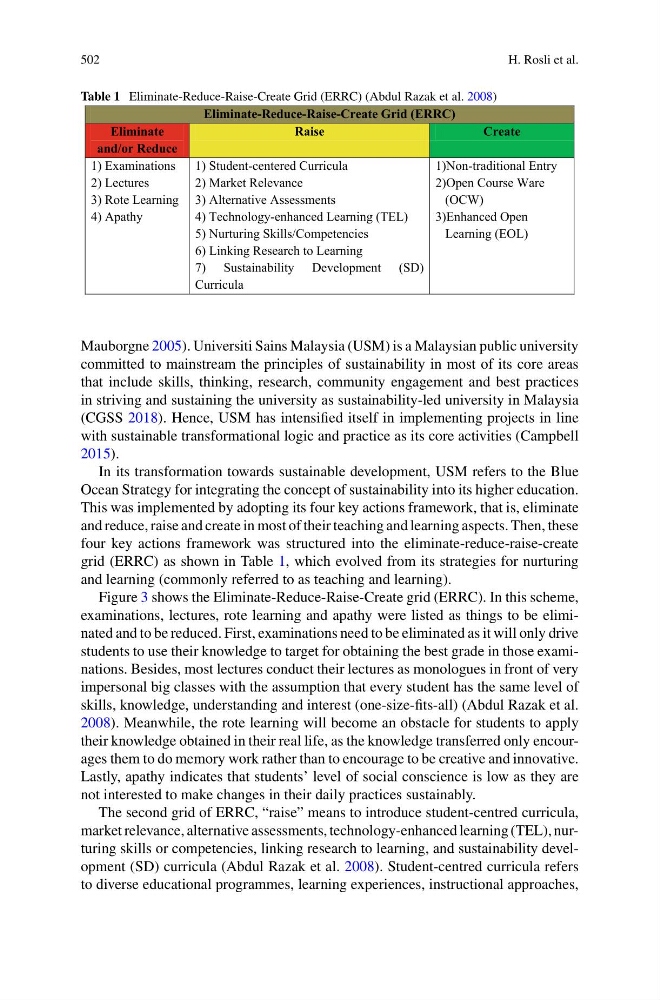
grid (ERRC) as shown in Table 1, which evolved from its strategies for nurturing
and learning (commonly referred to as teaching and learning).
Figure 3 shows the Eliminate-Reduce-Raise-Create grid (ERRC). In this scheme,
examinations, lectures, rote learning and apathy were listed as things to be eliminated and to be reduced. First, examinations need to be eliminated as it will only drive
students to use their knowledge to target for obtaining the best grade in those examinations. Besides, most lectures conduct their lectures as monologues in front of very
impersonal big classes with the assumption that every student has the same level of
skills, knowledge, understanding and interest (one-size-fits-all) (Abdul Razak et al.
2008). Meanwhile, the rote learning will become an obstacle for students to apply
their knowledge obtained in their real life, as the knowledge transferred only encourages them to do memory work rather than to encourage to be creative and innovative.
Lastly, apathy indicates that students’ level of social conscience is low as they are
not interested to make changes in their daily practices sustainably.
The second grid of ERRC, “raise” means to introduce student-centred curricula,
market relevance, alternative assessments, technology-enhanced learning (TEL), nurturing skills or competencies, linking research to learning, and sustainability development (SD) curricula (Abdul Razak et al. 2008). Student-centred curricula refers
to diverse educational programmes, learning experiences, instructional approaches,
H. Rosli et al.
Table 1 Eliminate-Reduce-Raise-Create Grid (ERRC) (Abdul Razak et al. 2008)
Eliminate-Reduce-Raise-Create Grid (ERRC)
Eliminate
and/or Reduce
Raise
Create
1) Examinations
2) Lectures
3) Rote Learning
4) Apathy
1) Student-centered Curricula
2) Market Relevance
3) Alternative Assessments
4) Technology-enhanced Learning (TEL)
5) Nurturing Skills/Competencies
6) Linking Research to Learning
7) Sustainability Development (SD)
Curricula
1)Non-traditional Entry
2)Open Course Ware
(OCW)
3)Enhanced Open
Learning (EOL)
Mauborgne 2005). Universiti Sains Malaysia (USM) is a Malaysian public university
committed to mainstream the principles of sustainability in most of its core areas
that include skills, thinking, research, community engagement and best practices
in striving and sustaining the university as sustainability-led university in Malaysia
(CGSS 2018). Hence, USM has intensified itself in implementing projects in line
with sustainable transformational logic and practice as its core activities (Campbell
2015).
In its transformation towards sustainable development, USM refers to the Blue
Ocean Strategy for integrating the concept of sustainability into its higher education.
This was implemented by adopting its four key actions framework, that is, eliminate
and reduce, raise and create in most of their teaching and learning aspects. Then, these
four key actions framework was structured into the eliminate-reduce-raise-create
grid (ERRC) as shown in Table 1, which evolved from its strategies for nurturing
and learning (commonly referred to as teaching and learning).
Figure 3 shows the Eliminate-Reduce-Raise-Create grid (ERRC). In this scheme,
examinations, lectures, rote learning and apathy were listed as things to be eliminated and to be reduced. First, examinations need to be eliminated as it will only drive
students to use their knowledge to target for obtaining the best grade in those examinations. Besides, most lectures conduct their lectures as monologues in front of very
impersonal big classes with the assumption that every student has the same level of
skills, knowledge, understanding and interest (one-size-fits-all) (Abdul Razak et al.
2008). Meanwhile, the rote learning will become an obstacle for students to apply
their knowledge obtained in their real life, as the knowledge transferred only encourages them to do memory work rather than to encourage to be creative and innovative.
Lastly, apathy indicates that students’ level of social conscience is low as they are
not interested to make changes in their daily practices sustainably.
The second grid of ERRC, “raise” means to introduce student-centred curricula,
market relevance, alternative assessments, technology-enhanced learning (TEL), nurturing skills or competencies, linking research to learning, and sustainability development (SD) curricula (Abdul Razak et al. 2008). Student-centred curricula refers
to diverse educational programmes, learning experiences, instructional approaches,