

460
G. Wilson and R. W. Pretorius
viewpoint, it is vital for conservation managers to regularly perform assessments of
the condition of the grassland (referred to as veld in South Africa). This can be done
by ecological indexing, through which a veld condition index is determined for an
area, thus providing an indication of the health of the veld, based on the assigned
grazing values of all the grass species present. At Telperion Nature Reserve data for
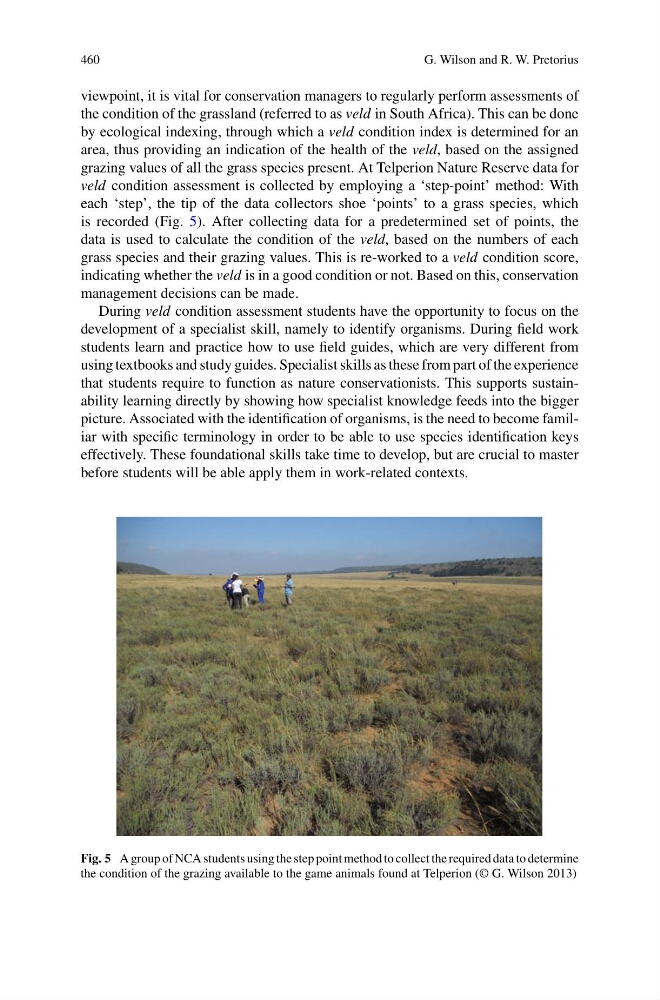
veld condition assessment is collected by employing a ‘step-point’ method: With
each ‘step’, the tip of the data collectors shoe ‘points’ to a grass species, which
is recorded (Fig. 5). After collecting data for a predetermined set of points, the
data is used to calculate the condition of the veld, based on the numbers of each
grass species and their grazing values. This is re-worked to a veld condition score,
indicating whether the veld is in a good condition or not. Based on this, conservation
management decisions can be made.
During veld condition assessment students have the opportunity to focus on the
development of a specialist skill, namely to identify organisms. During field work
students learn and practice how to use field guides, which are very different from
using textbooks and study guides. Specialist skills as these from part of the experience
that students require to function as nature conservationists. This supports sustainability learning directly by showing how specialist knowledge feeds into the bigger
picture. Associated with the identification of organisms, is the need to become familiar with specific terminology in order to be able to use species identification keys
effectively. These foundational skills take time to develop, but are crucial to master
before students will be able apply them in work-related contexts.
Fig. 5 A group of NCA students using the step point method to collect the required data to determine
the condition of the grazing available to the game animals found at Telperion (© G. Wilson 2013)
G. Wilson and R. W. Pretorius
viewpoint, it is vital for conservation managers to regularly perform assessments of
the condition of the grassland (referred to as veld in South Africa). This can be done
by ecological indexing, through which a veld condition index is determined for an
area, thus providing an indication of the health of the veld, based on the assigned
grazing values of all the grass species present. At Telperion Nature Reserve data for
veld condition assessment is collected by employing a ‘step-point’ method: With
each ‘step’, the tip of the data collectors shoe ‘points’ to a grass species, which
is recorded (Fig. 5). After collecting data for a predetermined set of points, the
data is used to calculate the condition of the veld, based on the numbers of each
grass species and their grazing values. This is re-worked to a veld condition score,
indicating whether the veld is in a good condition or not. Based on this, conservation
management decisions can be made.
During veld condition assessment students have the opportunity to focus on the
development of a specialist skill, namely to identify organisms. During field work
students learn and practice how to use field guides, which are very different from
using textbooks and study guides. Specialist skills as these from part of the experience
that students require to function as nature conservationists. This supports sustainability learning directly by showing how specialist knowledge feeds into the bigger
picture. Associated with the identification of organisms, is the need to become familiar with specific terminology in order to be able to use species identification keys
effectively. These foundational skills take time to develop, but are crucial to master
before students will be able apply them in work-related contexts.
Fig. 5 A group of NCA students using the step point method to collect the required data to determine
the condition of the grazing available to the game animals found at Telperion (© G. Wilson 2013)