

Adding Value to Open and Distance Learning Programmes …
459
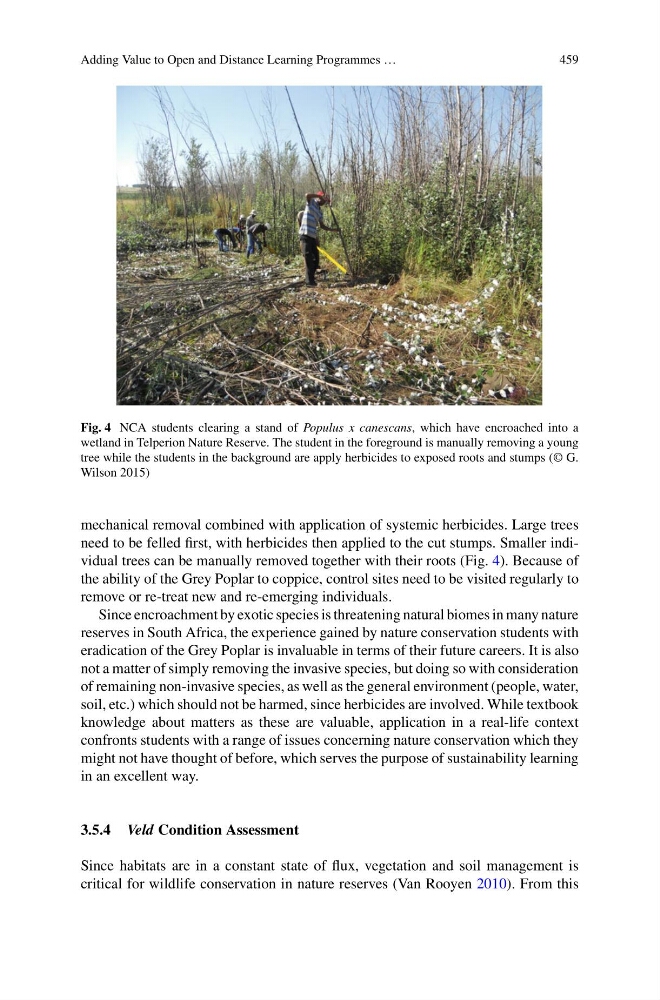
Fig. 4 NCA students clearing a stand of Populus x canescans, which have encroached into a
wetland in Telperion Nature Reserve. The student in the foreground is manually removing a young
tree while the students in the background are apply herbicides to exposed roots and stumps (© G.
Wilson 2015)
mechanical removal combined with application of systemic herbicides. Large trees
need to be felled first, with herbicides then applied to the cut stumps. Smaller individual trees can be manually removed together with their roots (Fig. 4). Because of
the ability of the Grey Poplar to coppice, control sites need to be visited regularly to
remove or re-treat new and re-emerging individuals.
Since encroachment by exotic species is threatening natural biomes in many nature
reserves in South Africa, the experience gained by nature conservation students with
eradication of the Grey Poplar is invaluable in terms of their future careers. It is also
not a matter of simply removing the invasive species, but doing so with consideration
of remaining non-invasive species, as well as the general environment (people, water,
soil, etc.) which should not be harmed, since herbicides are involved. While textbook
knowledge about matters as these are valuable, application in a real-life context
confronts students with a range of issues concerning nature conservation which they
might not have thought of before, which serves the purpose of sustainability learning
in an excellent way.
3.5.4 Veld Condition Assessment
Since habitats are in a constant state of flux, vegetation and soil management is
critical for wildlife conservation in nature reserves (Van Rooyen 2010). From this
459
Fig. 4 NCA students clearing a stand of Populus x canescans, which have encroached into a
wetland in Telperion Nature Reserve. The student in the foreground is manually removing a young
tree while the students in the background are apply herbicides to exposed roots and stumps (© G.
Wilson 2015)
mechanical removal combined with application of systemic herbicides. Large trees
need to be felled first, with herbicides then applied to the cut stumps. Smaller individual trees can be manually removed together with their roots (Fig. 4). Because of
the ability of the Grey Poplar to coppice, control sites need to be visited regularly to
remove or re-treat new and re-emerging individuals.
Since encroachment by exotic species is threatening natural biomes in many nature
reserves in South Africa, the experience gained by nature conservation students with
eradication of the Grey Poplar is invaluable in terms of their future careers. It is also
not a matter of simply removing the invasive species, but doing so with consideration
of remaining non-invasive species, as well as the general environment (people, water,
soil, etc.) which should not be harmed, since herbicides are involved. While textbook
knowledge about matters as these are valuable, application in a real-life context
confronts students with a range of issues concerning nature conservation which they
might not have thought of before, which serves the purpose of sustainability learning
in an excellent way.
3.5.4 Veld Condition Assessment
Since habitats are in a constant state of flux, vegetation and soil management is
critical for wildlife conservation in nature reserves (Van Rooyen 2010). From this