

458
G. Wilson and R. W. Pretorius
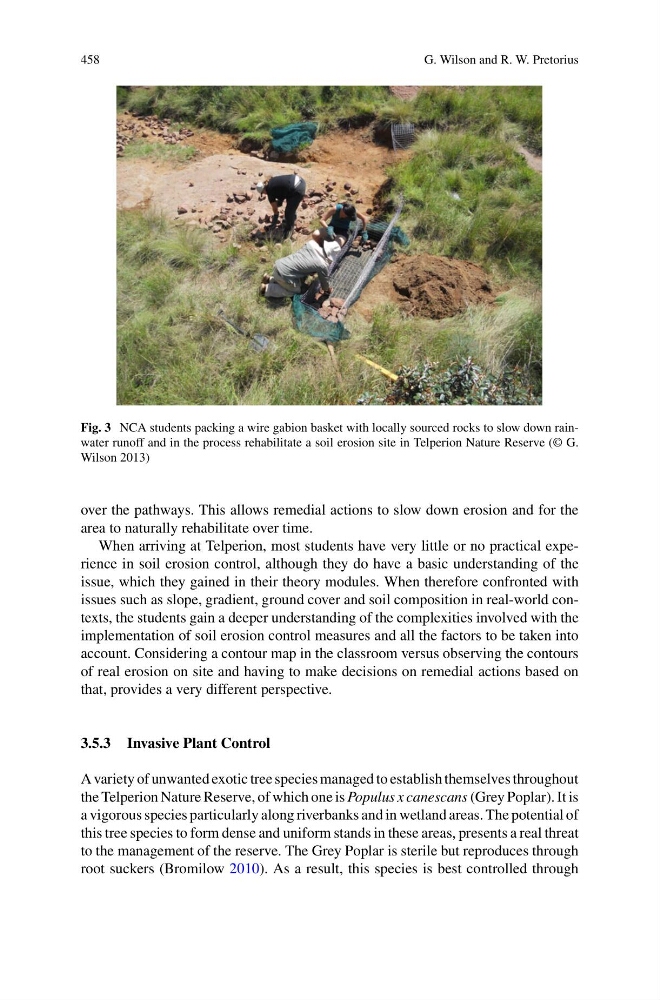
Fig. 3 NCA students packing a wire gabion basket with locally sourced rocks to slow down rainwater runoff and in the process rehabilitate a soil erosion site in Telperion Nature Reserve (© G.
Wilson 2013)
over the pathways. This allows remedial actions to slow down erosion and for the
area to naturally rehabilitate over time.
When arriving at Telperion, most students have very little or no practical experience in soil erosion control, although they do have a basic understanding of the
issue, which they gained in their theory modules. When therefore confronted with
issues such as slope, gradient, ground cover and soil composition in real-world contexts, the students gain a deeper understanding of the complexities involved with the
implementation of soil erosion control measures and all the factors to be taken into
account. Considering a contour map in the classroom versus observing the contours
of real erosion on site and having to make decisions on remedial actions based on
that, provides a very different perspective.
3.5.3 Invasive Plant Control
A variety of unwanted exotic tree species managed to establish themselves throughout
the Telperion Nature Reserve, of which one is Populus x canescans (Grey Poplar). It is
a vigorous species particularly along riverbanks and in wetland areas. The potential of
this tree species to form dense and uniform stands in these areas, presents a real threat
to the management of the reserve. The Grey Poplar is sterile but reproduces through
root suckers (Bromilow 2010). As a result, this species is best controlled through
G. Wilson and R. W. Pretorius
Fig. 3 NCA students packing a wire gabion basket with locally sourced rocks to slow down rainwater runoff and in the process rehabilitate a soil erosion site in Telperion Nature Reserve (© G.
Wilson 2013)
over the pathways. This allows remedial actions to slow down erosion and for the
area to naturally rehabilitate over time.
When arriving at Telperion, most students have very little or no practical experience in soil erosion control, although they do have a basic understanding of the
issue, which they gained in their theory modules. When therefore confronted with
issues such as slope, gradient, ground cover and soil composition in real-world contexts, the students gain a deeper understanding of the complexities involved with the
implementation of soil erosion control measures and all the factors to be taken into
account. Considering a contour map in the classroom versus observing the contours
of real erosion on site and having to make decisions on remedial actions based on
that, provides a very different perspective.
3.5.3 Invasive Plant Control
A variety of unwanted exotic tree species managed to establish themselves throughout
the Telperion Nature Reserve, of which one is Populus x canescans (Grey Poplar). It is
a vigorous species particularly along riverbanks and in wetland areas. The potential of
this tree species to form dense and uniform stands in these areas, presents a real threat
to the management of the reserve. The Grey Poplar is sterile but reproduces through
root suckers (Bromilow 2010). As a result, this species is best controlled through