

Adding Value to Open and Distance Learning Programmes …
461
3.5.5 Water Catchment Management
Related to its relatively low average rainfall, with many South African water resources
over-exploited or severely impacted, South Africa is regarded as a water scarce
country (Ololade 2018). This poses challenges for the management of conservation
areas, of which Telperion is an example. Thus significant effort is required to manage
water resources for conservation areas effectively. This includes testing of water
quality and monitoring of river health, which is difficult and expensive (Graham
et al. 2004). The South African Scoring System (SASS) for biomonitoring has been
developed for this purpose, but is very technical. A student-friendly version, referred
to as miniSASS was therefore developed, which enables easier monitoring of water
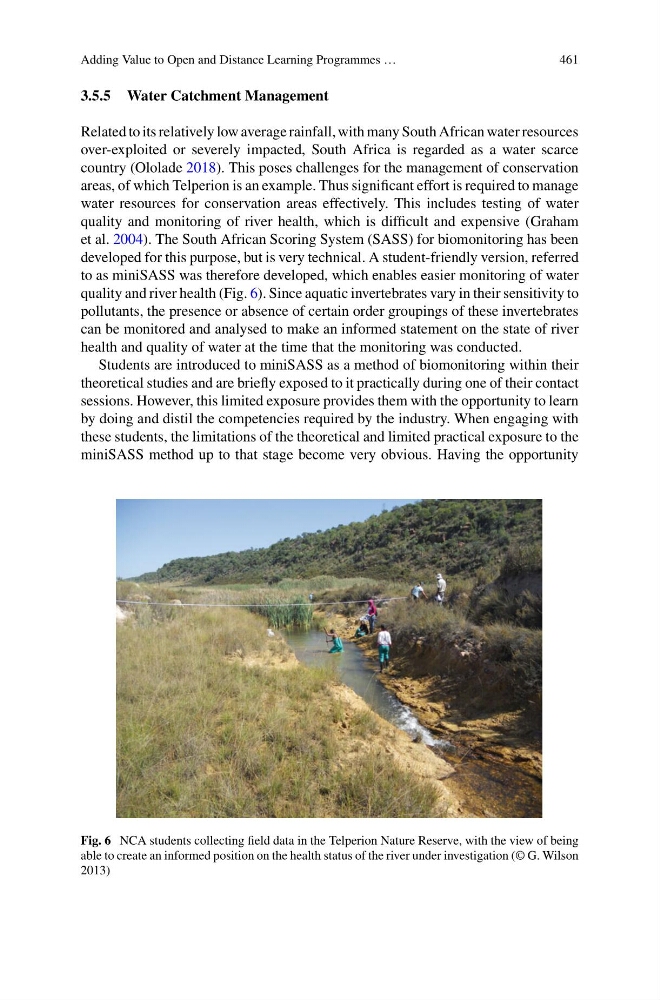
quality and river health (Fig. 6). Since aquatic invertebrates vary in their sensitivity to
pollutants, the presence or absence of certain order groupings of these invertebrates
can be monitored and analysed to make an informed statement on the state of river
health and quality of water at the time that the monitoring was conducted.
Students are introduced to miniSASS as a method of biomonitoring within their
theoretical studies and are briefly exposed to it practically during one of their contact
sessions. However, this limited exposure provides them with the opportunity to learn
by doing and distil the competencies required by the industry. When engaging with
these students, the limitations of the theoretical and limited practical exposure to the
miniSASS method up to that stage become very obvious. Having the opportunity
Fig. 6 NCA students collecting field data in the Telperion Nature Reserve, with the view of being
able to create an informed position on the health status of the river under investigation (© G. Wilson
2013)
461
3.5.5 Water Catchment Management
Related to its relatively low average rainfall, with many South African water resources
over-exploited or severely impacted, South Africa is regarded as a water scarce
country (Ololade 2018). This poses challenges for the management of conservation
areas, of which Telperion is an example. Thus significant effort is required to manage
water resources for conservation areas effectively. This includes testing of water
quality and monitoring of river health, which is difficult and expensive (Graham
et al. 2004). The South African Scoring System (SASS) for biomonitoring has been
developed for this purpose, but is very technical. A student-friendly version, referred
to as miniSASS was therefore developed, which enables easier monitoring of water
quality and river health (Fig. 6). Since aquatic invertebrates vary in their sensitivity to
pollutants, the presence or absence of certain order groupings of these invertebrates
can be monitored and analysed to make an informed statement on the state of river
health and quality of water at the time that the monitoring was conducted.
Students are introduced to miniSASS as a method of biomonitoring within their
theoretical studies and are briefly exposed to it practically during one of their contact
sessions. However, this limited exposure provides them with the opportunity to learn
by doing and distil the competencies required by the industry. When engaging with
these students, the limitations of the theoretical and limited practical exposure to the
miniSASS method up to that stage become very obvious. Having the opportunity
Fig. 6 NCA students collecting field data in the Telperion Nature Reserve, with the view of being
able to create an informed position on the health status of the river under investigation (© G. Wilson
2013)