

192
A. Khatoon
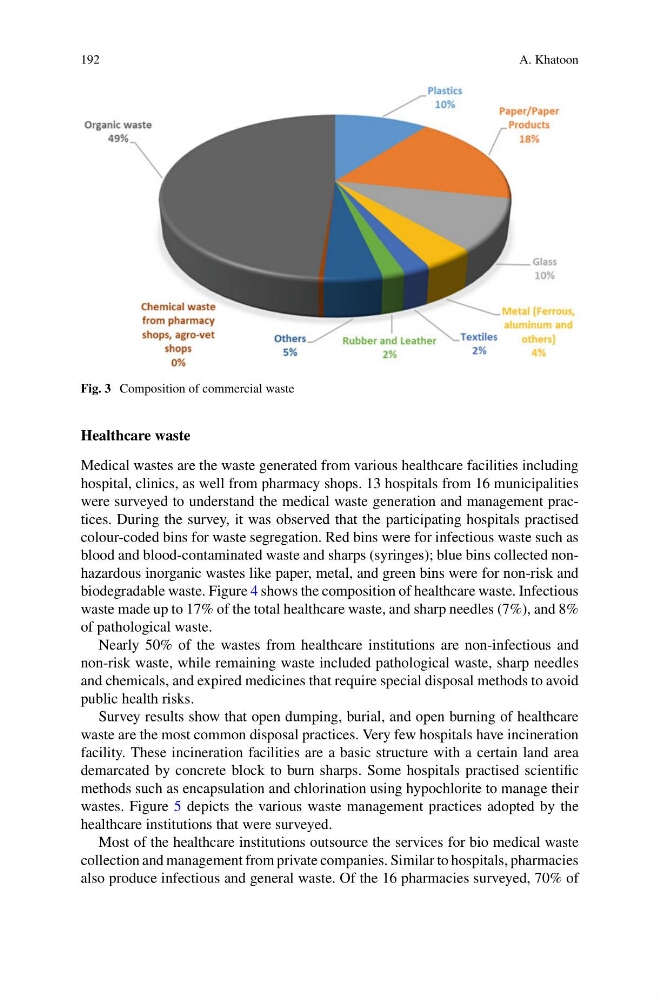
Fig. 3 Composition of commercial waste
Healthcare waste
Medical wastes are the waste generated from various healthcare facilities including
hospital, clinics, as well from pharmacy shops. 13 hospitals from 16 municipalities
were surveyed to understand the medical waste generation and management practices. During the survey, it was observed that the participating hospitals practised
colour-coded bins for waste segregation. Red bins were for infectious waste such as
blood and blood-contaminated waste and sharps (syringes); blue bins collected nonhazardous inorganic wastes like paper, metal, and green bins were for non-risk and
biodegradable waste. Figure 4 shows the composition of healthcare waste. Infectious
waste made up to 17% of the total healthcare waste, and sharp needles (7%), and 8%
of pathological waste.
Nearly 50% of the wastes from healthcare institutions are non-infectious and
non-risk waste, while remaining waste included pathological waste, sharp needles
and chemicals, and expired medicines that require special disposal methods to avoid
public health risks.
Survey results show that open dumping, burial, and open burning of healthcare
waste are the most common disposal practices. Very few hospitals have incineration
facility. These incineration facilities are a basic structure with a certain land area
demarcated by concrete block to burn sharps. Some hospitals practised scientific
methods such as encapsulation and chlorination using hypochlorite to manage their
wastes. Figure 5 depicts the various waste management practices adopted by the
healthcare institutions that were surveyed.
Most of the healthcare institutions outsource the services for bio medical waste
collection and management from private companies. Similar to hospitals, pharmacies
also produce infectious and general waste. Of the 16 pharmacies surveyed, 70% of
A. Khatoon
Fig. 3 Composition of commercial waste
Healthcare waste
Medical wastes are the waste generated from various healthcare facilities including
hospital, clinics, as well from pharmacy shops. 13 hospitals from 16 municipalities
were surveyed to understand the medical waste generation and management practices. During the survey, it was observed that the participating hospitals practised
colour-coded bins for waste segregation. Red bins were for infectious waste such as
blood and blood-contaminated waste and sharps (syringes); blue bins collected nonhazardous inorganic wastes like paper, metal, and green bins were for non-risk and
biodegradable waste. Figure 4 shows the composition of healthcare waste. Infectious
waste made up to 17% of the total healthcare waste, and sharp needles (7%), and 8%
of pathological waste.
Nearly 50% of the wastes from healthcare institutions are non-infectious and
non-risk waste, while remaining waste included pathological waste, sharp needles
and chemicals, and expired medicines that require special disposal methods to avoid
public health risks.
Survey results show that open dumping, burial, and open burning of healthcare
waste are the most common disposal practices. Very few hospitals have incineration
facility. These incineration facilities are a basic structure with a certain land area
demarcated by concrete block to burn sharps. Some hospitals practised scientific
methods such as encapsulation and chlorination using hypochlorite to manage their
wastes. Figure 5 depicts the various waste management practices adopted by the
healthcare institutions that were surveyed.
Most of the healthcare institutions outsource the services for bio medical waste
collection and management from private companies. Similar to hospitals, pharmacies
also produce infectious and general waste. Of the 16 pharmacies surveyed, 70% of