

7 Spin Torque and Zeta Force in Allene-Type Molecules
133
∂ ˆ
s k
e (x)
∂t
=
∂
∂t
1
2
ˆ
ψ
† (x)Σ
k ˆ
ψ(x)
.
(7.2)
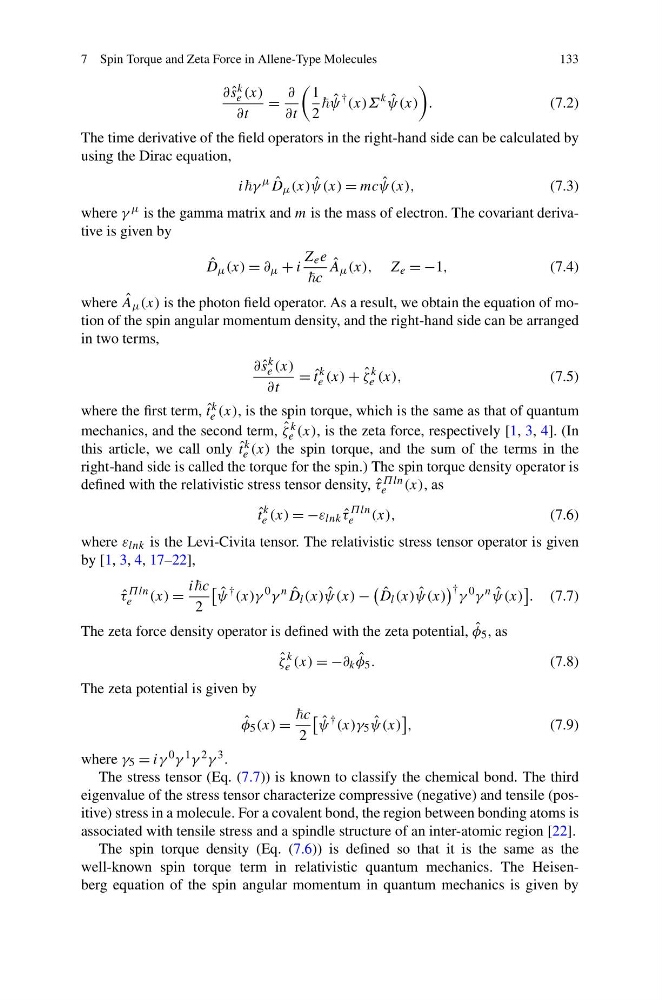
The time derivative of the field operators in the right-hand side can be calculated by
using the Dirac equation,
iγ
μ ˆ
D μ (x) ˆ
ψ(x) = mc ˆ
ψ(x),
(7.3)
where γ μ is the gamma matrix and m is the mass of electron. The covariant derivative is given by
ˆ
D μ (x) = ∂ μ + i
Z e e
c
ˆ
A μ (x), Z e = −1,
(7.4)
where ˆ
A μ (x) is the photon field operator. As a result, we obtain the equation of motion of the spin angular momentum density, and the right-hand side can be arranged
in two terms,
∂ ˆ
s k
e (x)
∂t
= ˆ
t
k
e (x) + ˆ
ζ
k
e (x),
(7.5)
where the first term, ˆ
t k
e (x), is the spin torque, which is the same as that of quantum
mechanics, and the second term, ˆ
ζ k
e (x), is the zeta force, respectively [1, 3, 4]. (In
this article, we call only ˆ
t k
e (x) the spin torque, and the sum of the terms in the
right-hand side is called the torque for the spin.) The spin torque density operator is
defined with the relativistic stress tensor density, ˆ
τ Πln
e
(x), as
ˆ
t
k
e (x) = −ε lnk ˆ
τ
Πln
e
(x),
(7.6)
where ε lnk is the Levi-Civita tensor. The relativistic stress tensor operator is given
by [1, 3, 4, 17–22],
ˆ
τ
Πln
e
(x) =
ic
2
ˆ
ψ
† (x)γ
0 γ
n ˆ
D l (x) ˆ
ψ(x) −
ˆ
D l (x) ˆ
ψ(x)
† γ
0 γ
n ˆ
ψ(x)
. (7.7)
The zeta force density operator is defined with the zeta potential, ˆ
φ 5 , as
ˆ
ζ
k
e (x) = −∂ k ˆ
φ 5 .
(7.8)
The zeta potential is given by
ˆ
φ 5 (x) =
c
2
ˆ
ψ
† (x)γ 5 ˆ
ψ(x)
,
(7.9)
where γ 5 = iγ 0 γ 1 γ 2 γ 3 .
The stress tensor (Eq. (7.7)) is known to classify the chemical bond. The third
eigenvalue of the stress tensor characterize compressive (negative) and tensile (positive) stress in a molecule. For a covalent bond, the region between bonding atoms is
associated with tensile stress and a spindle structure of an inter-atomic region [22].
The spin torque density (Eq. (7.6)) is defined so that it is the same as the
well-known spin torque term in relativistic quantum mechanics. The Heisenberg equation of the spin angular momentum in quantum mechanics is given by
133
∂ ˆ
s k
e (x)
∂t
=
∂
∂t
1
2
ˆ
ψ
† (x)Σ
k ˆ
ψ(x)
.
(7.2)
The time derivative of the field operators in the right-hand side can be calculated by
using the Dirac equation,
iγ
μ ˆ
D μ (x) ˆ
ψ(x) = mc ˆ
ψ(x),
(7.3)
where γ μ is the gamma matrix and m is the mass of electron. The covariant derivative is given by
ˆ
D μ (x) = ∂ μ + i
Z e e
c
ˆ
A μ (x), Z e = −1,
(7.4)
where ˆ
A μ (x) is the photon field operator. As a result, we obtain the equation of motion of the spin angular momentum density, and the right-hand side can be arranged
in two terms,
∂ ˆ
s k
e (x)
∂t
= ˆ
t
k
e (x) + ˆ
ζ
k
e (x),
(7.5)
where the first term, ˆ
t k
e (x), is the spin torque, which is the same as that of quantum
mechanics, and the second term, ˆ
ζ k
e (x), is the zeta force, respectively [1, 3, 4]. (In
this article, we call only ˆ
t k
e (x) the spin torque, and the sum of the terms in the
right-hand side is called the torque for the spin.) The spin torque density operator is
defined with the relativistic stress tensor density, ˆ
τ Πln
e
(x), as
ˆ
t
k
e (x) = −ε lnk ˆ
τ
Πln
e
(x),
(7.6)
where ε lnk is the Levi-Civita tensor. The relativistic stress tensor operator is given
by [1, 3, 4, 17–22],
ˆ
τ
Πln
e
(x) =
ic
2
ˆ
ψ
† (x)γ
0 γ
n ˆ
D l (x) ˆ
ψ(x) −
ˆ
D l (x) ˆ
ψ(x)
† γ
0 γ
n ˆ
ψ(x)
. (7.7)
The zeta force density operator is defined with the zeta potential, ˆ
φ 5 , as
ˆ
ζ
k
e (x) = −∂ k ˆ
φ 5 .
(7.8)
The zeta potential is given by
ˆ
φ 5 (x) =
c
2
ˆ
ψ
† (x)γ 5 ˆ
ψ(x)
,
(7.9)
where γ 5 = iγ 0 γ 1 γ 2 γ 3 .
The stress tensor (Eq. (7.7)) is known to classify the chemical bond. The third
eigenvalue of the stress tensor characterize compressive (negative) and tensile (positive) stress in a molecule. For a covalent bond, the region between bonding atoms is
associated with tensile stress and a spindle structure of an inter-atomic region [22].
The spin torque density (Eq. (7.6)) is defined so that it is the same as the
well-known spin torque term in relativistic quantum mechanics. The Heisenberg equation of the spin angular momentum in quantum mechanics is given by